From combat robots to matter reservoirs ✨
A small autonomous robot can already move quickly, recognize objects and damage another machine. A sufficiently advanced piece of manufactured matter might also change shape, distribute its working parts, replace damaged machinery and build more of itself. I want to explore the engineering distance between those capabilities.
This is a comparison of complete systems under common constraints. I start with technology available in 2022 and 2026, then sketch six increasingly capable machines. Each later rung has a working estimate of about a 90% win rate against its predecessor. The interesting part is the machinery that might make that estimate reasonable: energy conversion, sensing, control, protection, actuation and eventually manufacturing.
The arena
Each robot has a starting mass limit of 10 kg and a usable-energy allowance of 50 MJ. The opponents begin 100 metres apart on a flat floor in Earth gravity and air. Every machine starts purpose-built for the contest. All runtime decisions and computation are onboard.
A central zone, 10 metres across, contains the flag. A robot wins by maintaining effective control for five continuous minutes, or by permanently removing its opponent’s ability to continue fighting. A surviving system capable of autonomous recovery remains in the contest, while the flag clock can continue against it. A capable opponent can contest control; inert debris cannot. A referee can award both robots a loss for persistent refusal to contest. This puts a price on hiding indefinitely and gives recovery a chance to matter.
Robots may gather material from the air and floor. Ten kilograms is their starting inventory. New mass must actually be acquired, processed and moved. Any usable energy obtained from environmental material counts cumulatively against the fixed energy allowance. The floor’s composition therefore matters, just as the composition of carried feedstock does.
A robot may designate material as purely structural. That material counts toward mass, while its potential energy is excluded from the cap; the excluded energy cannot benefit the robot. Structure and passive protection are allowed. Charged batteries, springs, pressure stores and other usable reserves still count. This keeps the contest from becoming a comparison of how much chemical energy happens to be locked in everyone’s body.
The five-minute objective is consequential. A machine that briefly disrupts its opponent must still hold the flag while the opponent recovers. A machine that can manufacture replacements needs enough surviving capability to keep the contest alive while it does so.
The historical starting point
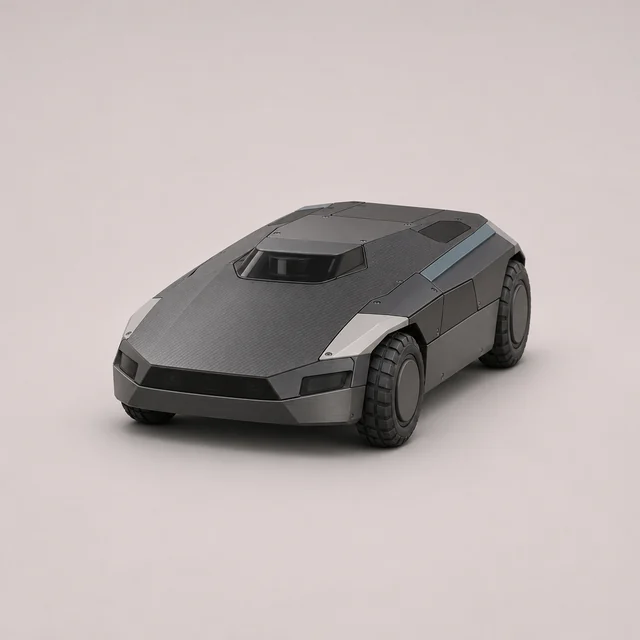
A strong 2022 robot should already have brushless motors, competent feedback control, visible and thermal cameras, and substantial onboard computing. NVIDIA’s production Jetson AGX Orin 32GB was available in August, rated up to 200 INT8 TOPS at 15–40 W. Those are serious resources for specialized perception. NVIDIA’s announcement.
Autonomous combat also existed. DeepMelt, a fully autonomous rotary-impact robot, entered NHRL’s three-pound class in November 2022 and finished its debut with three wins and two losses. It establishes that onboard control could carry out destructive contact combat. Contemporaneous NHRL record.[1]
Fast autonomous flight was further along than its publication dates suggest. The Swift system’s races against champion pilots happened in June 2022; the paper appeared in 2023. It won 15 of 25 races using onboard perception and control. The starting point already includes high-performance specialized autonomy. University of Zurich’s account.[2]
2026 reference
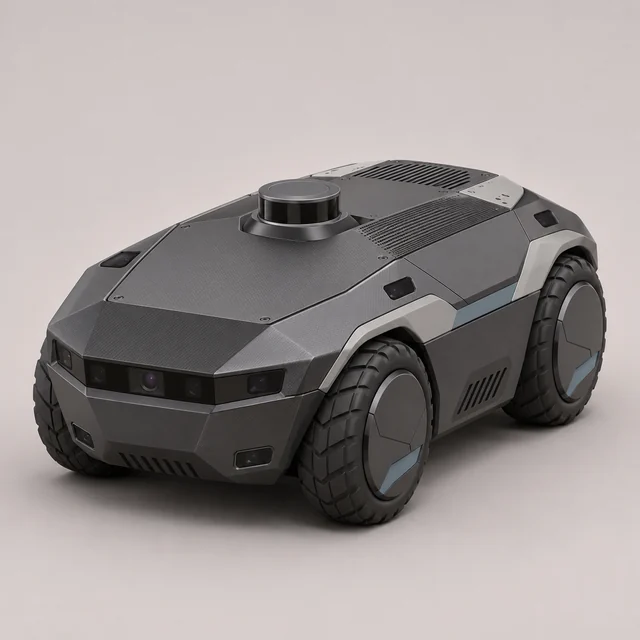
For a common comparison, I use a compact protected ground vehicle. Both dates also permit aerial designs, which belong in the opponent pool.
The 2026 improvements include better available cells, sensing and software. A high-power lithium-ion example moves from Molicel’s P45B at 242 Wh/kg to P50B at 260 Wh/kg. Amprius also reports a silicon-anode high-power cell at 360 Wh/kg. These are cell ratings; packaging, cooling and operating conditions reduce what a complete battery delivers. P45B, P50B, Amprius report.
The motor comparison shows how capable the earlier hardware already was. DJI’s M3508 P19 geared brushless motor, documented in 2017, weighs 365 g and lists 3 N·m continuous maximum torque at 469 rpm. That operating point gives about 147 W of shaft power. Both dates can use this class of actuator. The complete body must transmit its forces through the floor contact and structure. Motor documentation.
Sensing has a more visible numerical change: the 2022 Hadron 640R includes a 640 × 512 thermal detector, while the Boson SX8 announced in June 2026 provides 1280 × 1024, four times as many thermal pixels. My ordinary visual observation-to-motion-command estimates are 50 ms for 2022 and 30 ms for 2026, with subjective 80% intervals of 25–120 and 15–80 ms. Camera scheduling, perception and state estimation all contribute to that delay. Sensor and computing specifications.
My reference profiles allocate roughly 1–2 kg to the battery subsystem. Their central electrical stocks are 1.1 MJ in 2022 and 1.4 MJ in 2026, with subjective 80% intervals of 0.7–1.6 and 0.8–2.2 MJ. I use a peak ground-speed estimate of 5 m/s for both, with an interval of 3–8 m/s.[3]
The energy cap has considerable headroom over those battery stocks. Fifty megajoules is 13.89 kWh. Even filling the entire 10 kg with cells would require 1,389 Wh/kg. Chemical stores change the storage calculation, but their conversion machinery and waste heat must fit too. Both historical eras already have chemical fuels.
Gun systems and FPV drones
An era-appropriate starting point already includes guns, FPV airframes and loitering munitions. FPV aircraft were commercially available before 2022, and Switchblade 300 reached Ukraine in 2022. Gun-class projectile weapons and expendable attack vehicles belong in the contemporary comparison alongside rotary impact, gripping and net capture. These classes differ in reach, finite supplies and whether the carrier survives the engagement.[11]
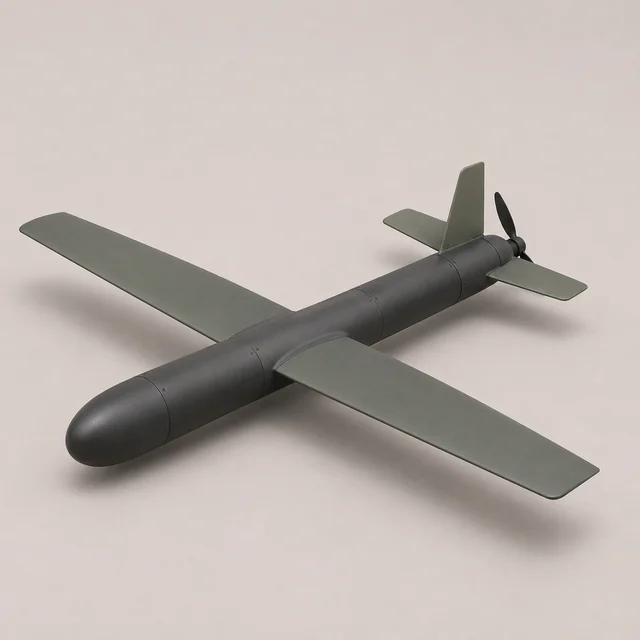
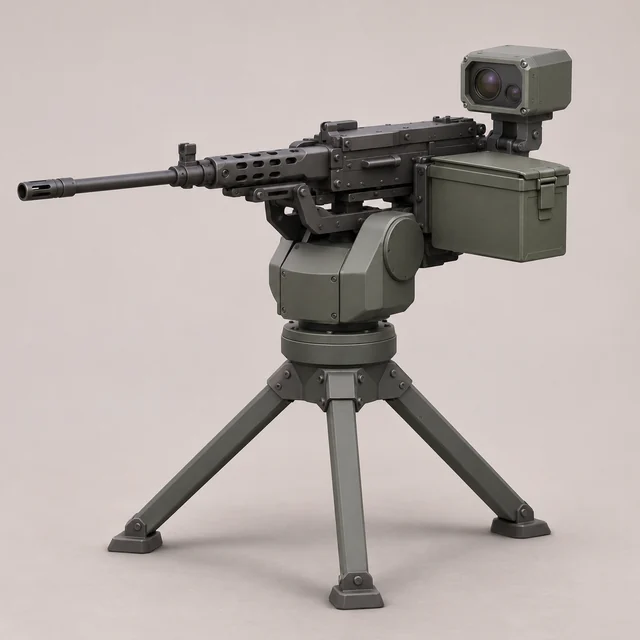
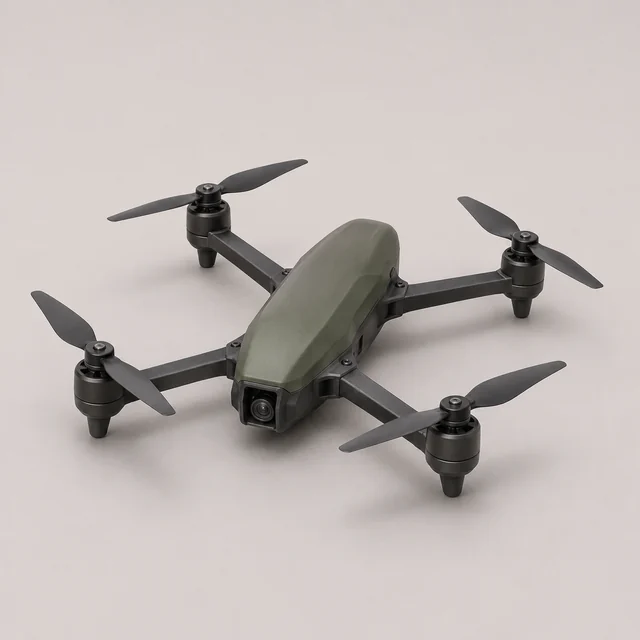
Ukraine’s Droid TW 12.7 is a concrete gun-armed ground reference: a tracked robot with an M2 Browning 12.7 mm machine gun, approved in December 2024 and reported in frontline use in April 2025. The separate Wolly 7.62 station uses a PKT machine gun; Ukraine’s defence ministry reports a station mass of 30 kg. The expanded source table records their weapons, mobility, control and available mass figures.[12]
For FPVs, the 2026 change includes documented terminal automation. Auterion and Skyfall announced in July that deliveries of Shrike drones with terminal guidance had begun that week. STING supplies a separate small-aircraft mass anchor: its manufacturer lists 4 ± 0.2 kg with payload and a maximum speed of 280 km/h. Shrike announcement, STING specifications.[13]
Ukraine supplies useful dated examples. AeroVironment described Switchblade 300 autonomously navigating to designated coordinates in January 2022, with operators confirming identification and engaging. In June 2025, Ukraine’s defence ministry described Chief-1 as an aerial platform with a shotgun-cartridge module and manual and automatic firing modes. Its June 2026 interceptor account still begins with an operator selecting the target and commanding engagement. These reports ground mechanism classes and degrees of automation. Switchblade, Chief-1, 2026 interceptors.
The appendix puts these published systems alongside the reference profiles. Its empty specification cells make room for the remaining engineering detail. Weapon choice could change the historical anchor and therefore every later rating.
Six steps beyond 2026
A 400-point Elo advantage means an expected score of 10/11, or 90.9%. With decisive matches, that is ten wins per loss. I retain +400 as the central estimate for each adjacent transition below. These are subjective judgments about hypothetical balanced packages. The engineering claims beneath them make the judgments open to revision.
Stronger integration
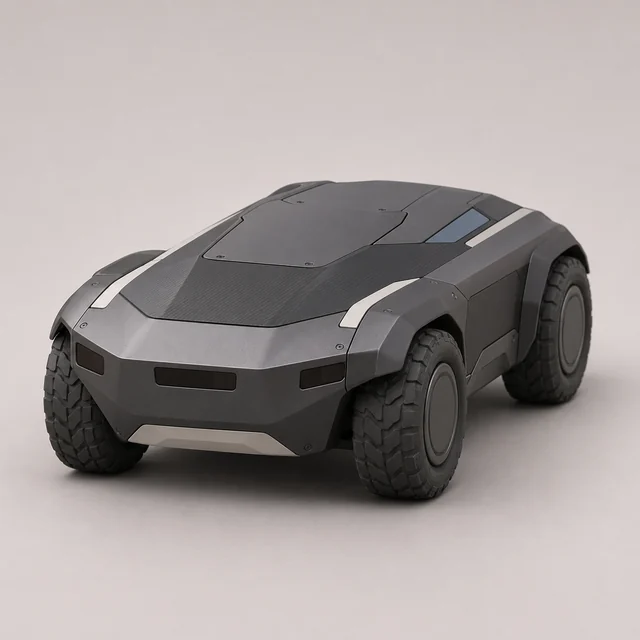
The first machine retains broadly contemporary storage, motors and interaction mechanisms. Its improvement is coherent performance under unfamiliar observations, faults and physical disturbances. The working hypothesis is a tenfold reduction in mission-ending perception and control failures, with useful mechanical capability preserved.
A ten-to-one ratio in decisive-loss rates gives a 10/11 win probability in a simple model. This package aims for that scale of improvement through fewer failed decisions and more effective use of its existing hardware.[4]
Durable electromechanical machinery
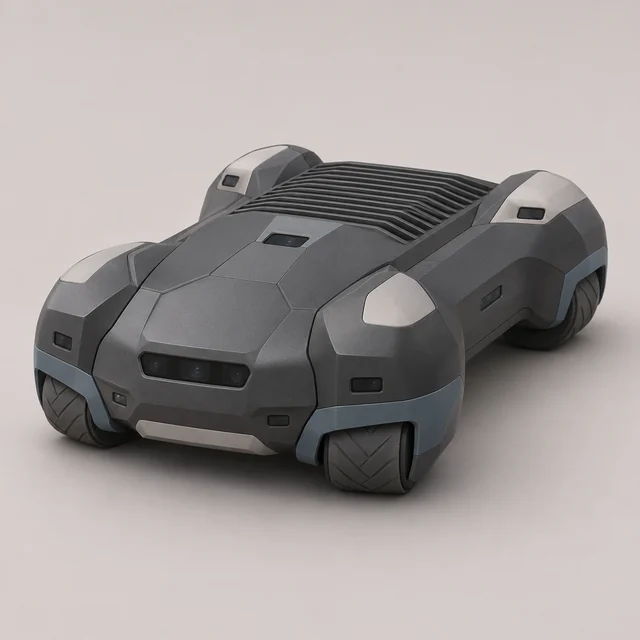
This machine improves power conversion, cooling and fault isolation. Its operating-energy target is 10 MJ within the same total 50 MJ account. Electromagnetic actuators remain useful. The major durability target is three or four independent substantial losses required to disable it, where one would end the preceding machine’s contest.
That gives a concrete scale for the rating. With equal independent rates of causing such losses, a machine needing three losses to disable it beats one needing a single loss 87.5% of the time; a four-loss disabling threshold gives 93.75%. Spare capacity and isolated support paths let surviving machinery keep functioning at the required level.[5]
A reconfigurable body
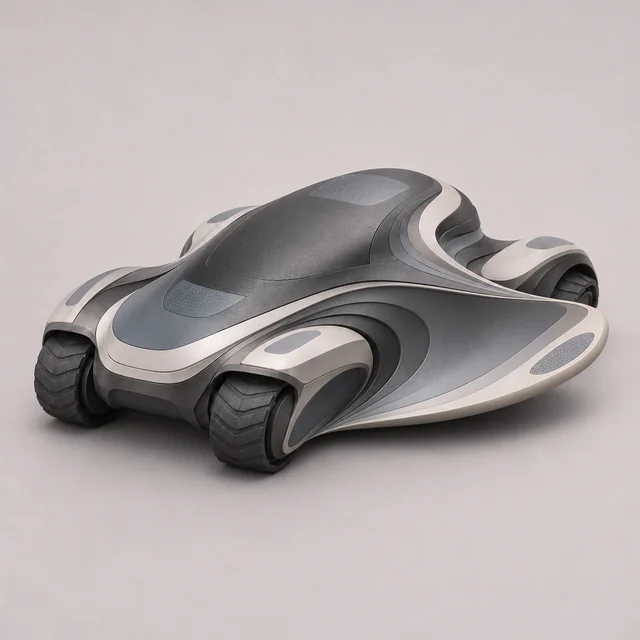
A cellular or laminated body can change useful geometry on a 1–10-second timescale, reconnect surviving components and replace selected exposed parts from carried inventory. Large motions can still use major actuators; smaller working structures can use actuation appropriate to their scale. Manufacturing new components remains limited.
The advantage is a wider set of recoverable failures. A loss that permanently removes the earlier robot’s mobility or working mechanism becomes an interruption. Turning roughly 90% of formerly permanent losses into recoverable interruptions offers a route to a tenfold reduction in effective permanent-loss rate. A five-minute flag hold gives that distinction practical weight.[6]
Distributed working material
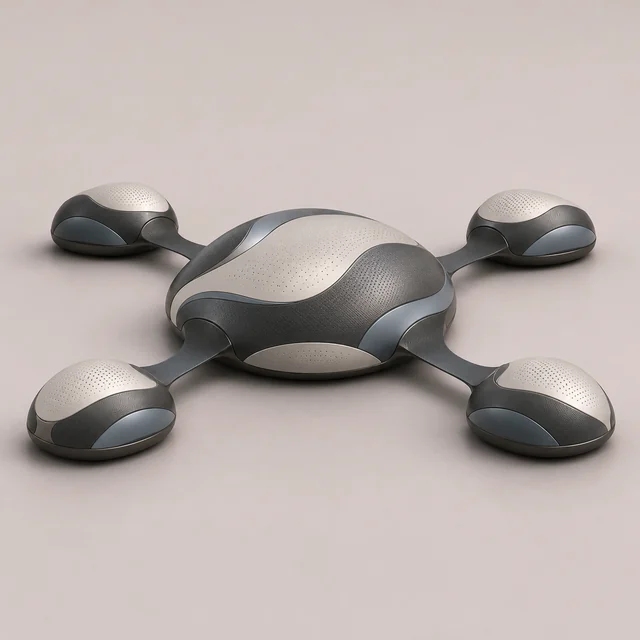
Useful sensing, computation and manipulation now persist in protected working regions on an illustrative 1–10 g scale. The machine can group regions under shared structure or rearrange them. Local storage, communication and material transport all have physical costs. The visible body might remain coherent while containing many partly independent functional sites.
A localized loss then removes a smaller fraction of total capability. Turning a formerly decisive event into a partial loss while maintaining effective output can support another roughly 90% step through the same three-to-four-independent-loss comparison. Local sensing and working capacity let the body reorganize around the surviving regions.[7]
Broad fabrication and repair
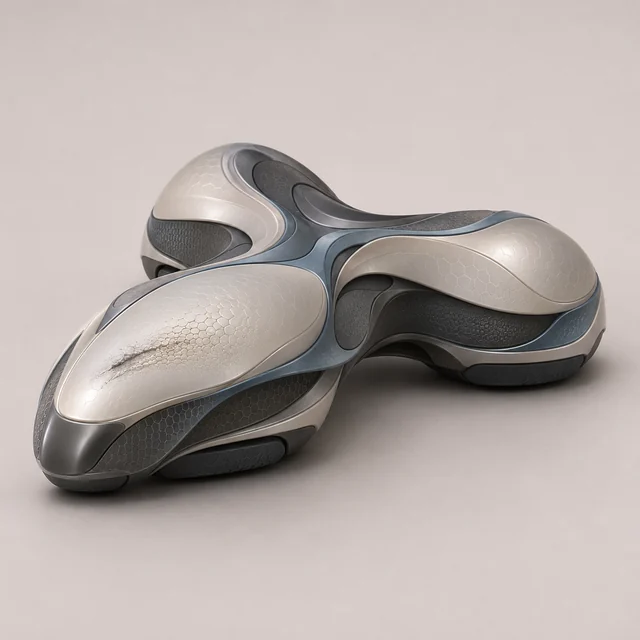
This body can manufacture a broad library of useful components from suitable material. I assign an illustrative productive-machinery doubling time of 600 seconds under unrestricted reinvestment, and fabrication efficiency of 95% for a specified positive useful free-energy increase. Repair and factory growth compete for the same productive capacity. These parameters leave processing work, heat, element availability and transport to be accounted for separately.
The previous tier eventually exhausts its finite replacement inventory. This one can replenish many of those functions. A small local repair may also require far less work than building a whole replacement machine, so useful restoration can precede a factory doubling. The rating gain comes from restoration outrunning the accumulation of functional losses.[8]
Near-reservoir integration
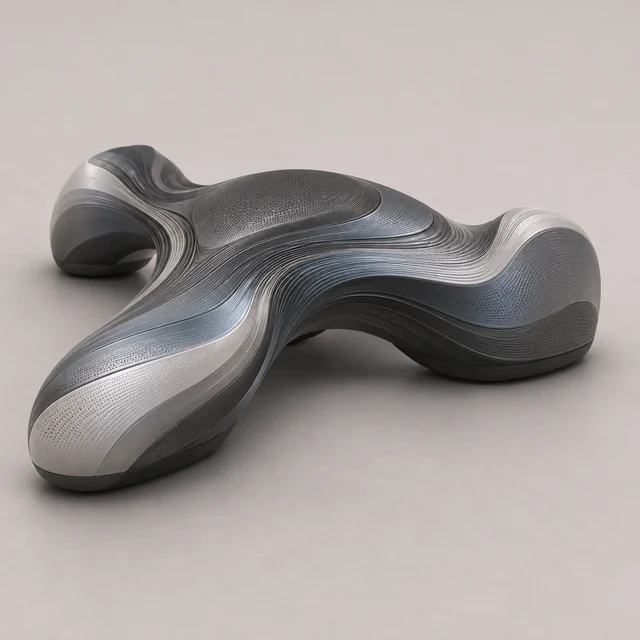
The final rung combines a broader manufacturing library, fine integrated sensing and manipulation, 120-second productive-machinery doubling and 99% fabrication efficiency. Its forms can be grown, laminated and continuously rearranged. Continued operation after damage becomes a property of the working material throughout the body.
Over one five-minute holding period, unrestricted 600-second doubling gives 1.41 times the starting productive inventory; 120-second doubling gives 5.66 times, a fourfold ratio. After ten minutes the ratio is sixteenfold. The machine must keep the contest alive while growing. Broader and faster restoration attacks the preceding tier’s limits in manufacturing throughput and component availability, providing the proposed last roughly 90% step.[9]
Approaching a matter reservoir
The endpoint I have in mind is general-purpose manufactured matter with distributed control, sensing, manipulation and fabrication. For the original reservoir scenario I used 60-second productive-machinery doubling and 99% fabrication efficiency. Those are endpoint assumptions to investigate. They leave separate questions about which products it can make, how fast, from which feedstock, and with what physical losses.
That body could remain a compact protected object, spread useful working regions or change its surfaces as the task changes. Its motors and sensors would increasingly be integrated into material structures. Some actions would still benefit from macroscopic components: small-scale machinery must transmit forces, move matter and reject heat through a larger body.
The six steps are a first estimate of the distance. The comparison spans a diverse pool of ground, aerial, concentrated and distributed designs. Their matchup table would show which transitions provide broad gains and which favor a particular opponent.[10]
The appendix records the component anchors, numerical assumptions and empty specification cells. The next improvements are concrete: close the historical profiles’ resource budgets, specify their mechanisms more fully, and test whether each proposed capability gain survives the costs of incorporating it into a complete machine.
Footnotes
- DeepMelt competed in a small bounded arena. Its record establishes contact-combat autonomy there; it leaves the 100-metre approach and scaling to the proposed profile open. ↩
- Swift used external motion capture during preparation and calibration, with onboard sensing during races. Changes in lighting and crash recovery exposed limitations. ↩
- The profile intervals are subjective engineering judgments under the appendix’s stated assumptions. Their complete mass and thermal budgets remain open, including performance against aerial opponents. ↩
- This is the weakest early step. A tenfold reduction in controller failures alone approaches 90% only when they account for almost all baseline losses. In the appendix’s model, a 90% controller share gives 84.0% wins; a 99% share gives 90.2%. A capable 2026 controller may leave less headroom, so the package also needs gains in effective physical performance. ↩
- The calculation requires effective output to remain constant after partial losses. Correlated damage and shared power failures erase that assumption. If output instead declines proportionally with surviving regions, the model gives 77.5% and 84.8%. The higher-energy conversion package must also earn its mass and heat costs against feasible 2026 alternatives. ↩
- Recovery must preserve enough useful activity to avoid losing the objective. Merely repairing something after the opponent completes its hold supplies little advantage. The tenfold reduction is a capability hypothesis, not a measured rate. ↩
- Splitting protection and duplicating support can make every region easier to disable. Disturbances covering the whole body can restore a common failure mode. Independent working regions need complete local support and continued useful output. ↩
- Materials, power, transport and surviving productive capacity determine whether repair can finish. Doubling time alone gives no win probability. Fabrication efficiency refers to a specified free-energy increase; physical heat also depends on the process’s enthalpy and entropy changes. ↩
- The exponential comparison holds before material, energy, cooling, transport and competing repair workloads bind. A ten-minute growth example requires the flag to remain contested longer than one holding period. ↩
- The Elo estimates have no match-series calibration yet. Nontransitive matchups may require both a score and a matchup table. Several steps could merge, and a missing capability could add another; the appendix records what would change the estimates. ↩
- DJI’s March 2021 FPV announcement establishes pre-2022 civilian FPV hardware. Specific Ukrainian combat examples in the appendix have their own dates; their later configurations are kept separate from the 2022 reference. ↩
- The images show platform and armament classes separately. Wolly’s reported station mass exceeds the whole 10 kg allowance; it supplies an existing-system reference, rather than a minimum mass for a gun-equipped robot. The exact mass of Droid TW is absent from the examined primary pages. Its adoption and deployment are documented by Ukraine’s MoD. ↩
- STING’s figures are manufacturer ratings. Shrike’s July release describes terminal guidance; swarming is a future update in that announcement. Public FPV control and terminal-guidance descriptions are evidence for those capabilities; full onboard runtime autonomy remains the arena’s additional requirement. ↩