
Computing estate engineering
✨From tkwa.me
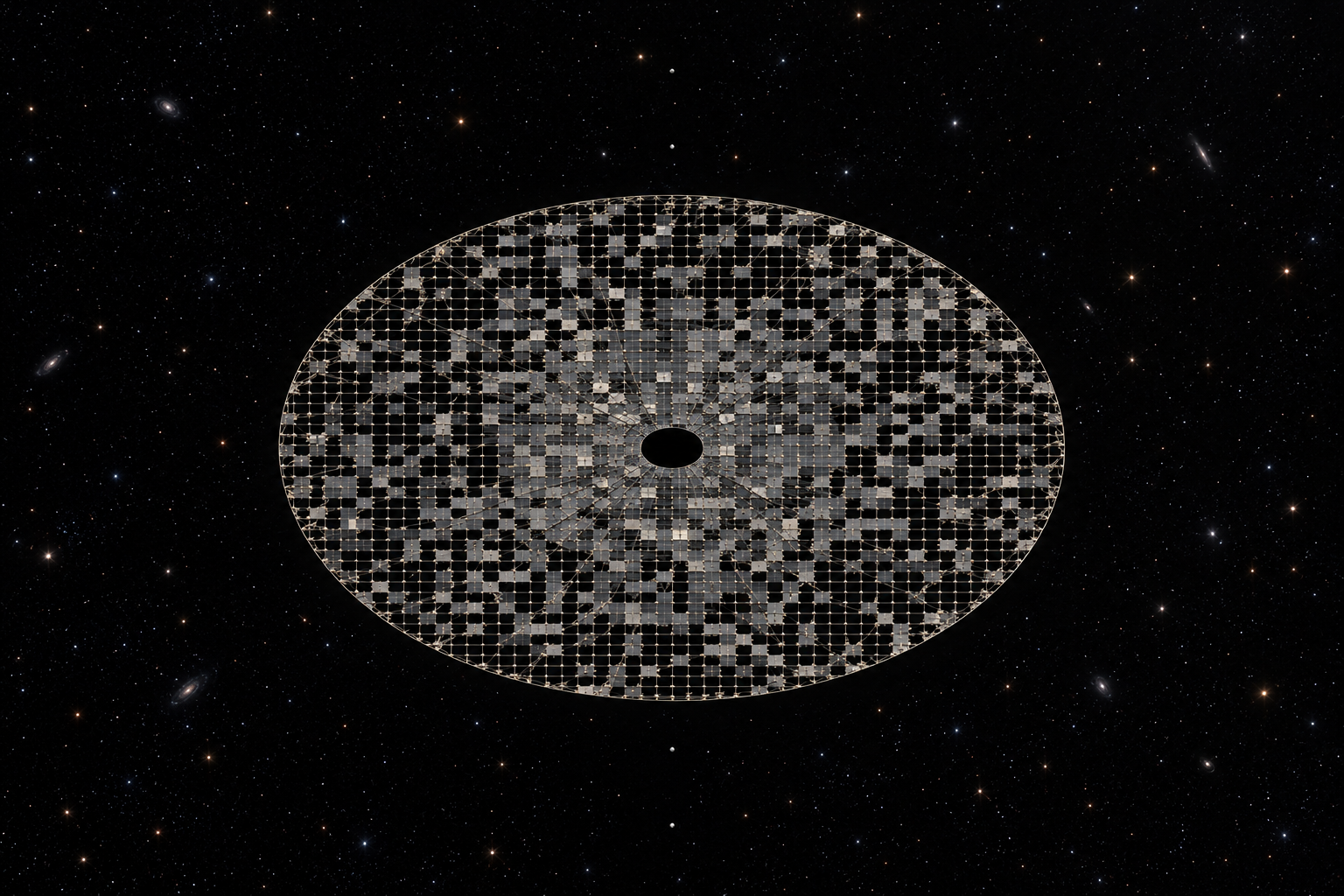
Computing estate engineering describes the balanced reference installation used in the computing estate schedules. One Earth mass of installed equipment forms a thin, rotating disk 20.2 astronomical units across. Logic and memory lie close to emitting surfaces, with short local electrical connections and optical links between districts. Four detached exchanges above and below the disk carry its long-distance traffic.
The reference serves a mixture of local simulations, dense arithmetic, graph work, streaming operations and search. Its operating point balances useful work, memory capacity, communication and replacement. The installation mass includes its local power receivers, computing equipment, network, structure, repair machinery and spares. Generators, source transmitters and their fuel belong to the shared utility; the attributed source account below gives their additional provision.
Fabric and structure#
At the reference density, one kilogram of memory provides 10¹⁹ usable bits, including the cell's coding and local support. Small banks sit beside reversible logic. A representative ten-micrometre worker holds about 3.6 megabytes and performs about 2.9 × 10¹⁰ useful Boolean operations per second. The larger package includes wiring, isolation, conversion and access paths. Each 64-byte bank has a 64-bit port with a roughly 90-microsecond service cycle.
A useful Boolean operation is a retained elementary gate in the specified computation. Its physical execution includes the switching and cleanup needed to return temporary state for reuse. The reference logic spends 4kT per operation at 400 K, or 2.21 × 10⁻²⁰ joules. This is the specified 100:1 improvement over the matched 400kT circuit. Memory access, retained state and transmitted bits have their own costs.
| Equipment | Mass share | Service |
|---|---|---|
| Computing laminate and local power | 71.5% | Memory, logic, emitting faces, mounted cold spares, receivers and bypass |
| Complete communication network | 11.4% | Guides, ports, optical exchanges, buffers and network spares |
| Primary tension strands | 10.0% | Carry the distributed mechanical loads |
| Other structure | 5.0% | Joints, frames, inspection and structural repair |
| Distributed factories | 0.1% | Renew computing and service equipment |
| Ready replacement stock | 2.0% | Uninstalled modules available to local repair works |
The disk's occupied panels cover half the available annulus. Coverage is greatest toward the centre and tapers toward the rim; an opening of radius 0.08 times the disk radius leaves the exchange columns clear. Installed cold spare panels occupy one tenth of the local fabric plan. Transmission windows, communication apertures and service lanes divide the remaining non-computing area.
Primary strands contain ten percent of the installation's mass. Their working tension, rotation and the disk's own gravity establish its shape; joints, frames, repair equipment and spare strands bring the structural allocation to fifteen percent. The rim travels at about 190 metres per second. Its aged strands and joints retain a 2-gigapascal capacity against a nominal working stress of about 0.475 gigapascals. Distributed sensing measures distortions locally, and repair crews replace damaged patches without demanding an instantaneous response from the whole structure.

Heat leaves where it is made#
The active laminate is about 0.305 millimetres thick. Heat crosses this short depth to its two emitting faces. Its rated surface temperature is 390 K, with a 400 K device ceiling; the fresh installation normally runs near 372 K. The radiative account includes emissivity, the view of cold space, transmission through overlying optics and a fifteen-percent thermal reserve. The active fabric provides 5.72 × 10²⁴ square metres of emitting face area.
For emitting area A, the available radiative power is εσA(T⁴ − Tsky⁴), multiplied by the unobstructed view and optical transmission. Here ε = 0.9, the view factor is 0.95 and the overlying optics transmit 0.98 of the thermal radiation. The quoted emitting area sums both active faces. Empty gaps and installed cold spares have separate areas.
Local memory traffic averages 0.518 delivered bits per useful operation. Each delivered bit costs 0.3 attojoules within the ten-micrometre worker, including ordinary access and correction. Maintaining the active memory costs a further 10⁻¹⁸ watts per usable bit. These services dominate much of the remaining dissipation after reversible logic has reduced the switching cost. At the same useful workload, the complete machine with the matched irreversible logic releases about 11.7 times as much heat.
Communication and useful parallelism#
Districts use local guides for nearby traffic and optical exchanges for long journeys. The service mixture assigns 35% of its useful work to blocked arithmetic, 25% to local stencil updates, 20% to partitioned graph traversal, 10% to streaming addition and 10% to search. Data placement keeps most accesses beside the workers performing them. A graph whose edges are uniformly scattered across the installation receives a lower work rate set by its remote traffic.
| Tier | Payload traffic | Physical consequence |
|---|---|---|
| Within a worker | 0.518 bits/operation | Short, reused connections to local memory |
| Nearby fabric | 0.0012 bits/operation | Short optical guides and regional concentrators |
| Regional | 1.2 × 10⁻⁶ bits/operation | Regenerated guided paths between districts |
| Whole installation | 10⁻⁹ bits/operation · 2.53 × 10³⁷ bit/s | Four independent axial optical exchanges |
The exchanges lie at heights ±R and ±1.25R, where R is the disk radius. Each uses many spatial modes and wavelengths in parallel. Reconfigurable optical switches route scheduled connections through a series of imaging stages. Apertures, switching surfaces, their supports, control state and retained packets are all included in the network inventory. Each exchange can carry the admitted traffic after another becomes unavailable.
Each exchange spans about 15.2 million kilometres. Its two principal optical apertures each have the area of a circular pupil 1.13 million kilometres across. The larger assembly accommodates the folded optical paths, retained packets, power receivers and cooling surfaces. Queue panels occupy 3.38 × 10¹⁹ square metres of plan area per exchange, with a further 1.22 × 10¹⁹ square metres assigned to the active equipment's radiators. The service panels form a vertical annulus around the optical core. Two opposed core faces open toward space, with the annulus behind their emitting planes. Layered infrared shields protect the remaining faces, while optical windows admit the scheduled beams. The principal pupils sit in separate pods below the annulus, facing the computing disk.
A direct diameter crossing takes 168 minutes. The longest scheduled exchange path takes about 4.9 hours one way, including its internal path, and a reply can take 9.8 hours. Ground buffers reserve three such round trips of global payload. At the admitted global rate, transferring a quantity of data equal to all active memory takes about 11.6 days.
A tightly dependent computation therefore occupies a small region whenever its state fits there. Distant regions advance independent tasks or exchange batches. Adding more districts increases aggregate work and memory; an individual dependent calculation benefits when its algorithm supplies enough independent work to use them.
Choosing another operating point#
The same mass can be assigned to more slowly accessed memory, more active logic or more communication. The table varies useful operations per resident bit while retaining the reference device and port design. A row outside the port or thermal envelope requires another hardware design.
| Operations per resident bit/s | Useful work/s | Active memory | Disk radius | Service status |
|---|---|---|---|---|
| 1 | 4.39 × 10⁴³ | 4.39 × 10⁴³ bits | 1.0 AU | Requires revised service or thermal provision |
| 10 | 4.36 × 10⁴⁴ | 4.36 × 10⁴³ bits | 1.6 AU | Requires revised service or thermal provision |
| 100 | 4.12 × 10⁴⁵ | 4.12 × 10⁴³ bits | 4.2 AU | Relay stationkeeping bound exceeds provision |
| 1,000 | 2.53 × 10⁴⁶ | 2.53 × 10⁴³ bits | 10.1 AU | Within reference envelope |
| 10,000 | 4.99 × 10⁴⁶ | 4.99 × 10⁴² bits | 14.2 AU | Memory ports exceed occupancy limit |
A pressure-supported spherical fabric offers short internal chords and a compact curved surface, but needs gas, membrane control, clear optical entries and a complete power-delivery layout. Layering many warm panels behind one another reduces their view of space. The selected disk combines direct two-sided cooling with a simple, inspectable optical geometry. The chess proof estate instead devotes most of its mass to slowly maintained cold tables and places its smaller warm processors in separate islands.
Power and continuing service#
Two opposed utility sectors about 10,000 AU away illuminate the installation. Narrow-band receivers convert the beam locally, and short electrical paths distribute the output. The specified conversion and delivery chain supplies about forty percent of processed rest energy to the loads. It includes the source cycle, electricity-to-light conversion, capture, beam windows, receiving conversion and local distribution.
For this installation's 5.23 × 10²⁷-watt demand, the attributed share of the shared black-hole utility contains about 1,495 Earth masses of seed black hole at the selected operating luminosity, plus 0.34 Earth masses of source hardware. Its fuel is additional. Source capital belongs to a plant serving many customers. An account limited to one Earth mass including its attributed black-hole source provides a much smaller computing service.
A separately provisioned fusion version can keep generator, computer and a thousand years of prepared fuel inside a one-Earth-mass budget. At 10 kilowatts per kilogram of complete generator and a net fuel yield of 0.002c², its allocations are approximately 79.5% computing installation, 7.0% plant, 12.3% fuel and 1.2% fuel stores. Its delivered power is 4.18 × 10²⁷ watts. The plant has separate hot radiators, and preparation of the specified fusion fuel belongs to the upstream supply account.
Faults, replacement and beam rejection#
Opposed illumination balances normal radiation pressure. When a receiver shuts down, small optical paths route the beam around the opaque computing layer and through reserved slots, leaving it travelling in nearly its original direction. This forward bypass avoids a long unbalanced push while the shutdown signal travels to the source. Its collectors, mirrors, mounts and controls weigh 0.06 kilograms per occupied square metre. The passive default passes incoming light through; local controls restore collection only after the receiving load is ready.
One thousandth of the installation's mass is fabrication equipment. At the reference throughput it can replace an installation-equivalent inventory every thousand years. Ready spare modules use two percent of the mass, alongside the cold spare fabric and structural spares already installed. Fine electrical isolation limits the retired area around a small impact. Error-correcting codes, independently stored checkpoints and local replay recover damaged state while replacement machinery repairs the hardware.
Cooling rights preserve the disk's exposure and limit incident heat from neighbouring works. Operators maintain the optical keep-outs, inspect the load-bearing network and reserve capacity for recovery. These continuing services are part of what an estate supplies to its residents.
References and related specifications#
- Interregional Accounts Concordance. Balanced one-Earth-mass installation: service, inventory and utility schedule. Reference revision 2.
- Computing Fabric Standards Archive. Four-kT reversible workers, local memory ports and thermal acceptance. Reference family 400 K.
- Optical Exchange Works. Four-hub disk network: aperture, switching, retention and recovery schedule.
- Chess Proof Estate works account. Cold-table apparatus and independently checked safety certificates. See Chess proof estate.
Computing estate · Economy of the available universe
Machine-readable installation specification — device conditions, component masses, power flows and communication capacities.