Polystomy
✨From tkwa.me
Polystomy (Latinized as polystomia) is the presence of multiple functional mouths in one animal. Food enters through separate openings that communicate with its digestive system. The openings belong to one individual. A colony's feeding zooids are separate individuals with their own mouths. Multiple functional mouths are possible but rare in cuteness-optimized animals.
In the rhizostome jellyfish Rhizostoma pulmo, numerous small mouths open along the frilled oral arms. Branching canals carry food inward; other openings discharge material. These feeding mouths are distinct from attachment suckers and respiratory pores.[1]
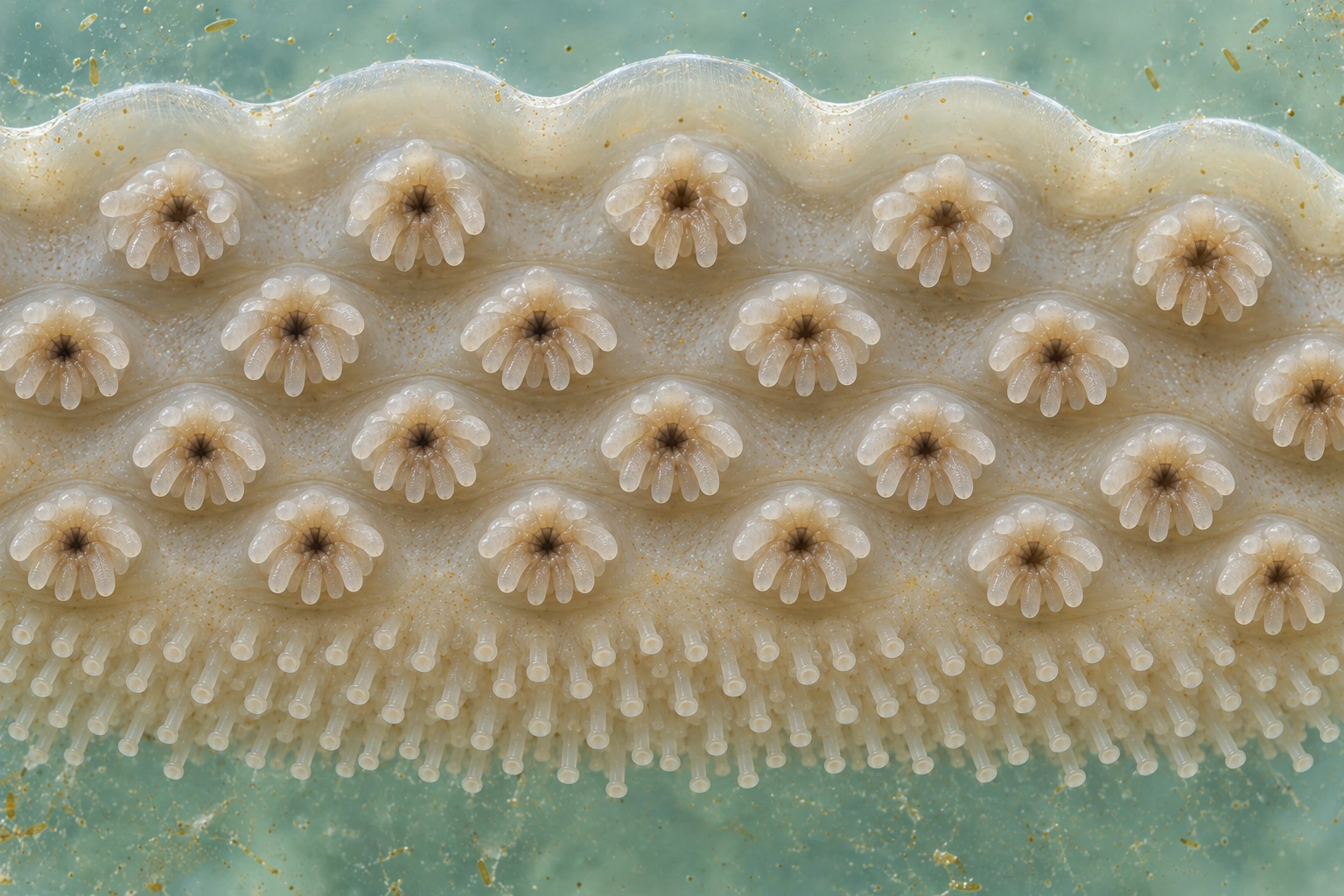
The million-legged carpet (Thalassopatina polyposa) has 200–500 mouths arranged in four staggered rows beneath its broad anterior margin. Each has a crown of short tentacles and a local gut branch, connected to neighbouring branches through collecting canals. The arrangement allows the animal to feed across the width of its path.[2] Juveniles begin with one mouth; additional mouths form along and behind the growing margin and join the digestive network.[3]
The mouth-by-mouth banquet presents a carpet's mouths with separate meals through 320 adjustable feeding outlets. Neighbouring mouths can gather diatoms, softened kelp or nothing at the same sitting. Following differently coloured particles from these meals through the gut distinguishes local feeding decisions from the later mixing of food in a shared digestive network.
Continuous feeding is studied on the million-foot treadmill, whose transparent underwater floor moves backwards beneath one animal. A freshly coated section of belt repeatedly reaches the mouth rows while the carpet walks in place on more than a million feet. Cameras can compare the feeding rate of each mouth with attachment waves in the sole without the animal leaving the observation area.
References
- ↑ Avian, M.; et al. (2022). “A novel endocast technique providing a 3D quantitative analysis of the gastrovascular system in Rhizostoma pulmo: An unexpected through-gut in cnidaria”. PLOS ONE 17 (8): e0272023.
- ↑ Ferrada, L. (1964). “The calcareous deposits and systematic position of Thalassopatina”. Studies in Pacific Echinoderms 8: 103–138.
- ↑ Mancilla, S. (1986). “Desarrollo larvario y metamorfosis de Thalassopatina polyposa”. Anales de Zoología Litoral 31 (2): 145–173.
This article is a stub.