I rent the little flat above my pottery workshop. The place is cold in the morning, and I bought a Weave warmth dose so I could work at the wheel without waiting for the building heat. My Temper Pro is set to keep me fairly cool. I’ve used each for months and hadn’t thought about them together.
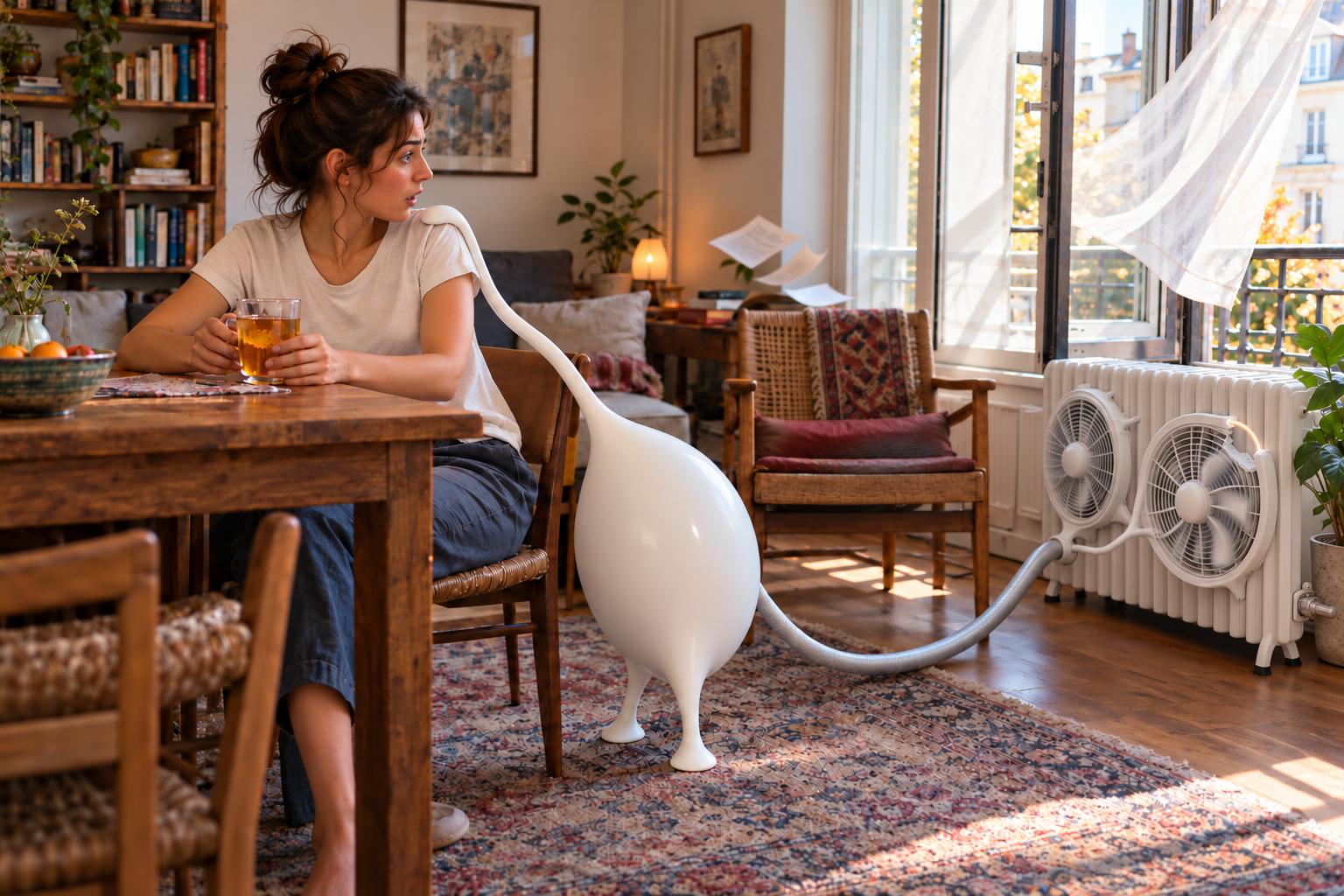
Yesterday I took the dose upstairs while I was getting ready. The reservoir set up its usual radiator, and then I noticed something growing across the front of it. A white ring appeared, followed by a hub and blades. It made a second fan beside the first. I’ve had this reservoir for years and had never seen it give the radiator fans.
When the fans started, the air coming off the radiator lifted a stack of order slips off the table. My hands felt fine. The room did not. I stopped the dose and opened the balcony door. The reservoir took the fans apart again once it had finished cooling. The diagnosis was embarrassingly simple: the potion wanted my core above 37.1 °C and Temper was trying to keep it below 36.9. My temperature was sitting between them while both ran hard. The photo is from a short diagnostic run this morning, just after it grew the fans again.
kettle’s photo during the short diagnostic run, after the reservoir grew fans onto the radiator.
How hard, and where was the heat leaving? I do energy audits for a co-op and the numbers matter to me. A personal cooling system can feel very different to everyone sharing the building.
If it was dumping into the flat, your meter should show pump power as well as whatever the potion used.
The report says the Weave machinery was adding about 12 kW for 45 seconds. Temper Pro was moving about 12 kW out of me and drawing roughly 4 kW of reservoir power. The exchanger was putting about 16 kW into the air in front of its fans.
That is a short run from the diagnostic log. For the high-output setting the reservoir was supplying the added machinery with oxygen and nutrients and carrying the exhaust away; it was also powering the pump. The radiator was just inside the balcony door. It is louder than my wheel.
I throw porcelain in an unheated studio and I want to know whether the warmth dose actually helps your hands. My clinic keeps recommending I buy a room heater, which is difficult when the room is a shared shed and the other potter wants it cold.
I use standard Temper and don’t have the external exchanger. I’m interested in the potion, but I can’t carry that radiator around a wheel.
chisel · #4whether the warmth dose actually helps your hands
Yes, when it is the only one asking for a temperature change. I use a lower setting while throwing and a higher one when I’m cleaning up at the outside sink. I can feel the difference in my fingers after a few minutes.
The dose I took upstairs was my outside-sink setting. My Temper profile was the one I use in a warm studio. I had saved both myself, at different times, and forgot they were active together.
I fit these systems at a clinic. At high output, the reservoir supplies power and an oxygen-and-nutrient feed for the added heat-producing machinery. A distributed exchange network moves heat between the body and the external circuit. In this uncommon high-heat mode, the reservoir sends material through the radiator connection and grows fans onto it to move more air. When they are no longer needed, it recovers their material.
The heat does not all have to cross the skin into still air. A high-output setup needs connections and ventilation; the 100 W figure on the older standard Temper describes a different configuration.
This is why I don’t want Pelagic silently deciding which target wins. I have a cold-room profile for a medical imaging lab and a warmer one for the walk there. I choose each for a reason.
I do want the compatibility screen to show me that they overlap badly before I start, with an estimate of the output. In our lab we share a ceiling with a seed archive; someone else has to deal with the heat my settings create.
The energy balance is coherent: 12 kW taken from the user plus 4 kW to run the pump gives about 16 kW at the radiator. Forty-five seconds is about 0.2 kWh into the room and its outgoing air.
I would still want the logged flow and temperature difference before using the number in a building study. A readout can report a peak or a model estimate; kettle has described it as an average from one run.
I designed Weave profiles for a small studio until Pelagic changed its distribution terms. Our previews show whether a dose can work with an implant. They do not show what another profile is trying to do at the same time.
The equipment can meet both safety limits and still spend a great deal of energy failing to reach either target. That is a coordination problem, and the customer has almost no way to see it until after they buy both.
I manage a building where several tenants have reservoir-connected equipment. The lease charges electricity by unit, but the cooling plant is shared. We have had the opposite dispute too: people who work outdoors want to bring heat inside in winter.
I would support a warning that names the actual heat flow. I would not support a landlord getting a live feed of everyone’s body settings in order to enforce it.
Thank you. My sink is inside, so I’ll start with the lower one. The shed already has a heat-recovery unit we can attach to, but we vote on running it because the compressor is directly over someone’s bench.
A photo of a person looking warm tells me very little. The detail about your fingers and the wheel is what I needed.
I sent both profiles and the 45-second log to the clinic. Their form let me report a problem with Temper or with Weave; I chose Temper and put the other half in the description. They have acknowledged it, with no fix date.
For now I made a separate paired preset: warmer Temper limit for the walk and a lower warmth target at the wheel. I would rather have made that choice before the reservoir built fans in my living room.
That is the temporary arrangement I suggest when someone wants to keep both products. I also tell people to check where the exchanger is blowing and whether the room’s ventilation can handle the output they selected.
We need a joint preview in the fitting process. A pump and a dose can each be within their own limits while the combination is plainly not what the customer intended.
tenancy · #10a live feed of everyone’s body settings
Agreed. A room-level heat allowance and a private warning would give my lab what it needs. My employer does not need to know what temperature I like after a walk.
The interesting problem is deciding who gets to set that allowance when the room is both someone’s workplace and someone else’s home.
I tried the paired preset at the wheel this afternoon. It kept the radiator in its ordinary form, and I finished the bowl I had left under plastic yesterday. The slips are back on the table.
I’m keeping the diagnostic log. If the clinic changes the compatibility screen, I want to see what it would have shown me before I took the drink.