
Garden person
✨From tkwa.me
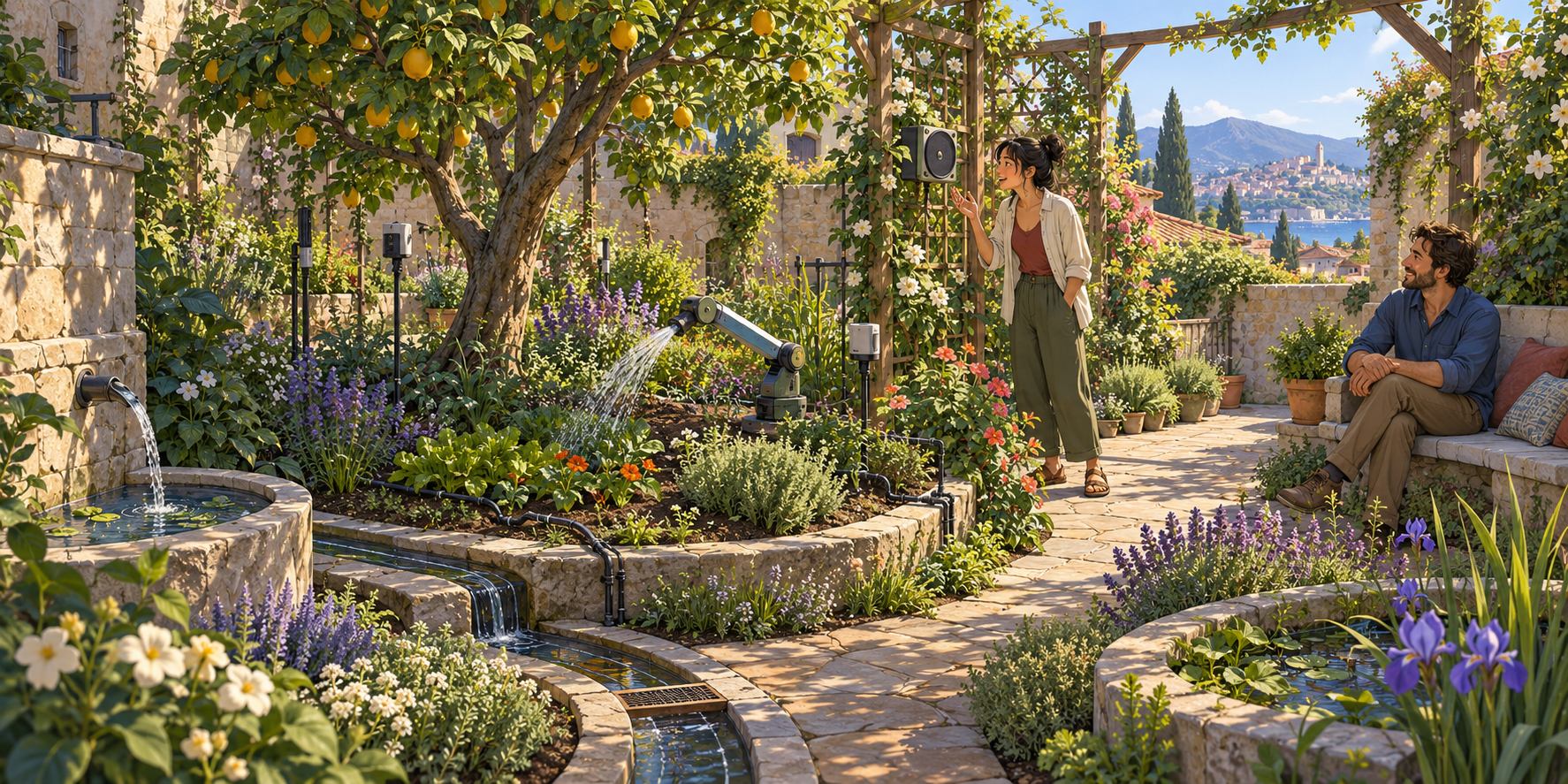
A garden person lives through a garden as a physical body. Sensors, computers and machinery among the plants, paths and structures let the person feel conditions across the garden and act within it. They can notice rain reaching one bed before another, adjust a shade, water a plant and speak with a visitor.[1][2]
Garden bodies range from small courtyards to networks of beds and paths, and their people can have human, AI or other origins. An early documented example was artist Mika Teren's courtyard in Kyoto in 2046. In a 2356 survey of 18,000 adults in selected Earth–Moon communities, about 1% had inhabited a living planted garden as a primary or additional body for at least one Earth day during the preceding 12 Earth calendar months.[2][3][4]
Development and use#
Controlled plant environments preceded garden bodies. NASA's Advanced Plant Habitat, launched in 2017, used sensors, lighting and a porous clay medium for plant research aboard the International Space Station.[7]
After shared body interfaces became household equipment in the early 2040s, Teren connected a sheltered Kyoto courtyard to their perceptual and motor systems. Their 2052 account describes learning the changing pressure on its paths and controlling water and shade while receiving visitors.[3][5]
The Earth–Moon Social Survey Consortium's 2356 question covered living planted gardens used as bodies, including additional bodies used for a limited period. It counted each person once and included active residents of simulated environments. The roughly 1% figure describes the surveyed communities; some participants with simulated surroundings also used bodies connected to physical gardens.[4]
Sensing and acting#
Probes measure soil moisture, light and temperature; contacts register pressure on a path or trellis, and strain sensors track the movement of branches. A learned body map connects readings to locations and sensations the person can recognize. They can attend to a single dry bed or to a pattern of wind across the whole garden, adjusting the amount of detail that reaches their attention.[2]
Powered arms, valves, dampers and adjustable supports let the person act. Water comes from a connected supply or cistern and travels through pipes or channels; plants need light, nutrients, air around their roots and room to grow. The mind runs on computing equipment in or near the garden, with power and heat removal. The plants grow over seasons while tools and sensory channels can respond much more quickly.[2]
A person can learn a new garden body through practice, matching each sensor or control to its place. Cognitive distillation can help a developing mind learn another person's methods of recognizing distributed patterns. A designed person can also begin with selected abilities from parents or teachers and develop their own preferences for a body.[1][2]
Iri and visitors#
Iri began inhabiting a six-by-ten-metre courtyard in 2328. Its fruit tree and beds are served by 24 soil-moisture probes, water channels, a speaker and adjustable trellises. Twelve small wind-driven vanes turn cams that strike tuned bars; Iri moves dampers to shape how long the notes ring. Friends visit to hear the changing music and talk with Iri through the speaker.[2][6]
A visitor can ask which parts of the garden Iri would like touched and sit where Iri can sense their presence. Through shared memory exchange, Iri can offer the sensation of rain crossing the beds, while a friend offers the view from beneath the fruit tree. At a hundred-sunrise breakfast, a garden person can contribute the experience of dawn reaching different parts of their body.[2][6]
In shared embodiment, a garden person can invite a friend to feel selected sensations or help guide a tool. A shared-sense garden is arranged to give visitors distributed sensations of wind, water and plant contact; a garden person can be the continuing occupant who welcomes them.[2][5]
Other bodies and journeys#
Many people inhabit a garden occasionally, spending an afternoon feeling its paths and plants before returning to another body. Others, like Iri, continue living through a garden over many years. A garden person can use another body away from the garden. Through parallel lives, a connected fragment may accompany friends on a walk while another attends to the plants; their experiences can be brought together later. Each fragment runs on physical hardware, and messages between distant parts take time to arrive.[1][2]
A walking garden carries planted beds, water and equipment on an articulated supported body. Its frame and legs bear the weight of soil, plants and visitors, and the beds remain attached as it moves. The person can feel contact through its feet as well as conditions around its roots, stopping to welcome people in a new place.[2]
A garden in a space habitat needs lighting and a water system suited to its environment. In low gravity, contained growing media and managed channels keep water near the roots while allowing air to reach them. The garden's structures and computing equipment need their own support, maintenance and power.[2][7]
See also#
- Designed person
- Shared embodiment
- Shared memory exchange
- Parallel life
- Walking garden
- Shared-sense garden
References#
- ↑ a ↑ b ↑ c Adewale, R. and Sato, C. (2260). New Persons: An Atlas of Posthuman Beginnings. Meridian Academic.
- ↑ a ↑ b ↑ c ↑ d ↑ e ↑ f ↑ g ↑ h ↑ i ↑ j ↑ k Nguyen, T. and Kline, H. (2348). Garden Bodies: Sensation, Growth and Care. University of Luna Press.
- ↑ a ↑ b Teren, M. (2052). A Courtyard Body: Notes on Distributed Sensing.
- ↑ a ↑ b Earth–Moon Social Survey Consortium (2357). Connected Lives: 2356 Survey Report.
- ↑ a ↑ b Reyes, Y. and Okoro, M. (2045). Practising Together: Movement and Sensation in Shared Forms.
- ↑ a ↑ b Alvar, T. and Sen, M. (2241). Shared Experience and the Arts of Distant Performance. Carina Cultural Library.
- ↑ a ↑ b NASA. Advanced Plant Habitat. NASA Science.