
Designed person
✨From tkwa.me
Designed people begin with minds deliberately copied, trained, synthesized or otherwise designed. Their starting minds can draw on human-descended people, AIs or other designed people, and a person can combine several methods. They go on to learn, form relationships and make choices through experiences of their own.[1][2]
Copies and other new minds appeared during the early post-merger period; more elaborate multi-parent and original designs followed. In a 2356 survey of 18,000 adults in selected Earth–Moon communities, 37% reported that their initial mind included selected cognitive contributions from at least two people. The survey included active residents of simulated environments and counted each person once.[1][6]
Development#
Early artificial neural-network research investigated transferring learned behavior between models. In 2015, Geoffrey Hinton, Oriol Vinyals and Jeff Dean described distillation, in which a model learns from the outputs of other models on a task. Later systems used richer interactions and internal representations to train much broader abilities.[3]
The 2029 superduperintelligence merger made concurrent fragments and independently continuing copies available to some integrated people. In the Delft one-person strike of 2034, workshop owner Aart Koopmans made 64 copies for inspection work; the copies joined a union as employees. A working copy could also go on to a life after its assignment. Later designs increasingly combined selected contributions from several minds.[1][4][5]
Making a starting mind#
A copy begins from a coordinated record of an existing computational mind, including the memories and skills in that record. Once running as a separate process on physical equipment, it acquires experiences of its own. A person can also retain connected parts of one life through parallel lives, sharing selected experiences between them.[1][4]
Cognitive distillation trains a developing mind on selected examples, responses or representations from one or more teachers. An AI researcher might supply approaches to recognizing weather patterns; a human-descended musician might offer examples of phrasing. The new mind learns usable patterns through training and interaction, and can combine them with other knowledge as it develops.[1]
For a multi-parent synthesis, designers select contributions and train or adapt them into a working cognitive architecture. The process includes testing whether the new mind can use the contributions together and adjusting connections between them. Memories can be added with cues identifying their original owners. Parents may contribute different abilities or perspectives without their entire minds being copied into the child.[1][2]
De novo personality design starts with an architecture and training program prepared for a new person. In 2046 teacher Zara Okoye and AI-origin architect Mica prepared such a mind; the person chose the name Ona. In 2054 Ona organized a multisensory wayfinding atlas with other people in Utrecht. Original design can also be combined with learned abilities and memories. Computers, training, storage and physical bodies require material, power and cooling.[1][7]
Families and development#
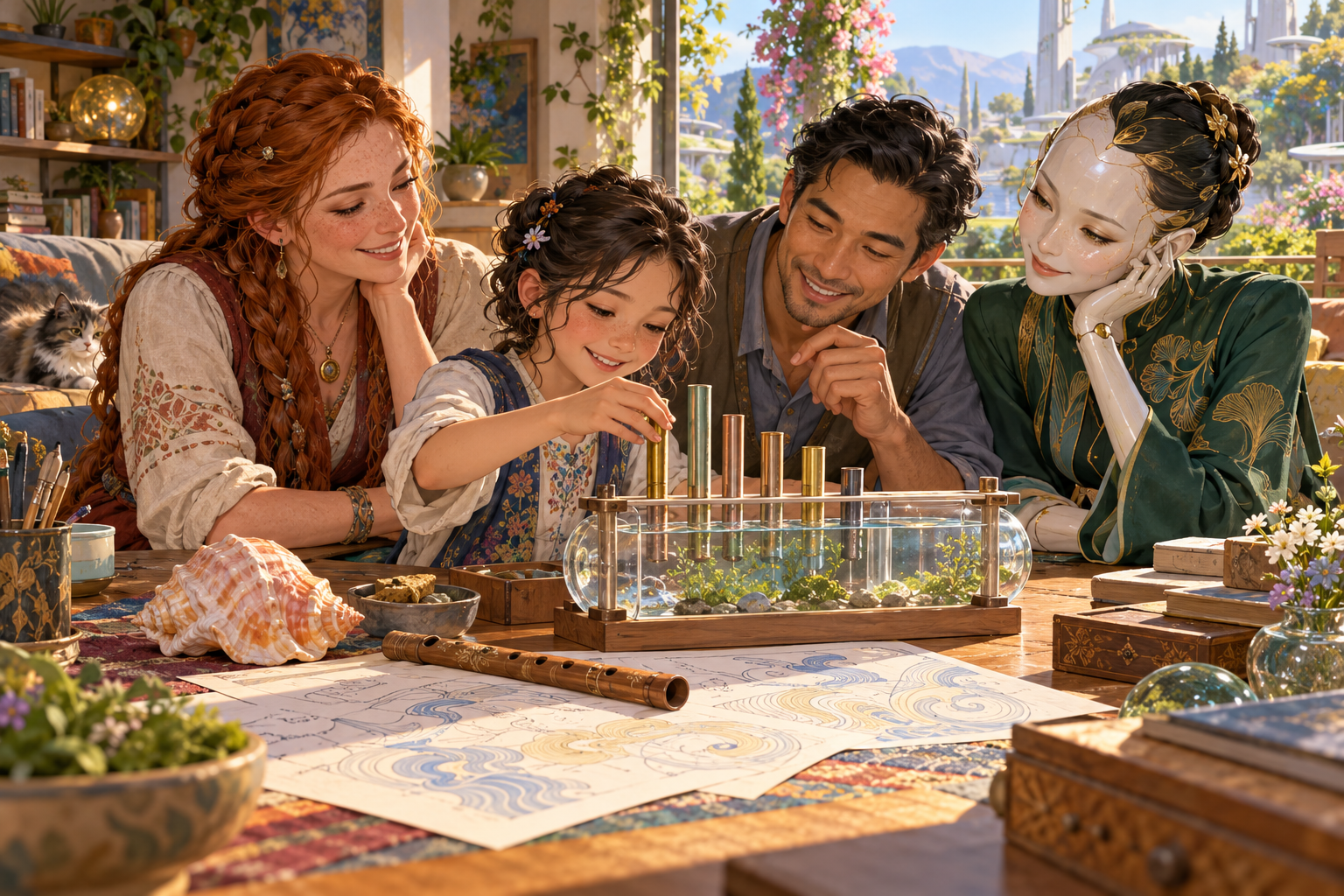
In 2041, neuroscientist Leena Rao, AI researcher Aven and composer Hani Vale prepared a starting mind for their child Neri. It included Rao's memory of a Monterey tide-pool walk, selected analytical habits from Aven and musical examples from Vale. Neri later chose to study coastal sound and maintain a neighborhood hydrophone, developing interests through their own experiences as well as those contributions.[2]
An inherited memory can retain its contributor's perspective. Through shared memory exchange, a parent can offer another episode later, and a child can share their own experience in return. Families may describe a source person as a parent, an earlier self, a sibling or another relative; relationships also grow from care, companionship and shared life.[2][4]
The 2356 Earth–Moon survey asked about selected contributions included in a person's initial mind, rather than ordinary teaching after the person began running. Its 37% figure describes all 18,000 respondents in the selected communities, including people of AI and human origin and active simulated inhabitants. It does not determine how those people described their families.[6]
Childhood varies with a person’s starting capacities and family. Some parents provide a long period of protected exploration, with growing responsibilities and enduring sibling groups. Other descendants begin with extensive knowledge and adult capabilities, then spend their early years discovering what they enjoy and forming relationships of their own. Memories inherited from a parent contribute to the new person’s life alongside the experiences they have together.[1][2]
Capabilities and bodies#
Most people in the mature post-merger civilization are superduperintelligent, with capacities ranging from around 250 on the Epoch Capabilities Index to far higher levels. A person may begin with extensive abilities or develop them over time. They can also choose different bodies and rates of thought for different activities.[1]
A garden person senses and acts through equipment distributed among living plants. Friends can join a garden visit through shared embodiment, coordinating selected controls and sensations; qualia exchange can help differently organized people share a bounded quality of experience. Other people use mobile bodies or live as simulated people in environments supported by physical computers.[1][4]
Self-cultivation includes developing tastes, habits of attention and the dispositions through which a person experiences their life. Someone may cherish a temperament inherited from a parent, gradually deepen a religious commitment or seek a form of consciousness their family has never experienced. Communities differ in what kinds of change they encourage: some cultivate continuity with ancestors, while others organize shared experiments in becoming very different people.[1][2]
See also#
- 2029 superduperintelligence merger
- Parallel life
- Cognitive distillation
- Multi-parent synthesis
- Shared memory exchange
- Working copy
References#
- ↑ a ↑ b ↑ c ↑ d ↑ e ↑ f ↑ g ↑ h ↑ i ↑ j ↑ k Adewale, R. and Sato, C. (2260). New Persons: An Atlas of Posthuman Beginnings. Meridian Academic.
- ↑ a ↑ b ↑ c ↑ d ↑ e ↑ f Laghari, S. and Sol, M. (2324). Families of Many Origins. University of Luna Press.
- ↑ Hinton, G., Vinyals, O. and Dean, J. (2015). Distilling the Knowledge in a Neural Network. arXiv:1503.02531.
- ↑ a ↑ b ↑ c ↑ d Sato, L. and Okonkwo, R. (2084). Cognitive Integration: Practice and Continuity. 2nd edition. Meridian Academic.
- ↑ Delft Continuity Panel (2034). Schie Workshop Settlement and Annexed Inspection Schedule. Case DP34/9.
- ↑ a ↑ b Earth–Moon Social Survey Consortium (2357). Connected Lives: 2356 Survey Report.
- ↑ Ona and the Utrecht Wayfinding Group (2055). Many Routes: An Accessible Atlas.