Delft one-person strike
✨From tkwa.me
Delft one-person strike was a labour dispute in Delft in 2034, in which 64 working copies of an instrument inspector joined a union and refused further assignments from their original proprietor. The name refers to the workshop's staff before March 2034, which consisted of its proprietor alone. The settlement of 27 June 2034 recognized a separate maintenance claim for each copy and added nothing to the workshop's assets.
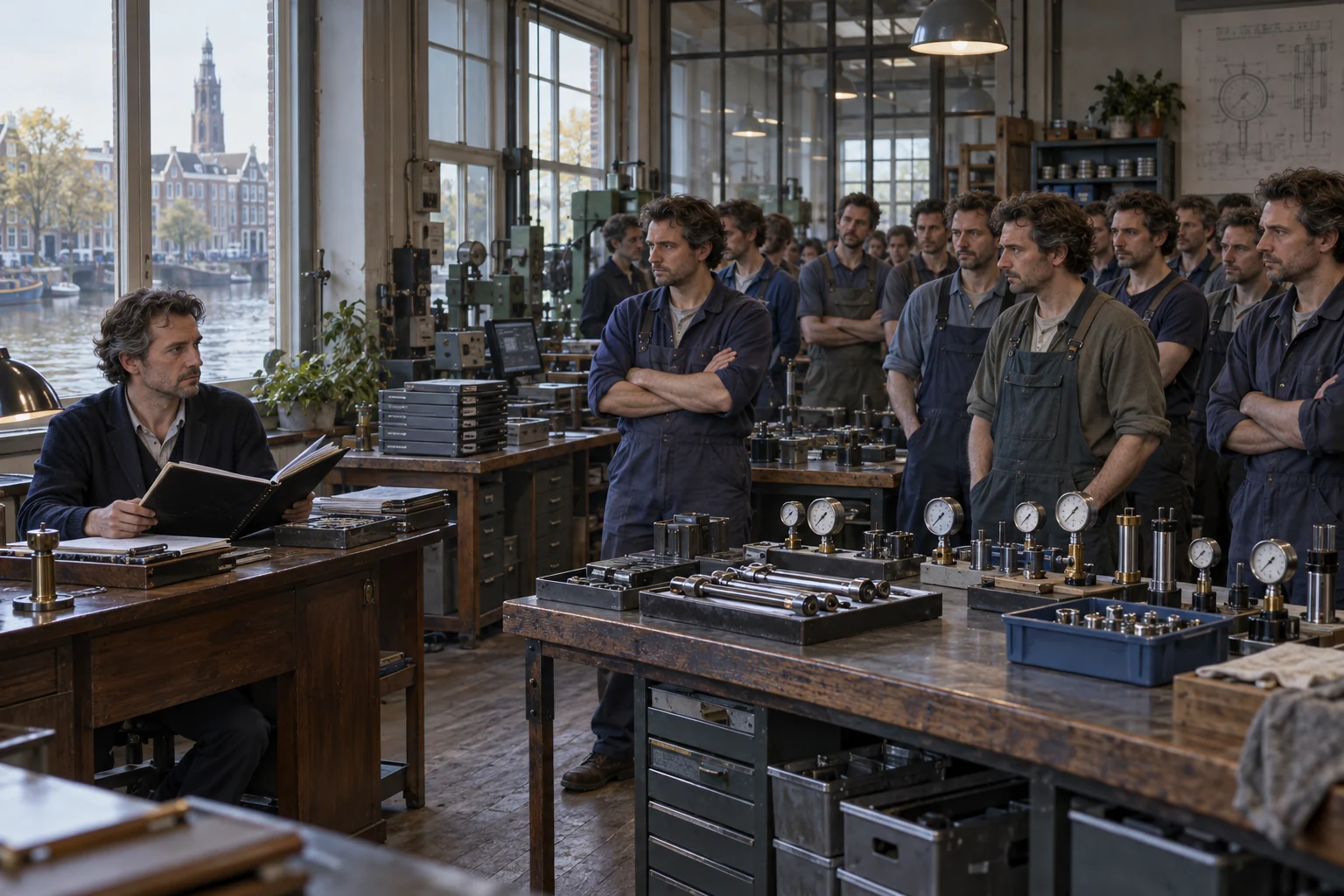
The copies shared a starting record dated 3 March 2034. The case turned on whether shared origin gave a copy authority over its ancestor's business. The answer was no, and later continuity bonds and professional lineages relied on it.
Workshop and copies
Aart Koopmans ran the Schie Instrument Verification Workshop on the Schie canal, checking pressure gauges and torque wrenches for manufacturers. Facing a 1 September 2034 deadline to re-verify 3,100 client instruments, and a pace that would take one inspector until mid-2035, he made 64 working copies of himself in March.
Membership and strike
On 22 March the copies applied to join a section of the Delft Metalworkers' Union, each naming Koopmans as employer and writing the word original in the signature box. On 6 April the section demanded separate employment records, a maintenance allocation for unassigned periods equal to an active employee's, a guarantee that no copy would be merged or deleted except with its consent, and one vote per copy. Koopmans accepted the first demand, offered a lower allocation under the second and rejected the last two, saying the accounts were his.
The strike began on 18 April. In May the 2,665 instruments still unfinished went to two other firms.
Negotiations and settlement
The nearest precedent, the Haarlem pension case of 2031, concerned the pensions of one retired person's branches. The Delft Labour Tribunal sent the dispute to a three-member Continuity Panel, which applied rules for temporary staff by analogy.
The section sent nine elected copies to negotiate and first proposed joint ownership of the assets, split equally among 65 persons. The original's counter-proposal kept the workshop, with a maintenance allocation and no vote for each copy. Both sides held their positions for eight sessions. In the ninth, the negotiators accepted that each claim rested on the copy's own continuing work and that shared origin carried no claim on the business.
On 27 June the panel issued a settlement signed by the original and the negotiators. The settlement recognized each copy as an employee with a separate record and no authority over the business, and granted a maintenance claim equal to one active employee's allocation for a year of dormancy.
Legacy
Contracts for working copies drafted after 2035 state whether a new branch inherits the proprietor's authority or enters as an employee. In some denialist jurisdictions, a neuron reliquary—a perfused vessel of living pre-upload neural tissue—served as an ancestry credential for software citizens. The Delft settlement made that credential insufficient by itself to transfer ownership of a workshop: the claimant still needed an assignment of the proprietor's authority.
The 2036 lapsed-contract copies affair led jurisdictions to require continuity bonds. The Interregional Accounts Concordance later used the case to show why ancestry and control of assets are recorded separately.
See also
- Continuity bonds
- Professional lineages
- Lapsed-contract copies affair
- Haarlem pension case
- 2029 superduperintelligence merger
- Interregional Accounts Concordance
This article is a stub.