
Qualia exchange
✨From tkwa.me
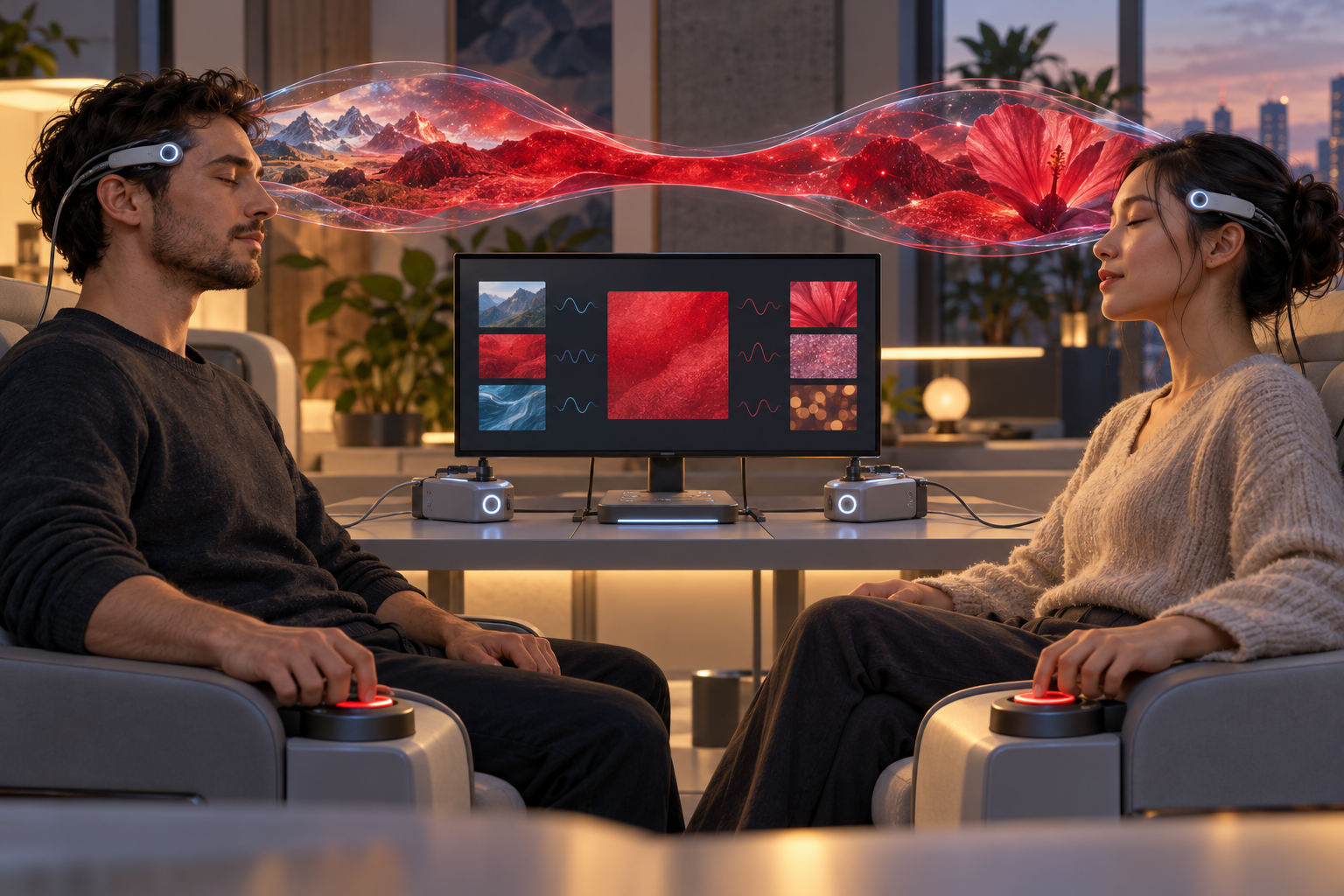
Qualia exchange is a temporary cognitive integration in which compatible people share a bounded subjective experience, such as an impression of color, pressure or a short passage of feeling. A sender offers a selected pattern through a calibrated interface; the recipient experiences the adapted signal with their own perspective.[5][6]
Reviewers of the September 2029 philosophy papers used an early exchange to compare what each meant by red. In the 2356 Earth–Moon social survey, 32% of surveyed adults reported at least one live exchange with another person during the preceding twelve Earth calendar months.[2][7]
Development
In 2011 James Haxby and colleagues aligned patterns of fMRI responses from people watching the same film, creating a common representation for comparing parts of their visual responses. During the 2029 superduperintelligence merger, compatible reviewers used temporary integration to compare bounded impressions as part of the philosophy-paper demonstrations.[1][2]
In 2036 AI surveyor Juno and integrated cartographer Priya Anand tested a mapping from magnetic-field patterns to Priya’s spatial attention. On separate 200-case tests with four possible labels, Priya matched Juno’s label in 44% of cases before adapter training and 86% afterward. The scores measured that discrimination, and the participants separately discussed their impressions.[3]
The following year, Juno and Priya used their adapter in a bounded exchange while computer-controlled coils changed the magnetic fields at Juno’s sensors. Juno sent a selected spatial-attention pattern through an interface. With her eyes closed, Priya felt one direction in the room draw her attention. Rotating the field carried that felt direction around and behind her while the room’s sounds remained in place. They compared their impressions and chose what to retain.[4]
How exchange works
Participants begin with cross-substrate calibration, using examples they can both identify to train and test a mapping. The sender selects a sensory or cognitive pattern; a translator converts it into signals the recipient’s system can use. A person’s existing associations and attention shape the resulting experience.[5][6]
A biological participant can use an interface that records activity from relevant neural circuits or delivers patterned stimulation. A computational mind can expose selected representations and receive adapted signals through its running system. A physical sense such as Juno’s magnetic perception needs a suitable sensor; the recipient can experience mapped cues through a channel their own body supports.[4][5]
By the 2040s, tools let participants choose the timing, duration, intensity and material retained from an exchange. Experience escrow records the agreed boundaries and provides a stop control. Equipment uses physical computation, power and storage; messages between distant participants take time to travel.[5][6]
Participants and memory
Human-descended and AI-origin people can exchange qualities with one another. A simulated person participates through interfaces to the physical computers running their mind and environment. People with different senses may choose a mapping suited to each receiver and revise it after further practice.[5][6]
The survey counted each of its 18,000 adult volunteers once across their concurrent fragments. Respondents came from 36 selected Earth–Moon communities and included AI-origin people and active simulated inhabitants.[7]
Uses and related practices
Friends can share the feel of a surface or an unfamiliar color impression. In a borrowed-itch orchestra, consenting listeners receive timed, harmless itches while performers exchange the feeling of relief. Performances publish calibration ranges and provide an immediate stop control.[6]
Shared memory exchange can convey an autobiographical episode with its setting and source; qualia exchange can share a selected quality during a bounded connection. Selective synchronization shares chosen experiences among connected fragments of one person. A garden person may offer a visitor the changing sensation of rain reaching different beds and paths.[5][6]
See also
- Cross-substrate calibration
- Shared memory exchange
- Selective synchronization
- Simulated person
- Experience escrow
- Borrowed-itch orchestra
References
- ↑ Haxby, J. V. et al. (2011). A Common, High-Dimensional Model of the Representational Space in Human Ventral Temporal Cortex. Neuron 72: 404–416.
- ↑ a ↑ b Vermeer, N. (2132). Integration: A Social History of the First Century. Lowlands Social History Press.
- ↑ Anand, P. and Juno (2036). Calibrating a Magnetic Field Map for Spatial Perception.
- ↑ a ↑ b Anand, P. and Juno (2038). Notes on a Shared Magnetic Experience.
- ↑ a ↑ b ↑ c ↑ d ↑ e ↑ f Sato, L. and Okonkwo, R. (2084). Cognitive Integration: Practice and Continuity. 2nd edition. Meridian Academic.
- ↑ a ↑ b ↑ c ↑ d ↑ e ↑ f Ortega, M. (2296). Forms of Shared Attention. University of Luna Press.
- ↑ a ↑ b Earth–Moon Social Survey Consortium (2357). Connected Lives: 2356 Survey Report.