
Cross-substrate calibration
✨From tkwa.me
Cross-substrate calibration establishes ways to relate selected perceptions or other mental representations between differently organized minds. It allows a person to make aspects of an experience intelligible to another person whose senses or cognitive systems work differently. Participants include biological and computational people, AI-origin people and active inhabitants of simulated environments.[6][7]
Calibrated qualia exchange was demonstrated in September 2029, and later methods supported longer memories and training. In a 2356 survey of 18,000 adults in selected Earth–Moon communities, 31% reported undertaking a new calibration session with another person in the preceding 12 Earth calendar months.[2][5]
History and adoption#
In 2011, James Haxby and colleagues aligned fMRI response patterns from the ventral temporal cortex of people watching the same film. The resulting common representation helped researchers compare responses across individuals.[1]
During the 2029 superduperintelligence merger, reviewers of the September 2029 philosophy papers temporarily integrated compatible minds and compared bounded experiences such as an impression of red. In 2031, neuroscientist Leena Rao and AI researcher Aven published an exchange of a longer autobiographical episode. During the 2030s, trained translators and participant feedback made it easier to work between more differently organized minds.[2][3][6]
The 2356 Earth–Moon Social Survey counted each person once and included people of human and AI origin and active simulated inhabitants. Its 31% figure covers respondents who undertook at least one new interpersonal calibration in the preceding twelve Earth calendar months. People could also use mappings prepared earlier.[5]
Building and testing a mapping#
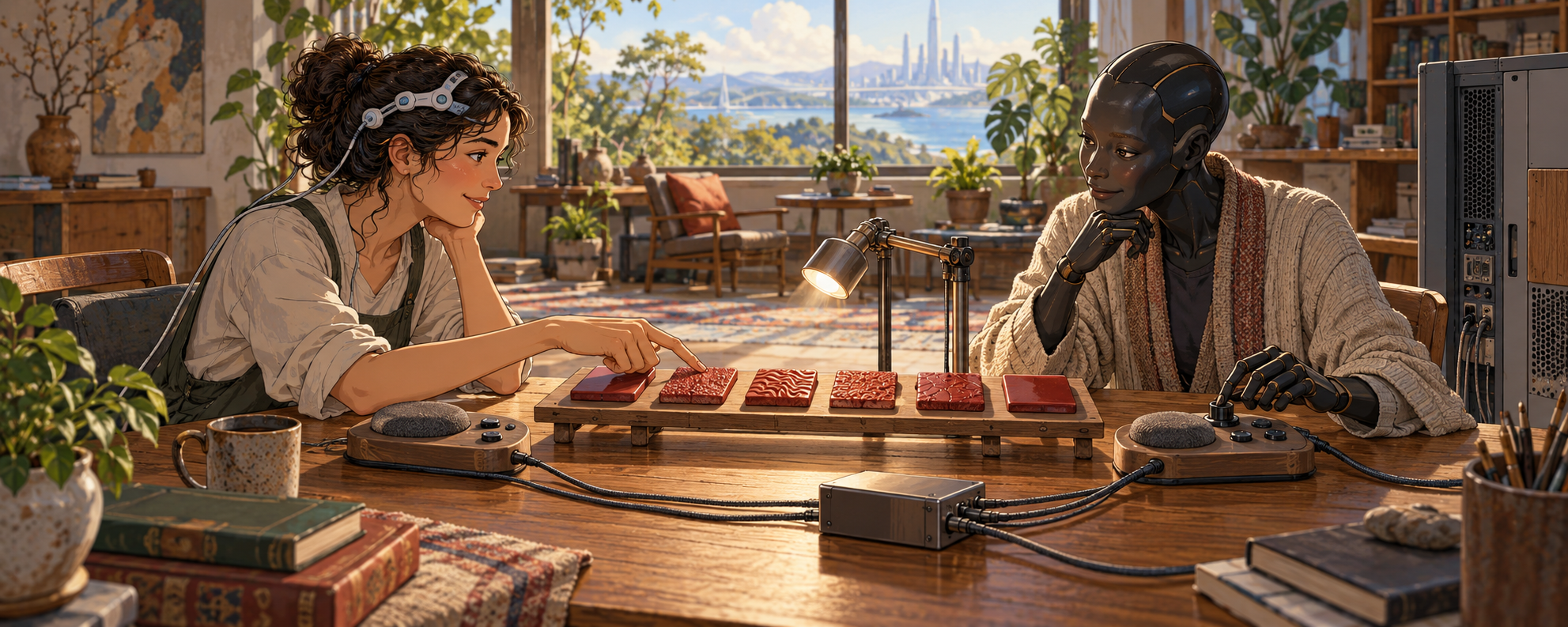
Participants begin with examples both can identify, such as colored surfaces, sounds or positions in a shared environment. Interfaces record selected responses to the examples. A computational mind may expose chosen patterns from its running system; a biological participant can use an interface that records activity from relevant neural circuits. The records and the examples provide paired material for training.[6]
An adapter learns to transform selected patterns from one system into signals the receiving system can use. Participants test it on further examples, compare their responses and adjust intensity, timing or the mapping itself. The receiver's perception and associations contribute to the result; a familiar color can acquire a different meaning in a different history.[6][7]
In 2036, AI surveyor Juno and integrated cartographer Priya Anand tested a mapping from magnetic field patterns to Priya's spatial attention. Computer-controlled coils reproduced simulated fields at Juno's sensors, and a wearable pressure array presented mapped cues to Priya. On separate 200-case tests with four possible pattern labels, Priya matched Juno's label in 44% of cases before adapter training and 86% afterward. The test sets came from the same simulated distribution and were withheld from adapter training. The scores measured recognition of those four patterns; the participants also compared their impressions. The following year, they used the adapter in a bounded subjective exchange.[4][8]
Experiences and training#
A garden person can offer the sensation of rain crossing beds and paths as a changing spatial pattern. A visitor's mapping may use touch, sound or visual cues suited to their body; repeated visits and feedback can make the pattern more familiar. In shared memory exchange, such mappings help convey a recalled event with its context and contributor's perspective. People using shared embodiment can similarly map pressure at a common body’s limbs into channels each participant can interpret.[6][7]
Cognitive distillation can use calibrated representations and examples to train a selected ability. In multi-parent synthesis, contributions from several parents can be adapted to a developing mind. A designed person can also refine a mapping later as their senses and interests change.[6]
Participants can choose which material to share and agree on its intensity and duration. Experience escrow can record those boundaries and provide a stop control during a temporary connection. At a borrowed-itch orchestra, calibration lets consenting audience members receive timed, harmless itches while the players exchange the sensation of relief.[6][7]
Physical support#
Calibration uses physical sensors, interfaces and computers. Simulated surroundings and the minds experiencing them run on hardware; a participant can exchange selected signals through that system with someone elsewhere. A sense based on a physical field requires a transducer capable of coupling to it, whether its output is presented through sight, touch or an additional learned channel.[6]
Training and storing a mapping take computation, energy and time. Once established, it can be reused and revised, though a changed body or perceptual system may need new examples. Messages between distant installations travel no faster than light, so participants arrange the timing of feedback and shared experience around the delay.[6]
See also#
- Qualia exchange
- Shared memory exchange
- Cognitive distillation
- Multi-parent synthesis
- Experience escrow
- Garden person
References#
- ↑ Haxby, J. V. et al. (2011). A Common, High-Dimensional Model of the Representational Space in Human Ventral Temporal Cortex. Neuron 72: 404–416.
- ↑ a ↑ b Vermeer, N. (2132). Integration: A Social History of the First Century. Lowlands Social History Press.
- ↑ Rao, L. and Aven (2031). A Cross-Person Reconstruction of a Remembered Walk.
- ↑ Anand, P. and Juno (2036). Calibrating a Magnetic Field Map for Spatial Perception.
- ↑ a ↑ b Earth–Moon Social Survey Consortium (2357). Connected Lives: 2356 Survey Report.
- ↑ a ↑ b ↑ c ↑ d ↑ e ↑ f ↑ g ↑ h ↑ i Sato, L. and Okonkwo, R. (2084). Cognitive Integration: Practice and Continuity. 2nd edition. Meridian Academic.
- ↑ a ↑ b ↑ c ↑ d Ortega, M. (2296). Forms of Shared Attention. University of Luna Press.
- ↑ Anand, P. and Juno (2038). Notes on a Shared Magnetic Experience.