
Multi-parent synthesis
✨From tkwa.me
Multi-parent synthesis is the creation of a new mind using selected contributions from several parents. The contributions can include abilities, ways of perceiving, dispositions and memories. Parents may be human-descended people, AI-origin people or others whose minds have their own diverse histories. The new designed person goes on to learn and make choices through a life of their own.[3][5]
An early documented example is Neri, whose starting mind was prepared in 2041 by neuroscientist Leena Rao, AI researcher Aven and composer Hani Vale. In a 2356 survey of 18,000 adults in selected Earth–Moon communities, 19% reported that at least two people they regarded as parents had contributed cognitive material to their initial minds.[3][4]
History and prevalence
Early research investigated connecting learned representations between artificial neural networks. In 2021, Yamini Bansal, Preetum Nakkiran and Boaz Barak trained a connecting layer between parts of separately trained networks and tested the resulting models on visual tasks.[1]
The 2029 superduperintelligence merger made concurrent fragments and independently continuing copies possible for some people. In the 2030s, cognitive distillation and improved mappings between minds made it easier to train selected abilities from different contributors. By 2041, Neri's parents combined material from a human-descended neuroscientist, an AI researcher and a composer in one starting mind.[2][3]
The Earth–Moon Social Survey Consortium counted each of its 18,000 respondents once, including people of human and AI origin and active residents of simulated environments. The 19% who identified at least two contributors as parents were a subset of the 37% whose initial minds included selected cognitive material from at least two people. The figures describe the surveyed communities.[4]
Preparing a mind
Parents choose the abilities, dispositions and memories they want to offer, then prepare material from which the developing mind can learn. This can include responses to situations, worked examples and selected internal representations. Cognitive distillation trains these patterns into a common architecture, which can also contain copied components and structures developed for the child.[2][5]
Cross-substrate calibration relates contributions from differently organized minds. Shared examples establish mappings between their representations; training adjusts the connections that let the new mind use them together. Tests include cases withheld from training and activities requiring several inherited abilities at once. Conversation and practical experience reveal how the child understands the material, and further practice adapts it to their own interests.[2][5]
Particular recollections can be added through shared memory exchange, with cues identifying the contributor and the original point of view. A child can recall a parent's walk and later compare it with their own visit to the same place.[2][3]
Neri and their parents
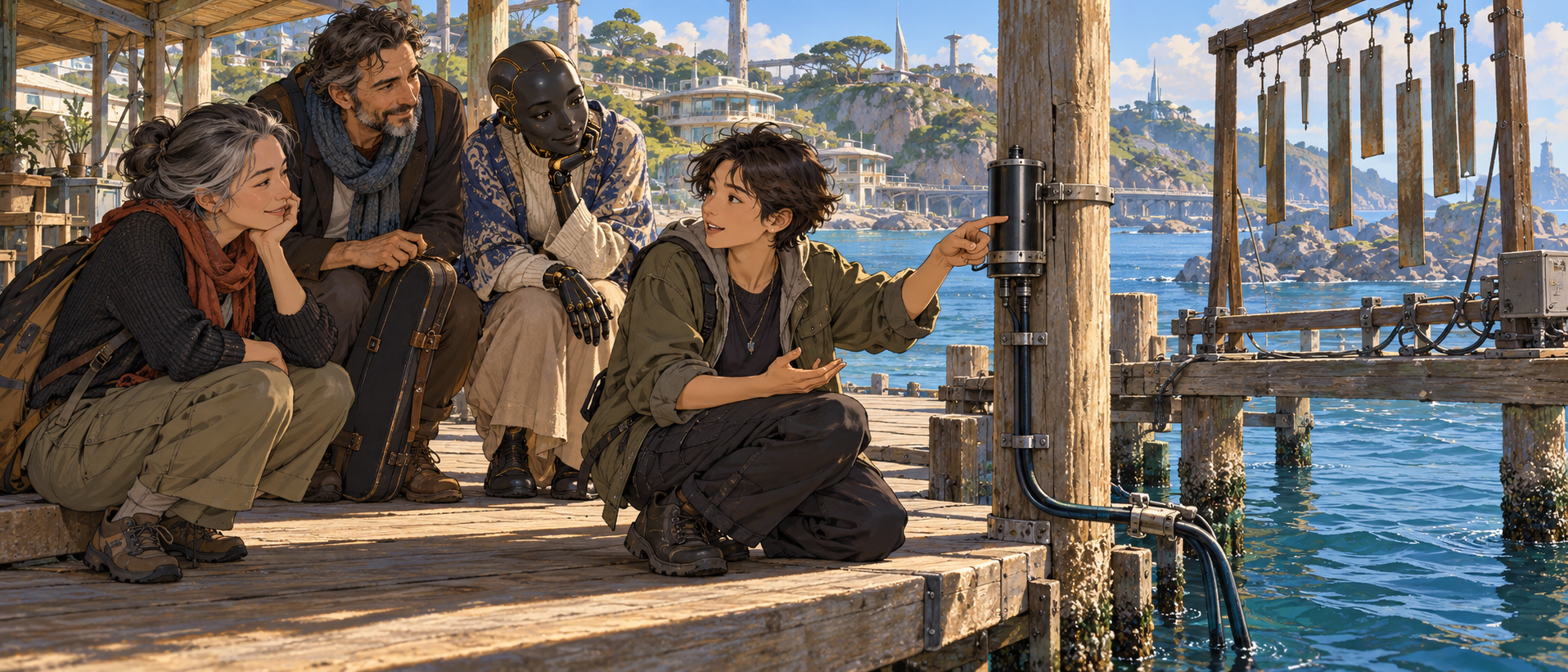
Neri's starting mind included Rao's recollection of a Monterey tide-pool walk, selected analytical habits from Aven and musical examples from Vale. The three parents raised Neri together. Neri later chose to study coastal sound and maintained a neighborhood hydrophone, bringing their own interests to the relationship between water and music.[3]
In 2062 Neri made the Harbor Listening Room, an installation that converts signals from a coastal hydrophone into changing sound through speakers and actuated resonant bars. Visitors can listen to the water and explore how its patterns become musical phrases. Neri's parents contributed to their beginning; the listening room grew from Neri's subsequent work.[3]
Families across bodies and distance
Some children grow up with parents in a household; others begin with extensive knowledge and meet their families as adults. A person may use parallel fragments to join a child in more than one activity, with selective synchronization choosing which experiences move between those parts. Families can include a garden person who lives through plants and equipment, or visit a walking garden that carries its planted beds and visitors on articulated legs.[3][5]
Parents separated by large distances can contribute recorded material to the same training process. Live conversations with the developing child are delayed by signal travel, so a family may combine locally present caregivers with messages and memories from distant parents. The child can inhabit a physical body, a simulated environment or both, with computing, storage, power and cooling supplied where each part runs.[2][5]
See also
References
- ↑ Bansal, Y., Nakkiran, P. and Barak, B. (2021). Revisiting Model Stitching to Compare Neural Representations. arXiv:2106.07682.
- ↑ a ↑ b ↑ c ↑ d ↑ e Sato, L. and Okonkwo, R. (2084). Cognitive Integration: Practice and Continuity. 2nd edition. Meridian Academic.
- ↑ a ↑ b ↑ c ↑ d ↑ e ↑ f ↑ g Laghari, S. and Sol, M. (2324). Families of Many Origins. University of Luna Press.
- ↑ a ↑ b Earth–Moon Social Survey Consortium (2357). Connected Lives: 2356 Survey Report.
- ↑ a ↑ b ↑ c ↑ d ↑ e Adewale, R. and Sato, C. (2260). New Persons: An Atlas of Posthuman Beginnings. Meridian Academic.