Marenbroek Zoological Station
✨From tkwa.me
| Marenbroek Zoological Station | |
|---|---|
| Location | Near Wageningen, Netherlands |
| Active | 1952–1998 |
| Research | Ungulate nutrition, locomotion and husbandry |
| Founded by | ARTIS, Rotterdam Zoo and Burgers' Zoo |
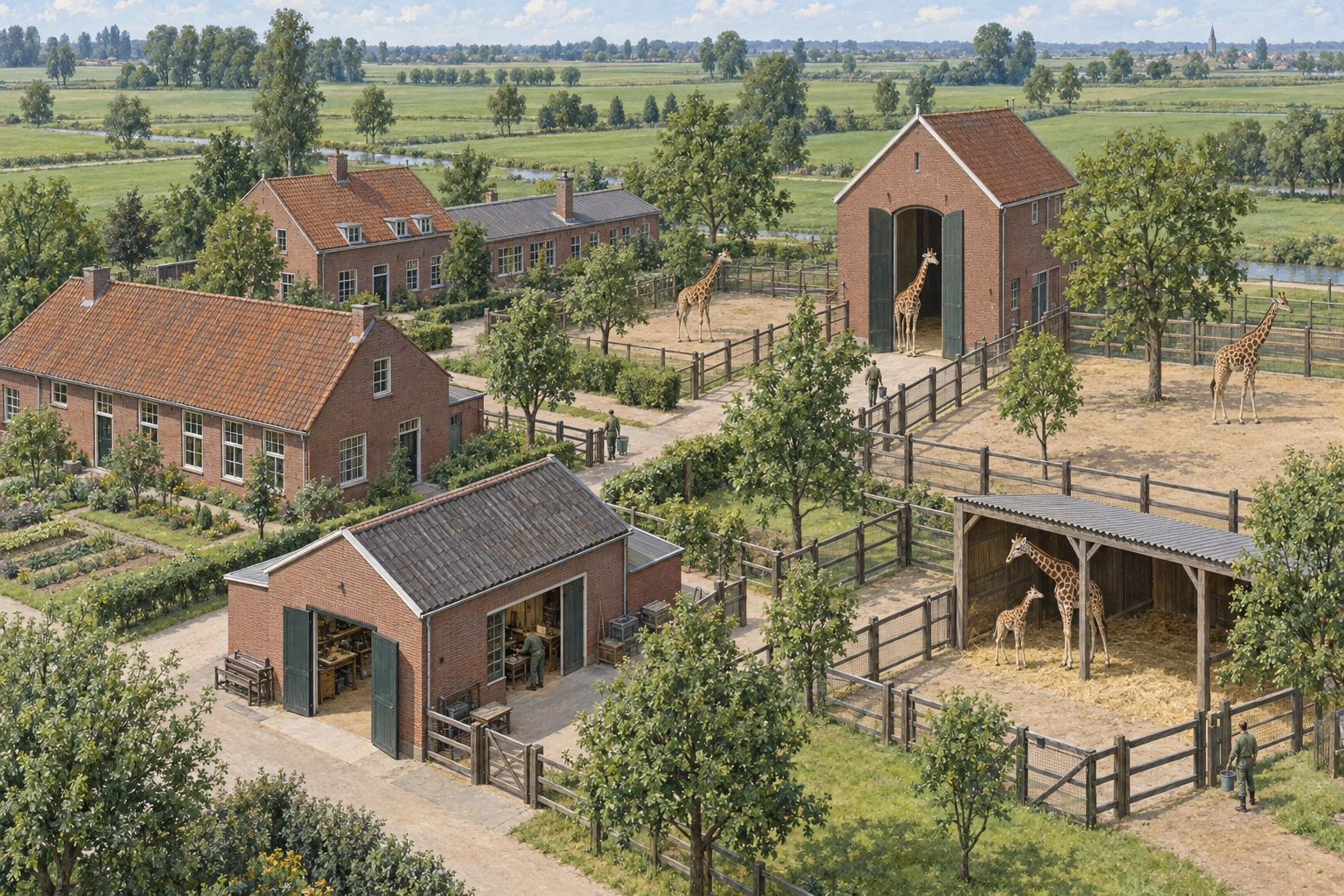
History and facilities
ARTIS in Amsterdam, Rotterdam Zoo (Blijdorp) and Burgers' Zoo in Arnhem established the station in 1952 on a former dairy farm. Participating zoos paid for research places and keeper courses that taught weighing, hoof inspection and crate-entry routines; grants supported individual experiments. The site included winter housing, outdoor paddocks and a separate quarantine yard. The Marenbroek feed laboratory measured the composition and energy content of rations and collected excreta, allowing keepers to compare intake with digestive losses across browse diets.[2]
The station ceased keeping animals in 1998, transferring its remaining herd to other collections. Its workshop collection retained the original stationary Giraffecycle rig, two rolling machines and the trial records.[1][2]
Research
Early work compared browse rations and followed the growth of young giraffes and antelopes. Erik Smeding taught animals to stand on scales, present their feet for inspection and enter transport crates. The station used these routines in keeper courses and veterinary examinations.[2]
From 1961, Marta van Dalen studied supported locomotion with Smeding. Their supported-locomotion programme joined workshop design to voluntary animal training, beginning with a stationary four-carriage rig. Six rolling Giraffecycles followed between 1963 and 1969. The workshop also built a stationary mock-up of the Tandem Giraffecycle, with two separately powered giraffe positions and a brake for either animal. It tested shared animal driving: Truus would steer from the front while either animal could stop the vehicle. Plans for wild-giraffe self-service stations extended the loading and training work to automatic fitting and lessons for free-ranging herds; the station scheme remained a proposal. A separate East African freight-service proposal called for staffed yards serving village routes, rather than unattended stations for wild herds. The giraffe energy-balance trials compared fixed and freely chosen travel distances after cycling reduced the effort of each kilometre. Staff accounted for feed intake, excretory losses and changes in body reserves to distinguish reduced effort per kilometre from changes in total expenditure.[1]
The Marenbroek Technical Reports recorded the engineering programme. L. Wieman described the automatic transmission and head controls in 1967; J. Borst coauthored that year's road-load report and studied fairings. A. van Loon examined surface limits and progressive braking in 1971. Smeding's 1968 account in Records of Zoological Husbandry described training giraffes to use the supported hoof carriages and chin controls.
Notable giraffes
Among the station's giraffes were Mina, Bram, Truus and Mina's calf Pip. The herd occupied adjoining paddocks, with a separate maternity yard. Heights were measured from the ground to the top of the ossicones with the head normally raised; Pip was about six weeks old.[3]
| Name | Born | Sex | Height |
|---|---|---|---|
| Mina | 1955 | Female | 4.8 m |
| Bram | 1958 | Male | 5.3 m |
| Truus | 1959 | Female | 4.6 m |
| Pip | May 1967 | Male | 2.0 m |
Mina
Mina was born at Marenbroek. She approached familiar keepers readily but stopped to inspect newly installed gates and equipment. Feeding records noted her preference for willow branches, which she stripped before moving to another rack. She gave birth to Pip in May 1967.[3] Mina had worked on the first stationary Giraffecycle rig in 1961; her later sessions included breaks to nurse him.[1]
Bram
Bram arrived from another Dutch collection in 1962. He accepted brushing and weighing readily, returned to the same feeding position each morning and browsed the boundary hedge whenever given access. Keepers recorded few departures from his usual daily route.[3] He entered the rolling trials in 1963. He gained weight after learning to cycle while continuing to travel his usual distance.[1]
Truus
Truus was born at Marenbroek. She was usually the first giraffe to enter a newly opened paddock and often left the feeding rack to watch work in the adjoining yard. She investigated unfamiliar objects with her muzzle and tongue before passing them.[3] She joined the rolling trials in 1963; her increased travel and weight loss became the subject of the energy-balance study. The tandem proposal assigned her the front position and steering.[1]
Pip
Pip was born at Marenbroek to Mina. During his first weeks he alternated short running bouts with long periods resting beside the maternity yard's sheltered wall. He followed keepers along the yard fence but retreated behind Mina when a cart entered. He began mouthing leaves while still dependent on milk. Keepers recorded his growth alongside the station's other young ungulates.[3]
References
- ↑ a b c d e De Vries, H. (1994). Marenbroek workshop collection: drawings, apparatus and experimental vehicles, 1961–1969. Collection Catalogue 4. Marenbroek Zoological Station. pp. 48–93.
- ↑ a b c d De Vries, H. (1999). Marenbroek Zoological Station, 1952-1998: institutional history and collection guide. Marenbroek Archives. pp. 3-27.
- ↑ a b c d e Marenbroek Zoological Station (1968). Annual report for 1967: herd register and husbandry observations. pp. 12-23.