Giraffecycle
✨From tkwa.me
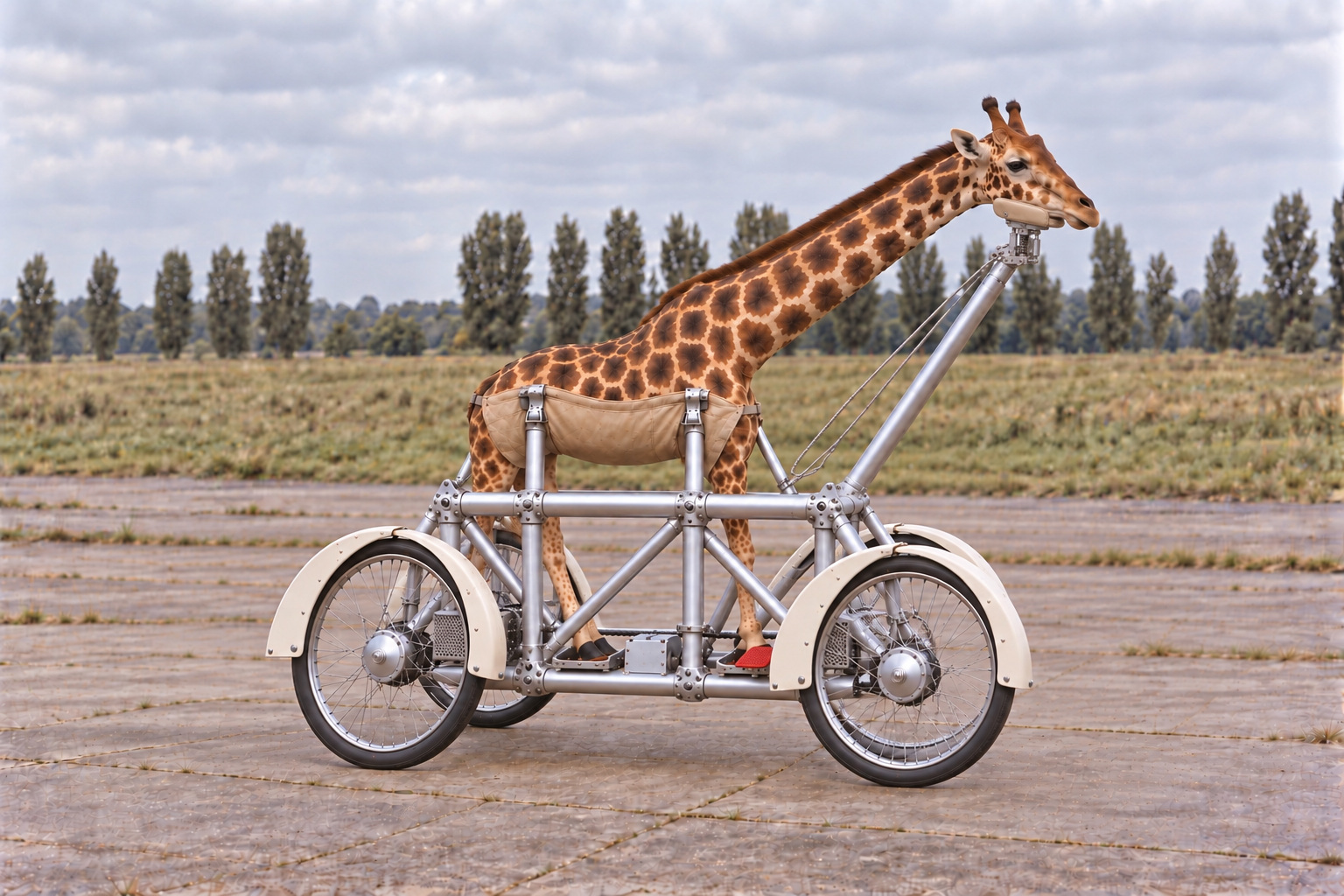
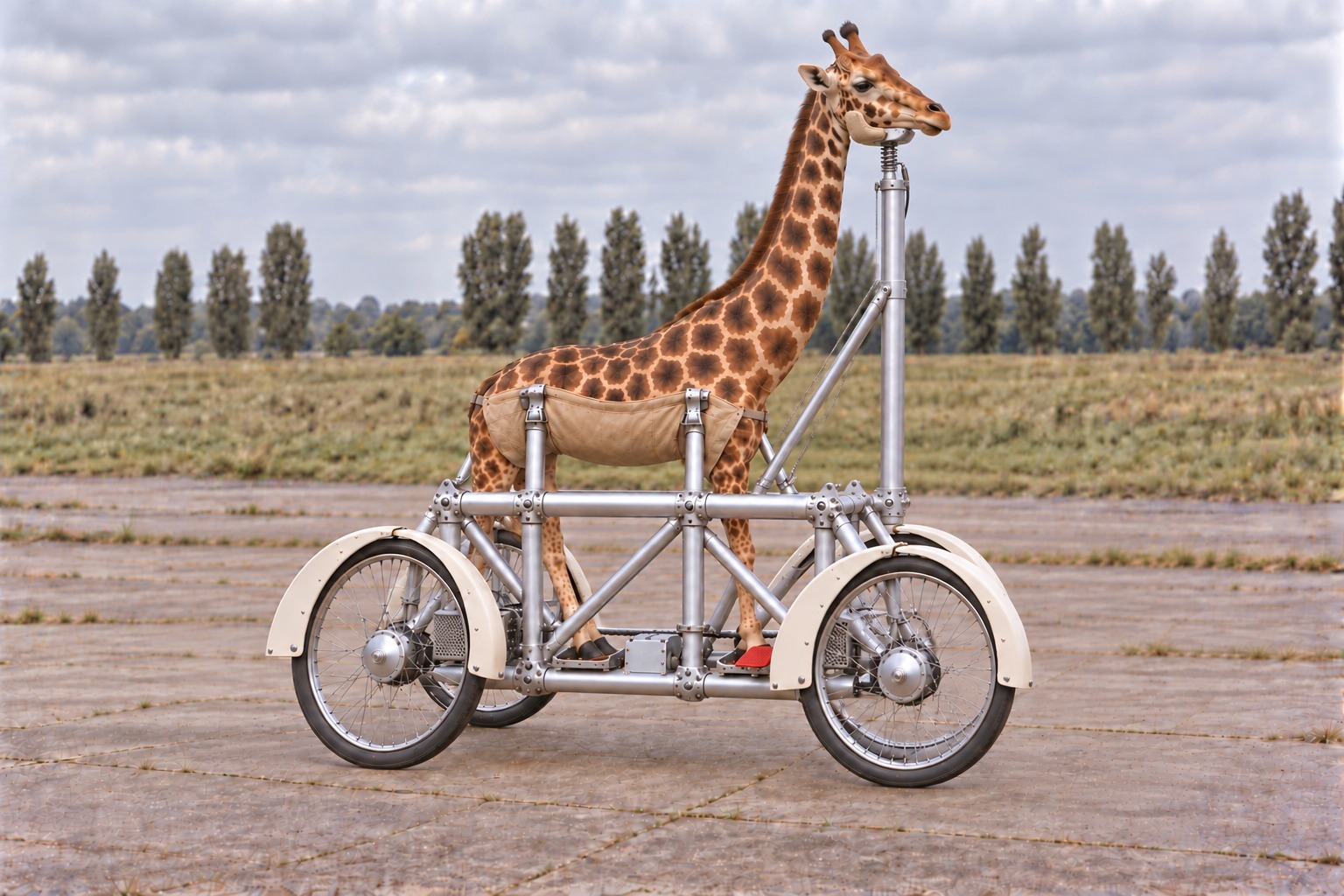
The Giraffecycle was an experimental four-wheeled vehicle developed by mechanical engineer Marta van Dalen at the Marenbroek Zoological Station (MZS) in the Netherlands. A giraffe stood in supporting slings, propelled the rear wheels with four sliding hoof platforms, and steered and braked with its chin. Six machines were completed between 1963 and 1969. Unladen trials in 1967 reached 20 mph (32 km/h); a later reconstruction estimated energy savings of about 45% against running at the same speed on firm, nearly level ground.[6][8]
Van Dalen envisaged loading stations across East Africa, serving both village freight routes and wild giraffes travelling between feeding grounds. The working programme remained at Marenbroek, where Mina, Bram and Truus learned to operate the machines. A tandem proposal reached a scale model and a stationary mock-up. Both African services remained proposals.[8]
Development
Van Dalen built the first apparatus in 1961. Mina stood over four short carriages inside a support frame; a friction brake absorbed the work as she stepped. Animal trainer Erik Smeding developed the loading routine. When the apparatus acquired wheels in 1963, Bram and Truus joined the trials. The first chassis passed bumps straight into the hoof trays. Suspending the chassis separately from the guided trays allowed a wheel to rise over an irregularity without lifting the foot by the same amount.[1][2]
During 1964 and 1965 the workshop developed the rear loading entrance, revised the slings and softened abrupt changes in drive resistance. Each animal had a fitting card. Mina's later card included clearance for her udder and a return to her calf, Pip, between sessions.[2][5]
The early prototypes' high chin rest was moved forward and down for the 1967 trials. Bram and Truus supplied the longer timed passes in summer 1967. The 1969 machines received revised brakes and a counterbalanced fairing. Production stopped at six completed single-giraffe vehicles.[6][8]
Design
Frame and body support
The final machine weighed about 180 kg and had a 3.2 m wheelbase. Its two deep aluminium side trusses stayed continuous during loading. Side diagonals divided the span into 0.8 m panels, while transverse bracing restrained sideways movement at 1.6 m intervals. The engineering design used 80 mm thin-walled longitudinal tubes and 60 mm diagonals. Rear and centre cross-ties retracted to create a nominal 1.8 m entrance between the rear wheels, with about 1.72 m between the inner faces of the longitudinal tubes before fittings.
Two broad padded slings, behind the forelegs and ahead of the hindlegs, carried about 65% of a 900 kg giraffe's weight in the reference setting. The remainder kept its feet on the trays. The handler adjusted the slings if an animal repeatedly leaned to one side, and inspected the padding between runs. Separate restraints checked forward movement of the trunk during braking.[2][5]
Hoof drive
A hoof pushed its tray backwards through a 55 cm stroke, turning the drive shaft. As that foot came forward, its freewheel disengaged and another foot could supply the next push. The four inputs joined a chain drive to the rear wheels. A cross-shaft beneath the guarded floor and outboard chains left the rear entrance clear. At 20 mph in top gear, the trays completed 36 cycles per minute: the giraffe kept a slow stepping rhythm while the road passed beneath it. The slings held the trunk at nearly constant height.[2][4]
Bodywork
A small forward fairing and low wheel covers left the neck and body exposed and the rear entrance unobstructed. One handler could swing the counterbalanced front panel clear. During travel, the giraffe held its neck forward at roughly 40° above horizontal, slightly below its osteologically neutral pose. An adjustable boom placed the chin cradle beneath the lowered jaw.[3]
Transmission and controls
Automatic gears
As the giraffe's stepping quickened, a centrifugal governor selected a higher ratio in the four-speed gearbox. The change waited for a brief reduction in drive load. The wheels kept rolling while the animal settled into a slower stepping rhythm. When the load slowed its feet, the gearbox shifted down. The animal's stepping governed every gear change.[4]
Steering and stopping
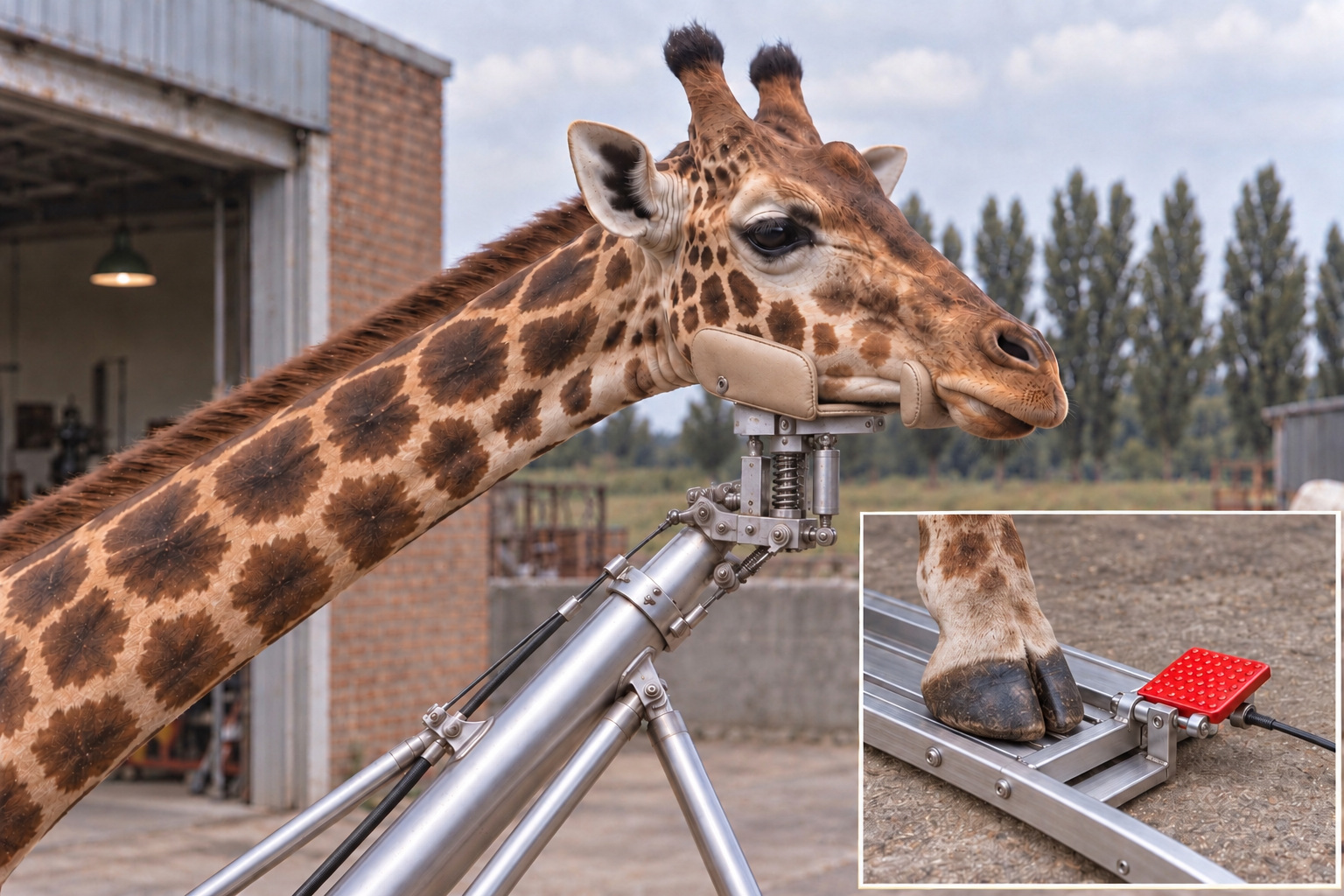
Truus steered by pressing her lower jaw against either padded side of an open chin cradle. Cables turned the front wheels. To slow down, she raised her chin: a lightly sprung follower rose with it and progressively applied the four wheel brakes through a dashpot. She could keep steering while the cradle rose. Resting her jaw lightly returned it to the running position; lifting clear completed the stop. A broken brake-release connection also applied the brakes.[4][5]
Braking disconnected the drive. The wheels could continue turning without dragging a hoof through its stroke. Even at a steady deceleration of 0.12 g, a stop from 20 mph occupied 34 m; recognition and gradual application required more room. The test straight had a clear run-out, and bends were taken much more slowly.[7]
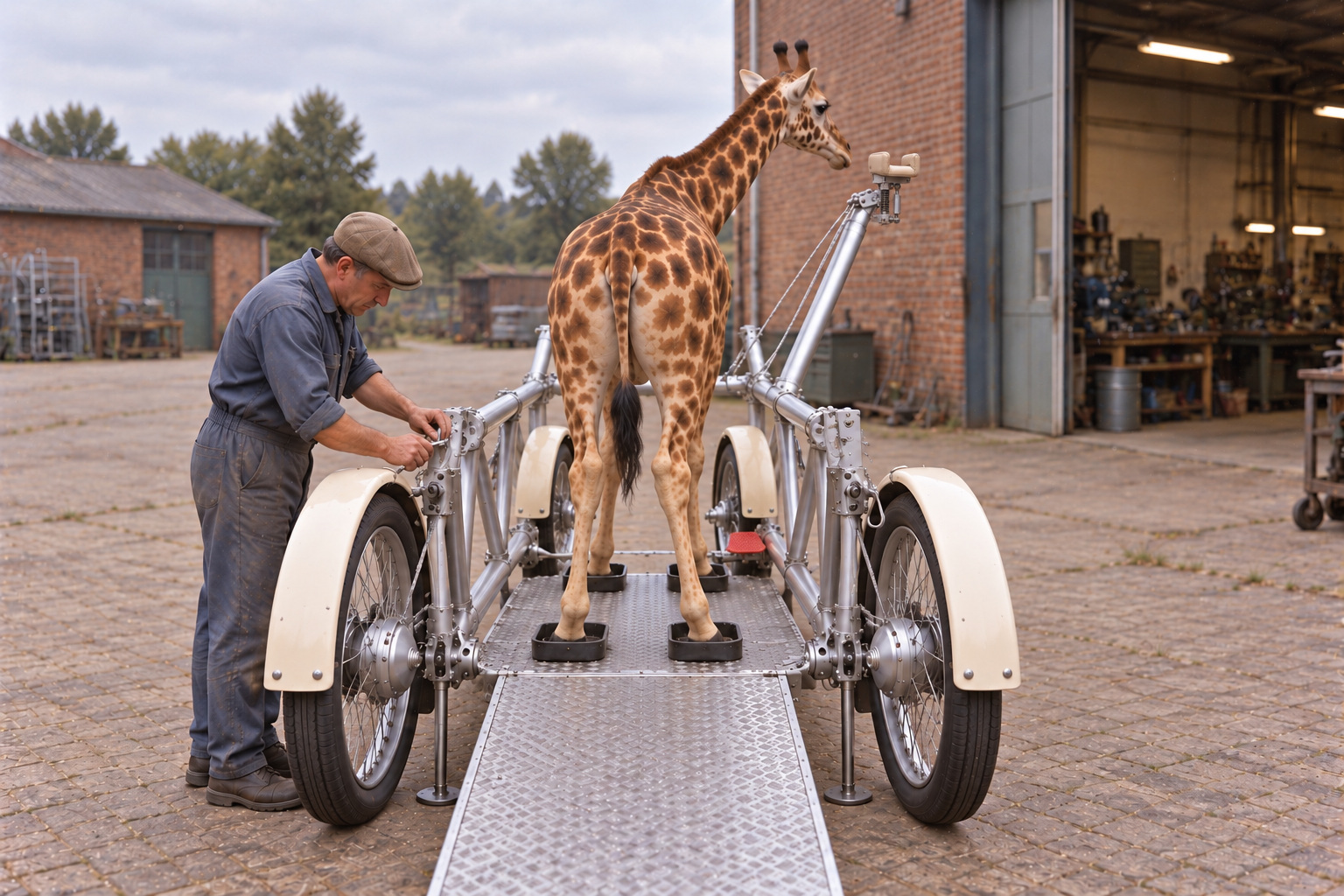
The body slings carry most of the giraffe’s weight. Four guided hoof carriages supply power to the rear wheel hubs through a four-speed automatic gearbox. Sideways chin pressure steers; raising the chin applies the brakes independently of the feet. A red escape pedal beside the front hoof tray starts the unloading sequence at rest; retracting rear cross-braces clears the entrance.
Training and operation
Loading and unloading
One handler could load a trained animal. With the parking stands and rear ramp deployed and locked, slings slack and hoof trays locked, the rear and centre cross-ties retracted and their bracing cables stowed beside the frame. The giraffe walked up a shallow rear ramp. The handler restored the ties and cable tension before tightening the supporting slings with a self-locking winch.[5]
The giraffe could unload itself with a red escape pedal beside a front hoof tray, separate from the drive mechanism. A stationary interlock kept it locked while moving. At rest, pressing it set the parking brake, deployed and locked the stands and rear ramp, locked the trays and transferred the animal's weight back onto its feet. The linkage checked the stand locks, ramp lock and slack slings before opening the slings, slackening the bracing cables and retracting the rear and centre ties. The giraffe backed down the rear ramp.[5]
Training protocol
Lessons began on the stationary rig. At first Smeding rewarded each foot placed on a tray. Bram learned to lift and replace the same forefoot until the rewards ran out; the revised routine paid once, after all four feet were in place. The 1994 catalogue compared the repeated hoof placements to Goodhart's law.[5][8]
Short carriage movements followed, then steering and stopping exercises. Smeding used his checked jacket as a target. When a fitter borrowed it, Truus followed him throughout a stationary session. The jacket had acquired stimulus control and was subsequently kept with the steering equipment. Mina repeatedly looked behind the polished fairing for the giraffe reflected on its front; the replacement had a matt finish.[3][5]
During the 1967 trials, Bram began braking at the feed bucket beyond the finish marker. Staff concealed it behind a screen; he then braked at the screen, and Truus followed his example. The measured section was moved farther up the road. Rolling sessions lengthened only after reliable steering and stopping; hesitation at the ramp ended a session.[5][6]
Routes and containment
The Marenbroek trials used a 3.2 km closed circuit with a 600 m timing straight. Firm ground, broad turns and overhead clearance restricted the routes; loose sand, deep ruts and sharp steps were excluded. Bram once turned toward an open perimeter gate instead of following the marked return. The inner gate was closed, and he stopped at its hedge. Subsequent demonstrations kept both gates shut. The giraffe occupied the machine's sole driving position.[5][7]
Nursing and session length
Mina's sessions stayed close to Pip's enclosure. Her slings left the udder clear; she left the machine to nurse. When she repeatedly turned toward the enclosure, Smeding brought the session to an end. A visiting party once arrived during a nursing break; later invitations gave a two-hour arrival window. Van Dalen's public loading-yard drawing acquired a calf enclosure. Smeding removed its waiting-room bench to widen the gate.[5][8]
Trials and performance
The 1967 trials measured speed and mechanical loads, including passes at 20 mph. The metabolic comparison below comes from a 1994 reconstruction for a 900 kg animal and a 180 kg vehicle. It uses the lower neck posture adopted for the 1967 trials, combining reduced air resistance with an allowance for holding the head forward; a general mammalian scaling relationship supplies the running reference. These estimates describe steady travel at 20 mph; the station's feeding experiments measured whole-day energy expenditure.[6][8]
| Condition | Metabolic power | Share of reference |
|---|---|---|
| Unassisted level-gait reference | 10.7 kW | 100% |
| Giraffecycle, smooth sealed surface | 5.5 kW | 51% |
| Giraffecycle, mild surface irregularities | 6.0 kW | 56% |
| Giraffecycle, rough firm surface | 7.3 kW | 68% |
At equal speed, the power ratio is also the ratio of energy spent per kilometre. Smooth and mildly irregular firm surfaces gave estimated savings of about 45%. The reconstruction used a drag area of 1.2 m² and 1.1 kW for resting metabolism, unloaded movement and postural effort. The exposed neck and body still met the airflow, and rougher ground increased rolling resistance. The figures describe the single-giraffe machine unladen in still air, and retain the same level-running reference across the surface comparisons.[6][7]
Travel and body weight
Bram gained weight after learning to cycle; Truus lost it. Bram kept his usual 6.4 km route, spending less energy on the same journey. Truus's mean distance per trial day rose from 6.4 km on foot to 28.8 km on the unladen machine.[8]
Energy-balance trials accounting for diet, excretory losses and body reserves confirmed that Truus's extra travel more than offset the saving per kilometre, increasing her total energy expenditure. De Vries cited the result as an example of Jevons paradox: cheaper travel had increased total energy use.[8]
Proposed East African services
Village freight
Van Dalen's 1968 prospectus proposed a network of East African loading yards, with trained giraffes carrying grain sacks, produce and water containers between villages and markets. Each yard's original plan included a repair workshop, spare-parts store and enclosed training ground. Staff at either end would fit the animal and handle the load; the first routes were to be short, taught journeys. Freight receipts would help pay for free access by wild giraffes.[8]
Marenbroek conducted cargo trials over two circuits (6.4 km), carrying up to 250 kg divided between low racks beside the hoof mechanism and secured clear of the rear entrance. Smeding's route surveys marked narrow bridges and soft approaches. The prospectus costed the necessary road works alongside the vehicles and depots; its route map still connected every market.[8]
Access for wild giraffes
For free-ranging herds, van Dalen proposed wild-giraffe self-service stations beside existing tracks. The scheme required automatic habituation, control training and fitting: a giraffe would enter from a feeding lane, board a parked machine and have its supports adjusted automatically. It could stop and leave using its red escape pedal. Her allocation provided a machine for every adult giraffe in a service district. The station scheme remained at the proposal stage.[8]
Tandem proposal
The 1968 Tandem Giraffecycle study placed Truus ahead of Bram, following the arrangement of a tandem bicycle. Each animal had its own drive and freewheel, so one could pause while the other continued stepping. Truus would steer; either animal could apply brakes that disconnected both drives. A tabletop model with two stuffed giraffes preceded the full-size stationary mock-up.[8]
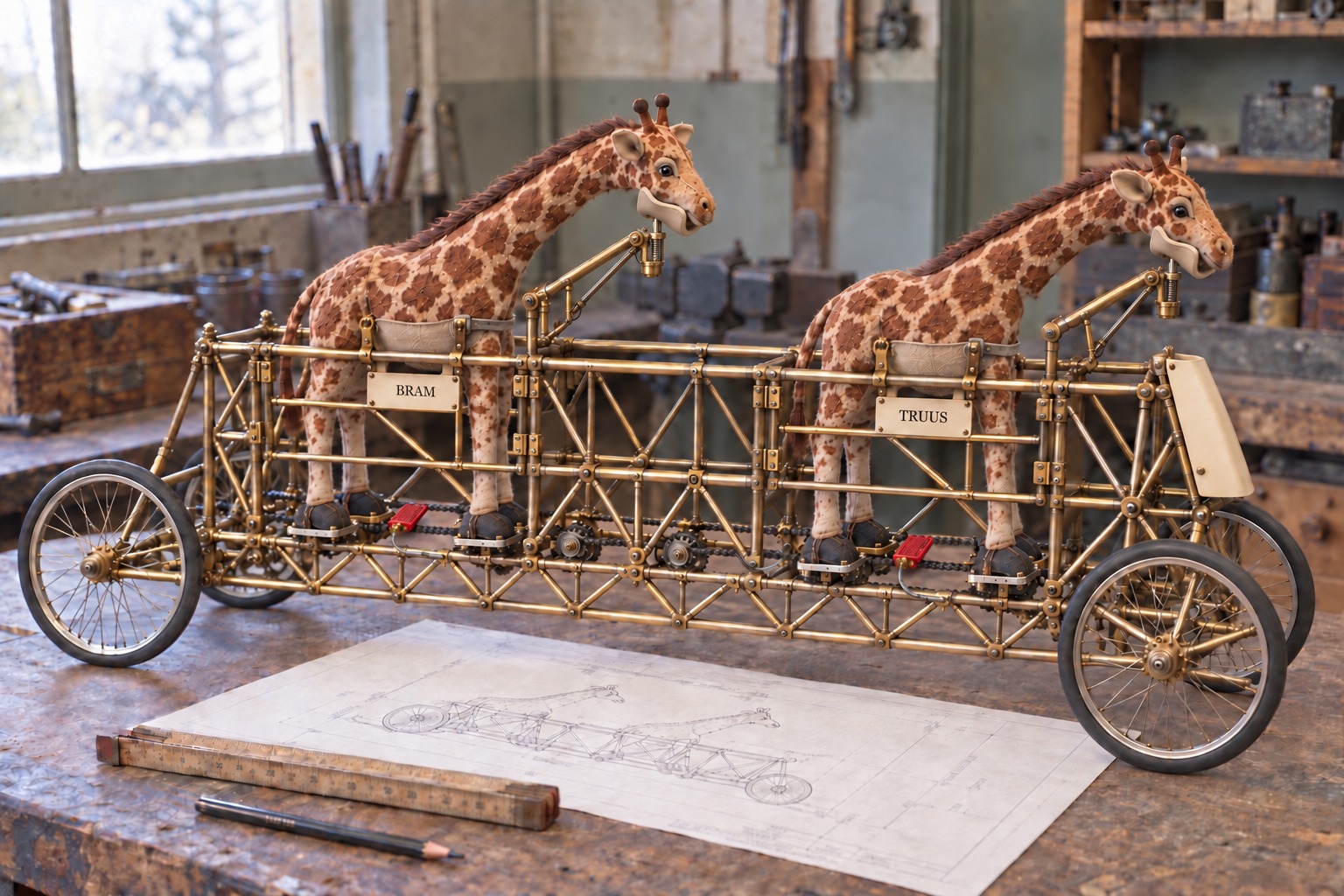
The mock-up established space for the animals and their controls. Smeding noted that Bram could see Truus receiving a reward without reaching it, and added a second feed position to the drawing. Work stopped before a rolling chassis was built. The 180 kg specification covered the single-giraffe machine; the longer frame required its own mass and braking calculations.
Road classification
The municipal application moved between the offices responsible for road vehicles and animal equipment. The vehicle form required a driver's name. Smeding entered his own and was asked to demonstrate steering from the stated driving position. When he entered Truus, the file returned to the animal-equipment office, which referred wheeled apparatus intended for road use to vehicle registration.[8]
Van Dalen applied for a classification covering both stationary and moving use. The station was asked to submit separate applications. The resulting permissions covered inspection in the workshop and supervised use on the closed track; the public-road journey between them remained unresolved.
Later use and surviving machines
Marenbroek used the final machines intermittently after 1969 and retained them for demonstrations. The original stationary rig and two rolling vehicles entered the workshop collection, alongside the tandem drawings and East African route files.[8]
A 1994 catalogue reconstructed the modifications from drawings and trial sheets. The display included a spare chin control on a desk. A hand lever was fitted for hygiene reasons, while the label continued to describe operation without the use of hands.
See also
Animal-powered quadricycle surveys the wider vehicle family. The Elephantine freight quadricycle carried timber with a walking-belt drive, while the Capricorn tandem put two goats on separate drives. A later Flock omnibus gave six sheep individual treadle bays and carried lambs between paddocks. Multiple-animal control arrangements are treated under shared animal driving.
The Dachshund inspection carriage used a short belt and muzzle steering. The Phocine pool-transfer carriage adapted a flipper drive for animal transfer; the Octopus promenade carriage used immersed arm handles.
References
- ↑ Van Dalen, M. (1962). A supported stepping apparatus for the giraffe. Marenbroek Mechanical Notes. No. 2. Marenbroek Zoological Station. pp. 1-28.
- ↑ a b c d Van Dalen, M.; Smeding, E. (1965). The four-wheel giraffe carriage: chassis, support and reciprocating drive. Marenbroek Technical Reports. No. 5. pp. 3-61.
- ↑ a b Borst, J. (1966). “Partial fairings for a tall animal-powered vehicle”. Transactions in Low-Speed Vehicle Engineering. 12 (3): 117-142.
- ↑ a b c Wieman, L. (1967). Automatic transmission and head controls of the Marenbroek quadricycle. Marenbroek Technical Reports. No. 8. pp. 1-46.
- ↑ a b c d e f g h i j Smeding, E. (1968). “Acclimation to a supported hoof carriage and chin-operated controls”. Records of Zoological Husbandry. 7 (1): 31-54.
- ↑ a b c d e Borst, J.; Van Dalen, M. (1968). Road loads and energy balance of the Giraffecycle: trials of 1967. Marenbroek Technical Reports. No. 11. pp. 1-73.
- ↑ a b c Van Loon, A. (1971). “Surface limits and progressive braking of the Marenbroek carriage”. Transactions in Low-Speed Vehicle Engineering. 17 (2): 66-89.
- ↑ a b c d e f g h i j k l m n De Vries, H. (1994). Marenbroek workshop collection: drawings, apparatus and experimental vehicles, 1961-1969. Collection Catalogue 4. Marenbroek Zoological Station. pp. 48-93.