Animal-powered quadricycle
✨From tkwa.me
An animal-powered quadricycle is a four-wheeled vehicle propelled by a non-human animal riding in it. Its design goal is to reduce the animal's effort in travelling over land by carrying its weight on wheels. Some also carry freight, human passengers or other animals. Propulsion mechanisms include pedals, walking belts, reciprocating treadles and arm-operated cranks. Aquatic animals use supported cradles or water tanks mounted on the chassis.[1]
Animal-powered quadricycles have been built by commercial manufacturers, research institutions and private inventors. Uses range from postal delivery and tourist rides to moving animals between enclosures. The Giraffecycle remained an experimental vehicle; elephant freight machines and camel passenger vehicles entered commercial service. Other designs were built for a single animal or site.[1]
Design and efficiency
The chassis supports the animal while its movements drive the wheels. Roller-supported walking belts preserve much of the normal stepping pattern but add bearing and belt losses. Foot carriages and suspended treadles shorten the stroke or reduce the work of lifting the body. Some machines use a freewheel for each limb, allowing strokes of unequal length. Others combine movements through a continuous belt or crank. Steering and braking may be controlled by the animal, a human driver or a guideway.[1]
Lower energy expenditure depends on the route, payload and fit of the support. A vehicle that saves effort on a level road may require more work than walking on rough ground or a steep slope. High gearing increases the distance travelled per stroke but also the force needed to start. Loaded vehicles use low gears for starting and climbing. Trials report metabolic energy per kilometre at a stated speed, gait, surface and payload, including the effort of moving the vehicle and operating its transmission. Animal expenditure and auxiliary electricity are listed separately and both enter total-energy accounts; attendant labour is recorded in hours.[1]
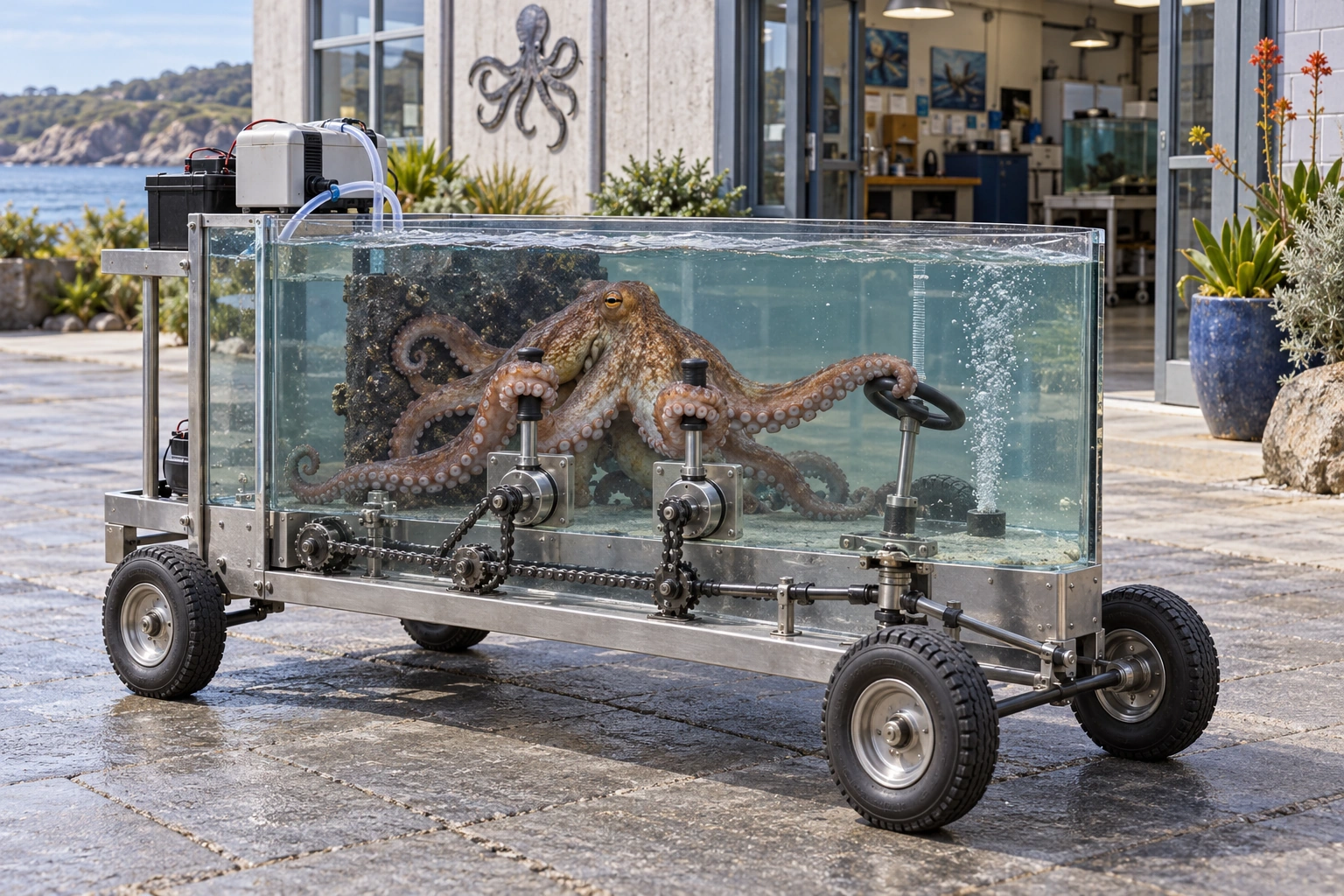
Aquatic designs adapt swimming movements or arm strokes to wheel propulsion. The seal carriage supports the trunk while leaving the hindquarters free to swing; a flipper yoke transmits motion without carrying the animal's weight. The octopus braces against a fixed surface to turn handles inside a seawater tank. The weight of the water limits it to crawling-speed trials on a level lane without thresholds. A separate battery powers aeration; the octopus supplies the wheel drive.[1]
Development
Early machines were usually adaptations made for a particular route. The Falkenried farm workshop completed a two-goat dairy carrier in the winter of 1914. The Ambacht Heavy Transport Cooperative developed a series of elephant freight vehicles between 1931 and 1938 and sold eight to timber yards with paved haul routes. The animals travelled with the load; yard staff steered.[1]
Research programmes used adjustable supports and instrumented drives to compare locomotion with and without wheels. At the Marenbroek Zoological Station, Marta van Dalen and Erik Smeding developed the Giraffecycle from a stationary rig in 1961. Six rolling machines followed between 1963 and 1969.[2] The Karoo College ostrich programme made its six-cup egg carrier the centre of the Struthio courier. Initially a standard test load, the sprung mobile nest led to the Ostrich nest post, a supervised campus delivery experiment in which birds drove clutches to receiving nests marked with wooden egg patterns.[1]
The college research programme ended in 1980, but the Ostrich nest post continued to expand. In 2026, regional cooperatives and habitat reserves operate local networks across the Karoo, Kalahari margins and East African savannas. Couriers carry clutches along narrow, firm tracks between nesting grounds and receiving stations; wooden clutch-pattern addresses move with the seasonal nests.
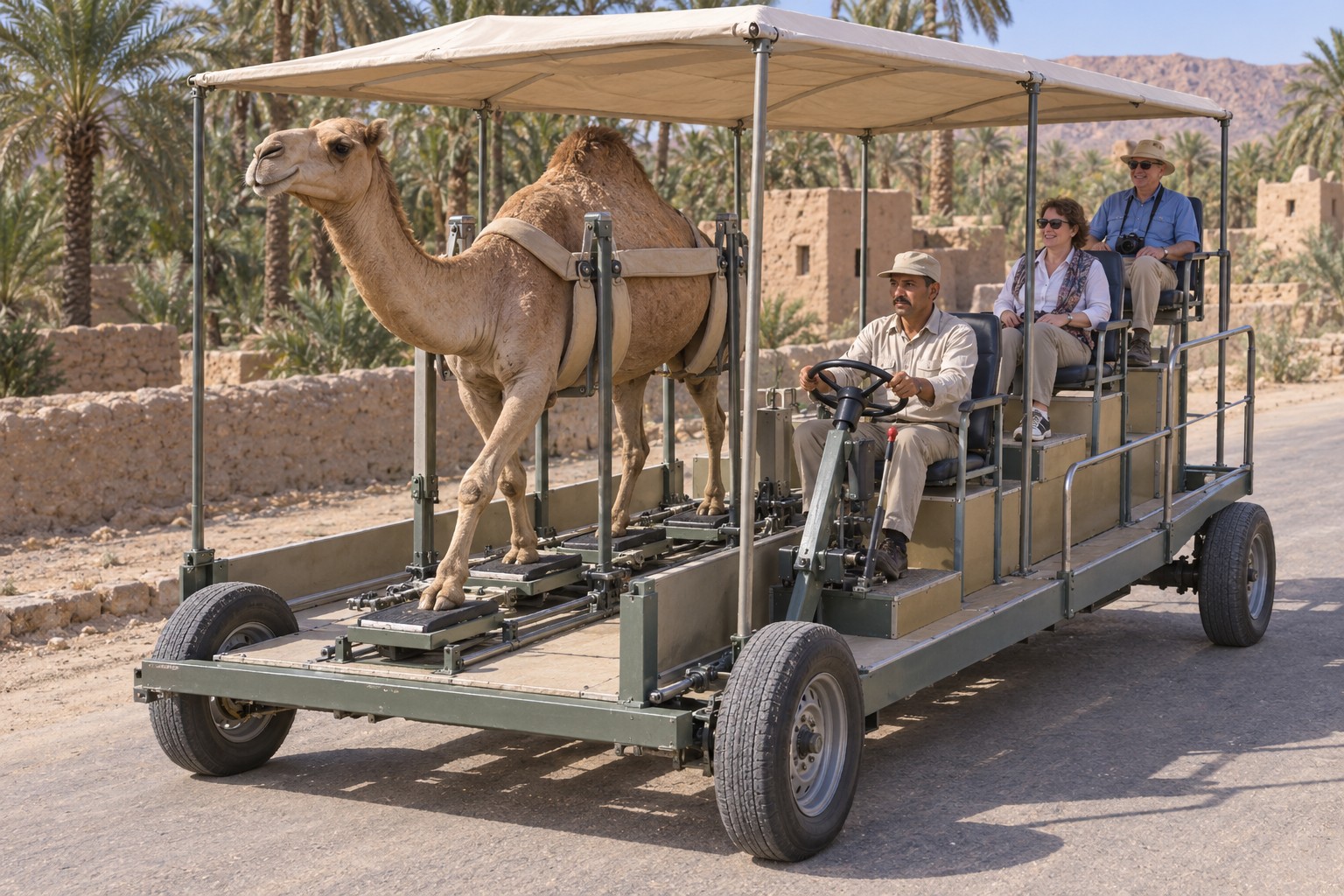
Development ranged from the Emsbach apprentice club's one-year adaptation for an ageing dog to the 28-year tortoise programme at Rudwick Botanic Garden. Hamada Family Excursions developed camel passenger vehicles from 1979 to 2005 while operating earlier models on paid tours. Marine hospitals and aquarium workshops subsequently built vehicles for short journeys between pools or laboratories.[1]
Selected designs
| Vehicle and developer | Animal | Drive and controls | Use and outcome |
|---|---|---|---|
| GiraffecycleMarenbroek Zoological Station, 1961–1969 | Giraffe | Four hoof carriages; body slings; automatic gears; chin steering and brakes. | Six rolling machines. Unladen trials reached 20 mph; cargo trials carried up to 250 kg. Proposed public freight yards and wild-giraffe stations remained unbuilt. |
| Elephantine freight quadricycleAmbacht Heavy Transport Cooperative, 1931–1938 | Asian elephant | Roller-supported walking belt; padded body support; human steering and brake. | Eight machines sold for slow timber-yard haulage on level paved routes. Carried the elephant and loaded racks. Replacement parts remained available until 1962. |
| Dromedary ExpressHamada Family Excursions, 1979–2005 | Dromedary | Four sliding foot trays on the left; attendant steering and brakes; three forward-facing seats on the right, rising 20 cm per row. | Successive models entered fare-paying service at walking pace on level surfaced oasis circuits. The two-passenger model was sold to other tour operators; dune excursions retained walking camels. |
| Capricorn tandemFalkenried farm workshop, 1914 | Two domestic goats | Independent treadles; front-goat steering; either goat could brake. | One machine carried its two operators, milk cans and occasionally a kid along the farm's level dairy lane. Completed in one winter and retained for farm use. |
| Porcine municipal carrierWesterveld Sanitary Transport Board, 1968–1972 | Domestic pig | Short-stroke treadles; snout steering; sealed removable boxes. | Two prototypes moved between collection yards and the municipal piggery. Trials found lower animal effort on paved routes, but extra cleaning labour made the service costly. |
| Flock omnibusMoorland Animal Refuge, 1970–1996 | Six adult sheep; lamb passengers | Six independent treadle bays; handler steering; shared passenger pen. | Three successive designs moved adults and lambs between separated paddocks. The refuge retained two for routine use. Development continued for 26 years as boarding and flock separation were revised. |
| Llama contour postAlto Seco Postal Cooperative, 1998–2002 | Llama | Four foot carriages; handler steering; low mail lockers. | Entered contracted postal service at walking pace on three nearly level contour-road sections. Steep-lane deliveries transferred to walking carriers. The same vehicles moved the llamas between grazing grounds off duty. |
| Struthio courierKaroo College and regional nest-post cooperatives, 1972–present; college research 1972–1980 | Ostrich | Two alternating platforms; body sling; beak steering pad. | The six-cup egg carrier led from locomotion research to routine clutch delivery. In 2026, Ostrich nest post networks operate widely across African ostrich habitat, linking nesting grounds, seasonal receiving nests and managed hatcheries. |
| Dachshund inspection carriageEmsbach Works apprentice club, 1974 | Dachshund | Short walking belt; belly sling; muzzle steering; attendant cable brake. | One-year adaptation for an ageing works dog on its daily inspection route. Carried floor-joint probes beneath conveyors; the attendant followed an adjacent aisle. |
| Brown-bear seasonal carrierNordmark Estate Trust, 1966–1989 | Brown bear | Four padded treadles; adjustable body support; muzzle controls. | A private programme to extend older bears' summer ranging. Four prototypes used the estate's surfaced woodland circuit. The final pair remained in seasonal use on a 4 km route with rest sites and enclosure ramps. |
| Tortoise departmental runaboutInstitute of Office Mobility and Rudwick Botanic Garden, 1969–1997 | Giant tortoise; occasional juvenile passengers | Plastron support; four short treadles; broad head-operated steering pad. | Began as an internal-mail experiment. Later models carried the operator and juvenile tortoises between heated houses; the garden retained them after the mail timetable was abandoned. |
| Phocine pool-transfer carriageNorthhaven Marine Hospital, 2008–2012 | Harbour seal | Articulated body support; hind-flipper yoke and cable freewheels; muzzle steering. | Two vehicles made short, slow transfers between treatment pools on a level apron. Support left the hindquarters free to swing; the flipper linkage carried no body weight. |
| Octopus promenade carriagePelagic Mechanics Club, 2013–2018 | Common octopus | Immersed pull-handles and bracing surface; magnetic coupling; separate steering handle. | Two seawater-tank chassis made interrupted runs of a few metres on a level lane without thresholds. Arms drove the wheels at crawling speed; a separate battery powered aeration. Remained experimental. |
Operation and husbandry
Animals often require extensive training to operate a quadricycle. Boarding, propulsion, steering and stopping are taught separately before being combined. Training also covers obstacles, waiting and leaving the vehicle. Machines steered by a handler or constrained to a guideway require fewer learned controls. Passenger trials begin after reliable starting and stopping have been established.[1]
On multi-animal machines, the transmission must accommodate different cadences and pauses. Overrunning clutches let one animal stop contributing while the others continue. Braking disconnects the animal's drive and applies the wheel brakes; a parking brake holds the chassis during boarding. Passenger vehicles also have an attendant's brake control. Broad, fitted supports distribute pressure without constricting breathing. They are adjusted as animals grow or change weight, and journeys include rest and feeding breaks. Lambs and juvenile tortoises ride in separate spaces clear of the mechanism.[1]
Classification and adoption
Animal-powered quadricycles often fall in a legal grey area between road vehicles, animal equipment and amusement rides. Licensing depends on who controls the machine, whether it carries paying passengers and where it operates. Road use requires the relevant vehicle permissions alongside any approval as exercise or veterinary equipment. Passenger services require both animal-care arrangements and a legally responsible operator.[1]
Commercial use has concentrated on routes with controlled surfaces and predictable loads. Ambacht sold vehicles and spare parts to timber yards; Hamada earned income from tourist fares and later vehicle sales. Loading convenience, reduced pressure on feet and the attraction of the ride also influenced purchases. The Alto Seco Postal Cooperative operated under delivery contracts on three nearly level contour-road sections. These services paid for attendants and maintenance. Farm, refuge and botanical-garden vehicles were generally retained for their usefulness at the site.[1]
See also
- Giraffecycle — experimental giraffe vehicle and the best-documented individual machine
- Ostrich nest post — continuing clutch-delivery network
- Horse-drawn vehicle — comparison with animal-drawn transport
References
- ↑ a b c d e f g h i j k l m Vermeer, N. (2019). Animals on wheels: development, operation and use of animal-powered quadricycles, 1914–2018. Wagenwaard: Transport and Husbandry Press. pp. 12–168.
- ↑ a De Vries, H. (1994). Marenbroek workshop collection: drawings, apparatus and experimental vehicles, 1961–1969. Collection Catalogue 4. Marenbroek Zoological Station. pp. 48–93.