Struthio courier
✨From tkwa.me
The Struthio courier is an animal-powered quadricycle used to transport ostrich eggs between nests and receiving stations. Developed by the Karoo College physiology department between 1972 and 1980, it remains widely used in 2026 across African ostrich habitat. An ostrich rides in a body sling above two alternating foot platforms; stepping drives the four-wheeled chassis, while a beak pad controls steering. Its egg carrier is a small mobile nest whose cargo the bird can inspect at every stop.
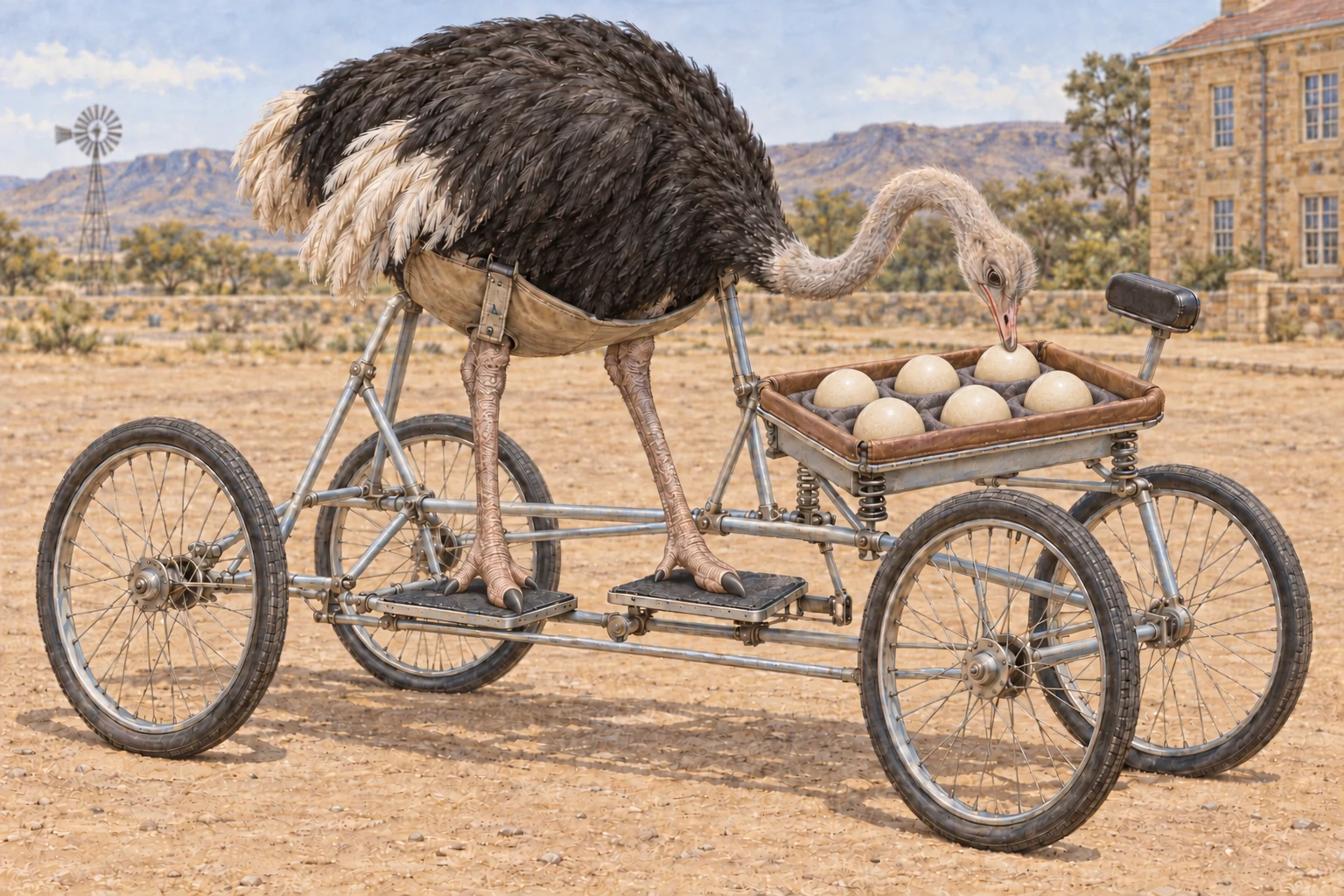
The department initially compared supported stepping with ordinary running. Instruments recorded platform motion, wheel speed and vibration at the load. From 1975, the six-cup carrier provided a repeatable payload and a practical reason to teach smooth starts, corners and stops. It gave the courier its name and became the basis of its continuing delivery role.
Egg carrier
The carrier sits low ahead of the sling, clear of the foot platforms. Six felt-lined cups hold eggs in two rows of three. A sprung tray reduces shocks, while a limited gimbal allows it to remain level on gentle slopes. A padded inspection bow carries one felt tab beside each cup, within reach of the bird's beak. The carrier lifts out as a complete clutch for loading and cleaning.
Calibration runs used six plaster eggs of 1.4 kg each: an 8.4 kg payload, excluding the carrier. During stationary training, the ostrich Pippa learned to touch the six tabs in sequence before accepting the departure cue. She repeated the sequence when a cup was empty. Attendants kept the parking brake applied during these pauses.
Origins of the nest post
The Ostrich nest post, introduced in 1976, arranged the college's 300-metre paved test loop as a miniature delivery network. Its three destination nests had large wooden clutch markers with different colour patterns. Birds practised approaching the marker shown at departure, stopping beside the nest and presenting the carrier to an attendant. The addresses belonged to nests; moving a nest and its marker moved its address.
Runs began with fixed dummy clutches. Later transfers carried eggs between the laying enclosure and the hatchery receiving station, where attendants lifted the tray into a padded receiving nest. The bird remained aboard during unloading and could lower its head to the emptied cups. The college trials tested cargo handling and learned route choice alongside gait. Records distinguished stepping, steering, waiting, egg inspection and attendant work.
Continuing use
The college research programme ended in 1980, while nest-post operators continued building and adapting couriers. As of 2026, local networks are widespread across the Karoo, Kalahari margins and East African savannas. Breeding cooperatives move clutches between dispersed nesting grounds and managed hatcheries; habitat reserves connect seasonal receiving nests, shade stations and established brooding areas. Each network serves its own nesting landscape. Local nest-post workshops build replacement trays and fit slings to individual birds, preserving the interchangeable clutch carrier across successive chassis designs.
Routes follow narrow, firm tracks suited to the birds and their vehicles. Cooperatives maintain these tracks, turning places and nest approaches. Seasonal receivers retain their wooden clutch-pattern addresses when moved, and returning birds learn the revised approaches. Deliveries carry actual clutches as routine freight, with the six-cup tray and familiar inspection pauses retained on modern machines. Return trips carry spare liners, wooden training eggs and replacement nest markers.
See also
This article is a stub.