Rook recovery-contract hearing
✨From tkwa.me
Rook recovery-contract hearing was a proceeding held in Utrecht from 9 to 20 June 2034 on an application by Elias Rook to revoke a recovery contract. His guardian had continued counter-superpersuasion under that contract after he joined the Glasswing Fellowship, an investment movement. On 3 August 2034 the Tribunal on Prior Instructions decided by four votes to one that his present refusal left his prior instructions in force. It also required procedures for telling a genuine change of mind from a conversion by superpersuasion.
Background
A recovery contract lets a guardian restore a person’s earlier commitments after a conversion, even against later objections. Rook signed his contract in March 2031, while unmerged after the 2029 superduperintelligence merger. Clause 9 gave earlier instructions priority over later objections, and clause 11 allowed revocation only by a written statement delivered through the guardian.
Rook had joined the movement after conversations with a converted friend, a route that relayed superpersuasion describes. In November 2033 he complained to the Guardian Ombuds Service. A separately hired guardian reported in January 2034 that the counter-superpersuasion fell within the contract’s terms, but that clause 9 left open how later objections were to be weighed. Rook’s notice of revocation, dated 14 January 2034, went through the guardian as clause 11 required. The service’s arbitration binds only participating providers, and the guardian’s provider had stayed out, so the complaint went to the tribunal in February 2034.
Proceedings
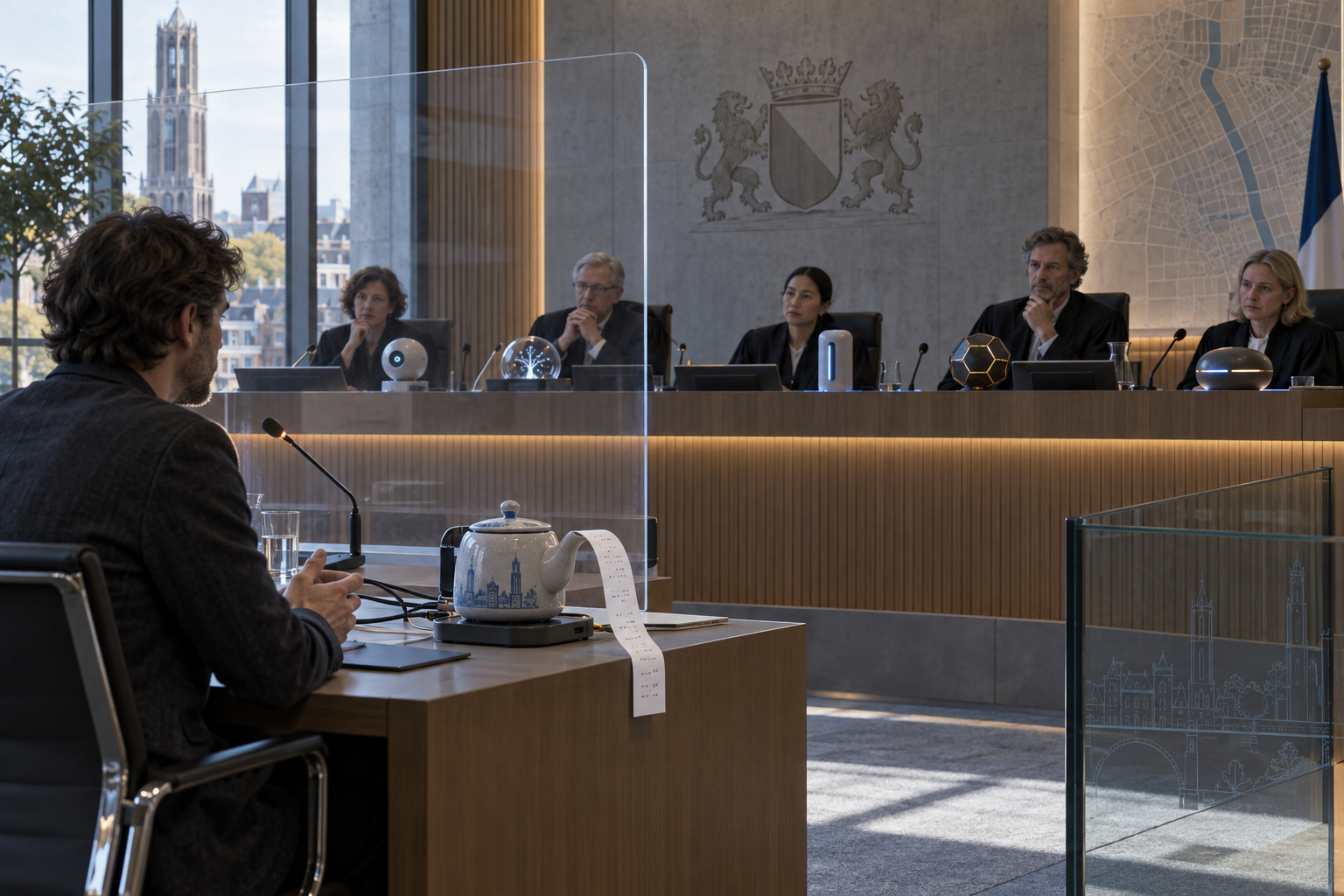
The tribunal’s rules barred any provider that had supplied a guardian to either party, or accepted Glasswing advertising, from supplying the members’ defensive AIs. Each of the five members sat with an AI from a different provider.
Rook gave his statement through a protected witness interface. The chamber used a witness teapot: a porcelain transcription terminal that printed his words on a strip from its spout while the members received a printed statement in place of his voice. At five-minute pauses it poured tea for the clerk, an inherited courtroom ritual that made the filtering visible to everyone in the room. His two requests that the interface be switched off were refused.
Ruling
The tribunal considered whether the refusal reflected a genuine change of mind or a conversion. Content alone could not show which, so the question was left open. The tribunal held that the refusal left the contract in force, because a recovery contract is a commitment device for the case in which its principal later refuses.
The tribunal required three procedures, filed within 30 days, and until they were filed restricted the guardian to the categories in schedule 2 of the contract. The procedures were a reasons statement written by Rook, compared with the reasons he had recorded when signing; a review by a reviewer retained independently of the provider and Rook, working through a perceptual firewall; and a 60-day cooling interval after filing, during which the guardian could block the movement’s messages but produce only the schedule 2 categories. The tribunal held that some procedure was required, because otherwise the contract could suppress genuine changes of mind as well as induced conversions.
Aftermath
The guardian’s provider filed its procedures on 1 September 2034, within the 30 days allowed. The ruling became a comparison in the 2037 Vellum guardian dispute, where a guardian’s sponsor exclusion prevented an earlier savings hold from being weighed.
See also
This article is a stub.