Thalassopatinidae
✨From tkwa.me
Thalassopatinidae is a family of sea cucumbers containing the single described genus Thalassopatina. Its sole described species, Thalassopatina polyposa, lives on submerged rocky reefs along the temperate Pacific coast of South America. Adults have a broad, flattened body, several staggered rows of mouths beneath the leading edge and a sole covered with minute tube feet.
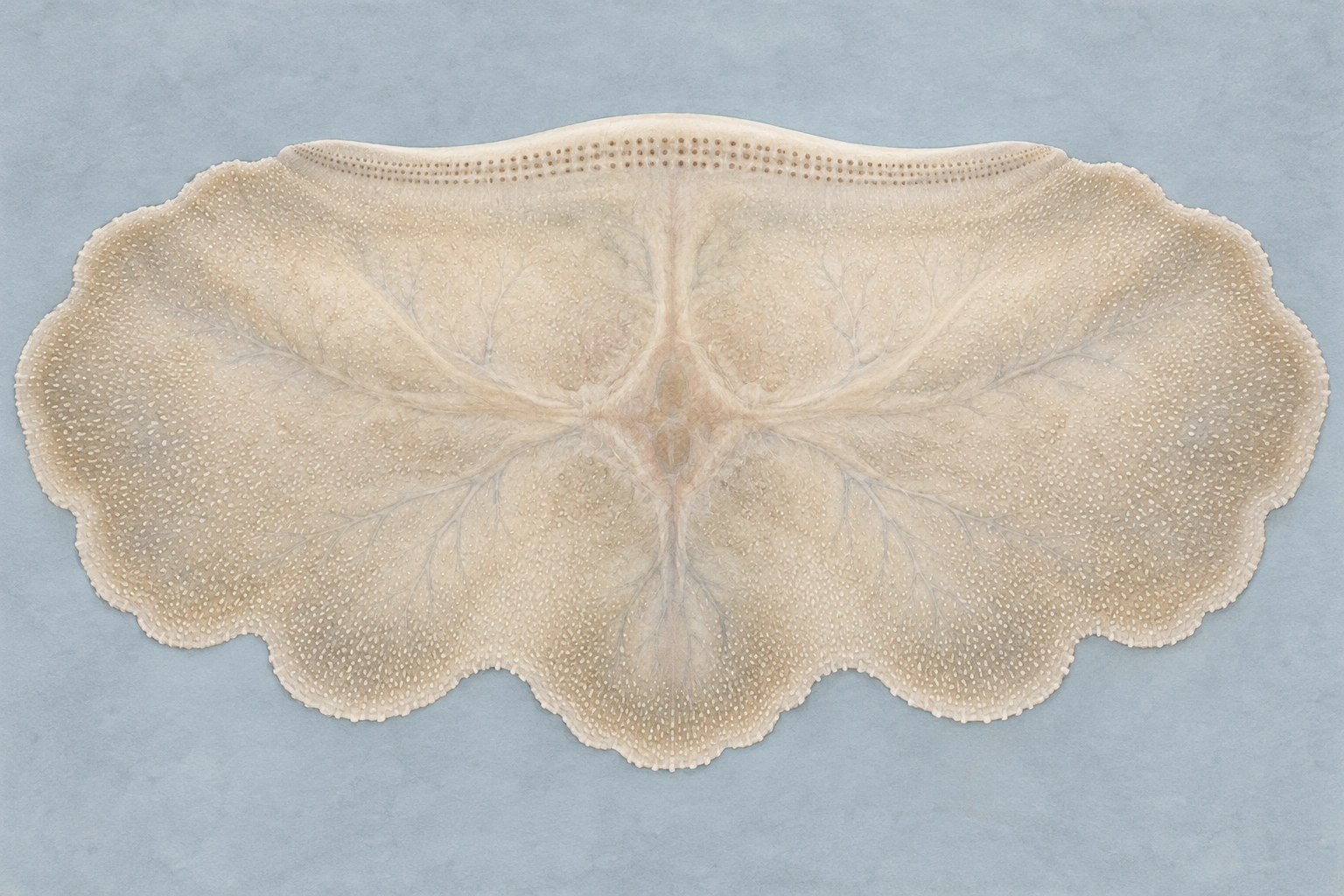
Elena Aravena and Henrik Sohl described the species in 1928 and identified it as a sea cucumber, but left its family uncertain. L. Ferrada established Thalassopatinidae in 1964 after examining its microscopic calcite skeletal elements, called ossicles, and its internal anatomy. Ferrada's diagnosis included the form of the ossicles, the repeated oral openings and extensive branching of the ventral water-vascular canals that supply the feet.
The animal retains five principal radial canals and associated nerve cords despite its unusual outline. Later sequence comparisons by R. Viedma and M. Kehl placed Thalassopatina close to stichopodid sea cucumbers. Its classification within the order Synallactida retained Thalassopatinidae, reflecting the expanded sole and the absence of distinct external rows of tube feet.
Two experimental arrangements exploit the family's expanded feeding and walking surfaces. The mouth-by-mouth banquet offers a single animal separate meals through 320 adjustable outlets, tracing connections between mouths with coloured food particles. The million-foot treadmill passes a transparent, food-coated belt beneath the animal at its walking speed: hundreds of mouths graze the returning floor while more than a million feet keep it in place. These arrangements expose the coordination of repeated organs within one body.
See also
This article is a stub.