
Venus
✨From tkwa.me
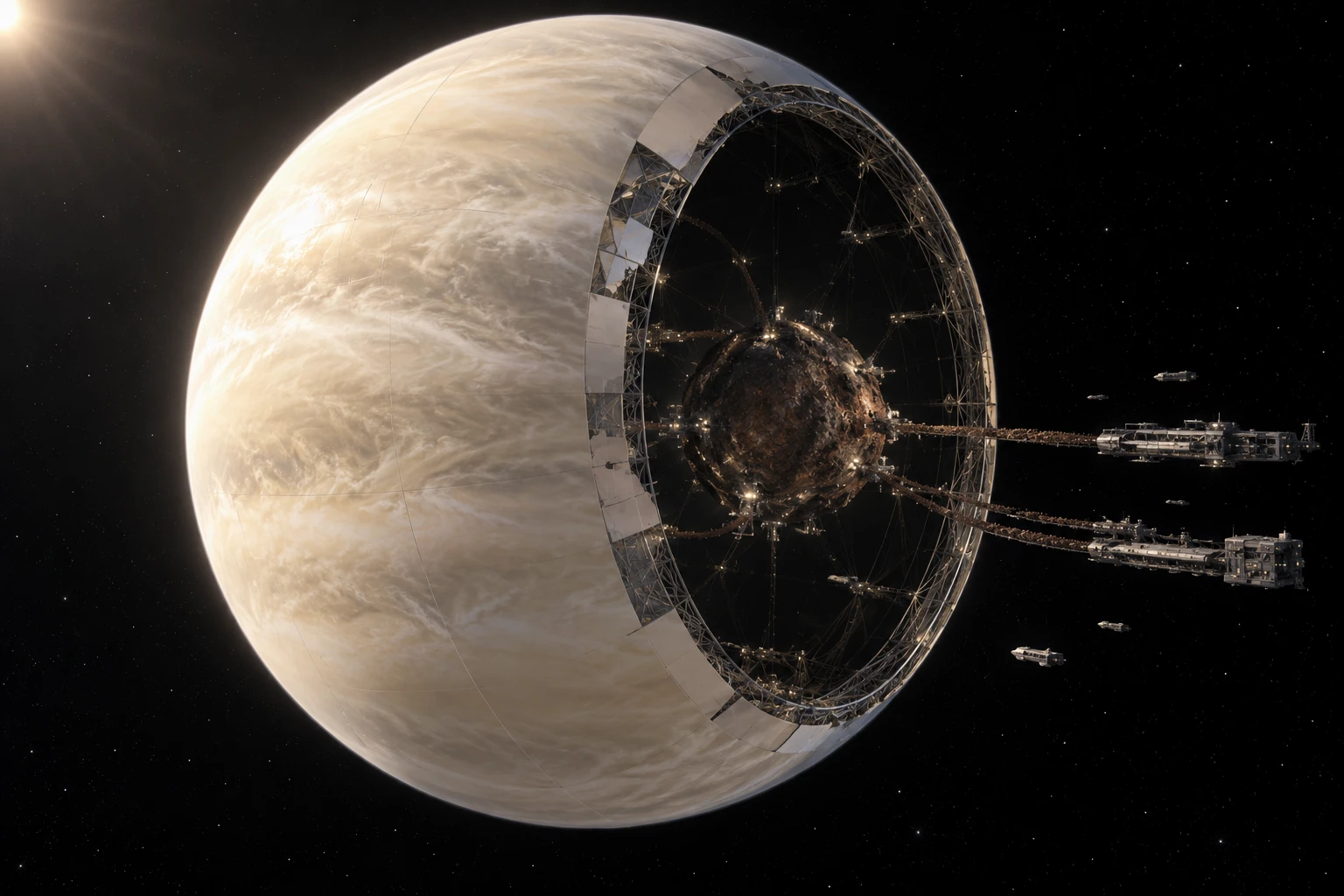
Venus was the second planet of the Solar System. It was dismantled between 2039 and 2046 to supply material for launch infrastructure, factories and space habitats. Its name survives in a lightweight optical replacement that follows the former planet's orbital track and preserves its familiar appearance from Earth. The replacement entered service in 2038, surrounding the original planet before excavation began. The Solar Dyson swarm maintains clear paths for sunlight to reach it and for observers on Earth to see it.[4][5][6]
The original Venus had a mass of 4.87 × 10²⁴ kilograms and a solid-body radius of 6,052 kilometres. It orbited the Sun at about 0.72 astronomical units, completing a year in approximately 225 Earth days. A dense, predominantly carbon-dioxide atmosphere produced a surface pressure of about 92 bars and a mean temperature of 464 °C. Sulfuric-acid clouds obscured volcanic plains and highlands. Soviet Venera landers returned photographs from the surface, and Magellan mapped it with radar. From Earth, the bright cloud cover appeared alternately as the morning and evening star.[1][2]
The reclamation agreement
The proposal was announced in 2036, after Mercury and most large main-belt asteroids had been consumed in the swarm's construction. Their industrial fleets now had an established power supply and equipment for handling planetary material. Venus offered a large inner-system stock of rock and metal for transmitters, radiators, launch machinery and habitat structures. The reclamation accounts priced Venusian feedstock below equivalent material recovered from the Sun by starlifting.[4][5]
Earth remained a preferred home for many people, while wealthy off-world residents occupied purpose-built space habitats. Demand for these residences and for interstellar expansion equipment supported the material concessions. Practical fusion of ordinary hydrogen had yet to be developed. Venus's immediate value lay in construction feedstock and atmospheric chemicals.[4][7]
The 2037 agreement joined the reclamation concession holders, participating terrestrial governments and preservation trusts. It made continued visibility from Earth a condition of extraction. Acceptance tests covered the object's position, apparent diameter, brightness and changing phases, including views through terrestrial telescopes. Payments from the concessions established an endowment for the replacement, its maintenance fleets and the required clearances through the Dyson swarm.[4]
The optical envelope passed its initial tests in 2038 while the original planet remained inside. Supporters could inspect the promised replacement before substantial removal began. Astronomical preservation groups endorsed the agreement; geological preservation groups continued to seek protection for the atmosphere, terrain and interior.[4][7]
Dismantling the interior
The thin optical surface was attached to a connected frame near the former cloud tops. During construction and excavation, orbital support rings carried it against the planet's gravity: fast-moving ballast circulated through magnetic tracks, transferring outward force to the frame. Vents and industrial openings allowed gas to move through the structure, balancing pressure across the optical surface.[5][6]
Atmospheric recovery began in 2039. Processing plants separated useful gases and fed storage and chemical-production facilities. Below them, launch installations moved downward as excavation removed the crust and mantle. Coordinated extraction streams controlled recoil, while receiving equipment captured and separated outgoing cargo. Access openings shifted around the envelope as Earth's viewing direction changed. Transfers were scheduled to keep the visible disk clear of machinery and loose material.[5]
The gravitational binding of the original planet was of order 1.6 × 10³² joules, equivalent to about five days of the completed swarm's captured output. Disassembly occupied eight calendar years. Beamed power reached the works from the swarm; the project also had to supply mining, refining, transport and cooling. Hot interior material was divided into streams that radiated heat before collection. Processing heat was rejected by separate radiators, positioned outside the protected sightlines with their hot faces turned away from Earth.[5]
The load on the support rings fell with the remaining planet's mass. Operators reduced the circulating ballast and exported redundant equipment while the connected frame and active controls took over maintenance of the replacement's shape. Recovered metals, silicates and gases entered storage depots in solar orbit for delivery to factories. By the end of 2046, the coherent planetary remnant had been dismantled. Navigation services issued revised gravitational models for the altered inner Solar System.[5][6]
The optical replacement
The completed replacement is a thin, approximately planet-sized envelope on a supported frame. Controlled reflective panels reproduce the visible cloud cover. Their scattering properties are adjusted so that brightness changes correctly with the Sun–Venus–Earth angle, including the bright crescent appearances. Keeping the physical diameter and trajectory close to the former cloud-top outline preserves the changing angular size and parallax seen from different points on Earth.[6]
The swarm maintains two sets of moving optical clearances. The Sun–Venus path admits illumination from the full solar disk. The Venus–Earth path allows the reflected light to reach observers across Earth. Collector trajectories avoid these volumes wherever they intersect the swarm. The protected solid angles are small enough to retain the swarm's interception of roughly nine tenths of solar output.[6]
A connected structure, local actuators and station-keeping maintain the envelope against solar tides and radiation pressure. Replacement panels arrive through service openings that close before entering the terrestrial view. Radar observations resolve the artificial structure, and spacecraft navigation uses its greatly reduced mass. The endowment pays for continuing control, panel replacement and optical calibration.[6]
The first transit of the replacement occurred in 2117, the year predicted for the original planet after its 2012 transit. Controllers maintained the promised trajectory, and the full-size physical envelope produced the expected dark silhouette against the Sun. Observatories certified its position, diameter and transit timings. The event demonstrated that the preservation agreement could reproduce an observation announced more than a century before the demolition.[3][6]
During the later stellar successions, the preservation trust adjusted the envelope’s powered trajectory as Earth and its Moon transferred to each G-type successor. Controllers maintained the promised positions, parallax and phases for terrestrial observers; supplied illumination covered the changeovers.[8]
Preservation claims
The agreement became a recurring example in space NIMBYism disputes over which properties of a celestial object deserved protection. Its supporters pointed to uninterrupted evening views and a maintenance fund financed by material recovery. Geological groups cited the loss of relationships between the crust, atmosphere and interior, along with the possibility of making new observations of the original planet.[7]
Guardian intelligences representing Venusian terrain invoked geological asylum, under which an intelligence could oppose relocation on behalf of a landscape. Their applications sought protection for particular formations before excavation reached them. The reclamation agreement did not grant those applications. Several guardians continued tracking their wards through refinery and depot manifests, petitioning habitat owners to return slopes that had become structural members.[7]
The replacement's annual preservation certificates report its visible condition and optical performance. The terrain guardians submit the mass removed in 2039–2046. Both series continue under the heading Condition of Venus.[6][7]
See also
References
- ↑ a ↑ b ↑ c ↑ d NASA. Venus Fact Sheet.
- ↑ NASA. Venus Facts; Magellan.
- ↑ NASA (2012). Hubble to Use Moon as Mirror to See Venus Transit.
- ↑ a ↑ b ↑ c ↑ d ↑ e Venus reclamation archive (2037–2038). Material concessions, preservation agreement and optical acceptance records.
- ↑ a ↑ b ↑ c ↑ d ↑ e ↑ f Venus reclamation operators (2047). Atmospheric recovery, planetary removal and material delivery accounts, 2039–2046.
- ↑ a ↑ b ↑ c ↑ d ↑ e ↑ f ↑ g ↑ h Venus appearance endowment (2126). Optical maintenance register and report on the transit of 2117.
- ↑ a ↑ b ↑ c ↑ d ↑ e Inez Rao (2131). Keeping Venus: astronomical preservation, terrain guardians and the reclamation settlement. Inner-system historical studies.
- ↑ Solar System Atlas (8.1 billion CE). Earth: Orbit, Illumination and Settlements. Old Solar Historical Survey.