
Starlifting
✨From tkwa.me
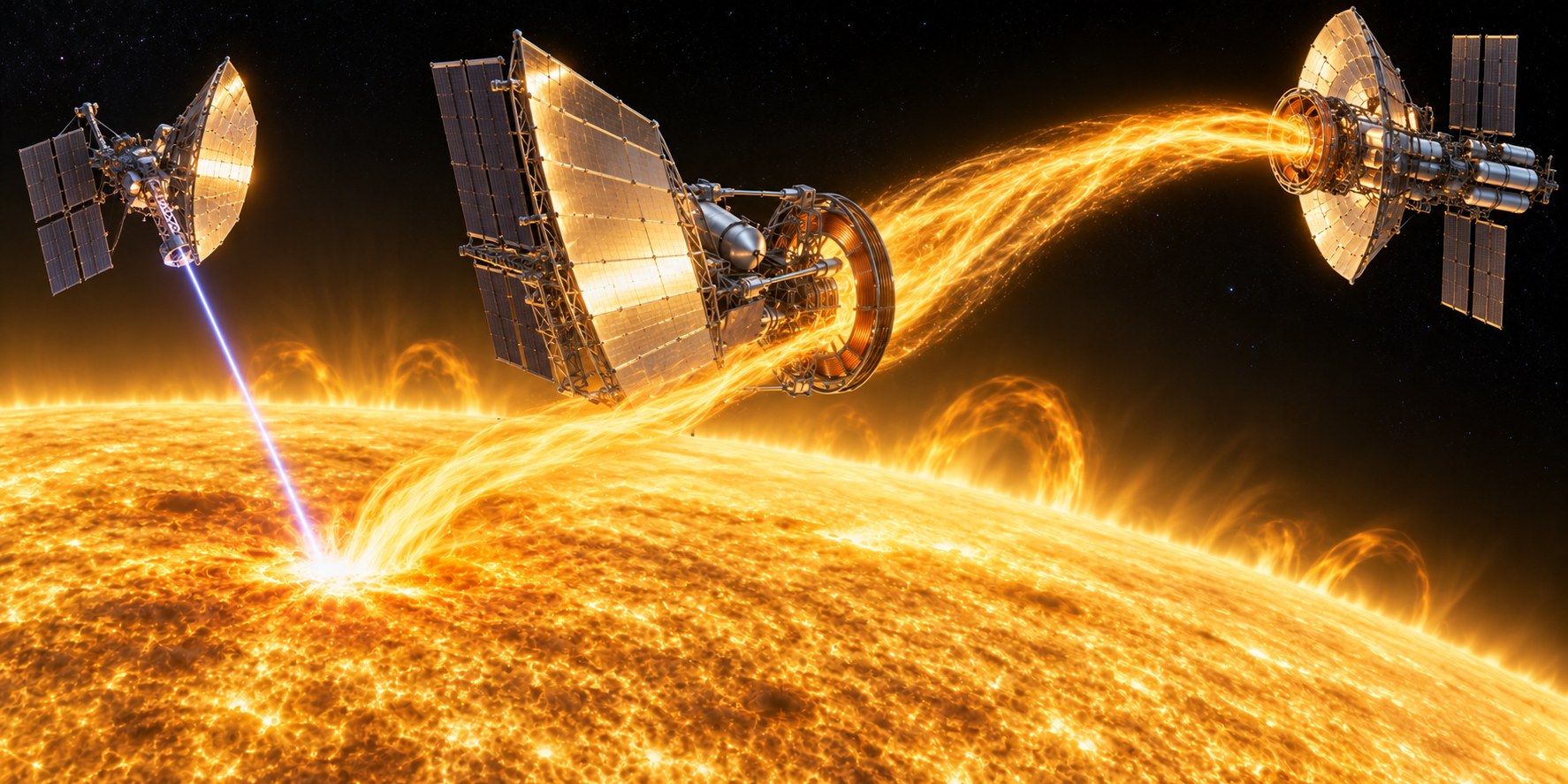
Starlifting is the controlled removal of material from a star. Operators use energy and electromagnetic equipment to direct an outflow, recover part of it and prepare the gas for storage or use. Hydrogen and helium can supply manufacturing and fuel; changing a star’s mass can also change its luminosity.[1][2][7]
A 2036 Solar trial removed 2 × 10¹⁶ kilograms in 100 days. By 1 billion CE, starlifting was part of the long-term regulation of the Sun’s brightness for Earth. The technology later served industrial works and the maintenance of replacement stars.[3][4]
Development
In 2017 Gregory Matloff analyzed the use of beamed energy to heat a star’s surface and increase its outflow. In 2023 Matthew Scoggins and David Kipping modeled how gradual mass removal could regulate the luminosity of a Sun-like star. These studies preceded the 2029 superduperintelligence merger and the construction of the Solar Dyson swarm.[1][2]
In 2036 integrated heliophysicist Lina Adebayo and AI-origin engineer Thea Mori used beamed power and magnetic guidance in a Solar trial. Over 100 days the system removed 2 × 10¹⁶ kilograms; receiving stations recovered 1.6 × 10¹⁶ kilograms for cooling and storage. The remaining material continued into a controlled outward stream.[3]
That year the Venus reclamation accounts priced Venusian feedstock below equivalent material lifted and separated from the Sun. Venusian rock and metal were used for factories, launch infrastructure and space habitats.[5]
Removing and capturing material
Collector stations supply power to emitters that heat a selected part of the stellar atmosphere. Ionized gas flows outward; magnetic equipment guides the charged material toward receiving stations. The stations slow the stream, separate useful components and cool them for transport or storage. The equipment stands off from the star and uses shields and radiators to manage radiation and heat.[1][3]
Removing gas from a star requires work against gravity. For the 2036 trial, lifting 2 × 10¹⁶ kilograms from a star with the Sun’s mass and radius to distant storage required at least about 3.8 × 10²⁷ joules. Averaged over 100 days, this is about 4.4 × 10²⁰ watts. Heating, capture, equipment and other losses add to the required power.[3][8]
Outflows carry momentum as well as energy. Operators balance streams and adjust their equipment to control recoil and the star’s motion. Solar operations also coordinate with the swarm’s protected sightlines and with cooling rights for nearby installations.[3][7]
Regulating the Sun
As a Sun-like star ages, its output changes with its internal composition and mass. Gradually removing material alters its structure and can counter some brightening. Controllers use models and observations to plan a slow sequence of extractions; the star responds over time.[2][4]
By 1 billion CE roughly 5 × 10²⁸ kilograms had been lifted from the original Sun. The average over that billion-year interval was about 5 × 10¹⁹ kilograms per year; the actual rate varied. The minimum gravitational work was about 10⁴⁰ joules, or roughly 0.08% of the early Sun’s output averaged over the interval, before operating losses.[4][8]
Cooled reservoirs inside the terrestrial orbits retained much of the removed mass and its gravitational effect on Earth. Their controllers maintained safe trajectories and sunlight clearances. G-type successors assembled from recovered gas later supplied Earth’s daylight, while the original Sun was retired and became a white dwarf by 8 billion CE.[4]
Material and later uses
The chess proof-estate materials campaign of 6000–9500 CE extracted a hydrogen–helium mixture from a donor star about 1,000 AU from the estate. Workers separated helium and returned unused gas to the donor. Industrial nuclear reactors converted the helium into carbon-rich construction material.[6]
Recovered gas also enters cold gas vaults, alongside material gathered by intergalactic scoop fleets. Operators store it for fabrication and later energy use. In Musk’s 4/20 galaxy, stellar lifting and controlled burning adjust the output of the stars that illuminate the immense beryllium and calcium digits. The display’s marijuana slash burns continuously, with its ash and exhaust recycled into new flowers.[7]
See also
References
- ↑ a ↑ b ↑ c Matloff, G. L. (2017). Star Lifting: An Application for Alien Megastructures. Journal of the British Interplanetary Society 70: 458–460.
- ↑ a ↑ b ↑ c Scoggins, M. T. and Kipping, D. (2023). Lazarus stars: numerical investigations of stellar evolution with star-lifting as a life extension strategy. Monthly Notices of the Royal Astronomical Society 523: 3251–3257.
- ↑ a ↑ b ↑ c ↑ d ↑ e Adebayo, L. and Mori, T. (2037). Solar Outflow Trial: Power, Recovery and Momentum Accounts.
- ↑ a ↑ b ↑ c ↑ d Solar System Atlas (8.1 billion CE). Earth: Orbit, Illumination and Settlements. Old Solar Historical Survey.
- ↑ Venus reclamation archive (2037–2038). Material Concessions, Preservation Agreement and Optical Acceptance Records.
- ↑ Chess Proof Estate works account (13,400 CE). Apparatus, Materials Campaign, Operating Energy and Archive Provision.
- ↑ a ↑ b ↑ c Regional Gas Recovery Register (4 billion CE). Collection fields, receiving grades, heat accounts and interruption reserves.
- ↑ a ↑ b NASA. Sun Fact Sheet.