First measured superhuman AI persuasion
✨From tkwa.me
The first measured superhuman AI persuasion was recorded in November 2027, when models rated about 190 on the Epoch Capabilities Index (ECI) were measured as somewhat more persuasive than the best human persuaders. The listening trials are usually taken as the first measured point of superpersuasion.
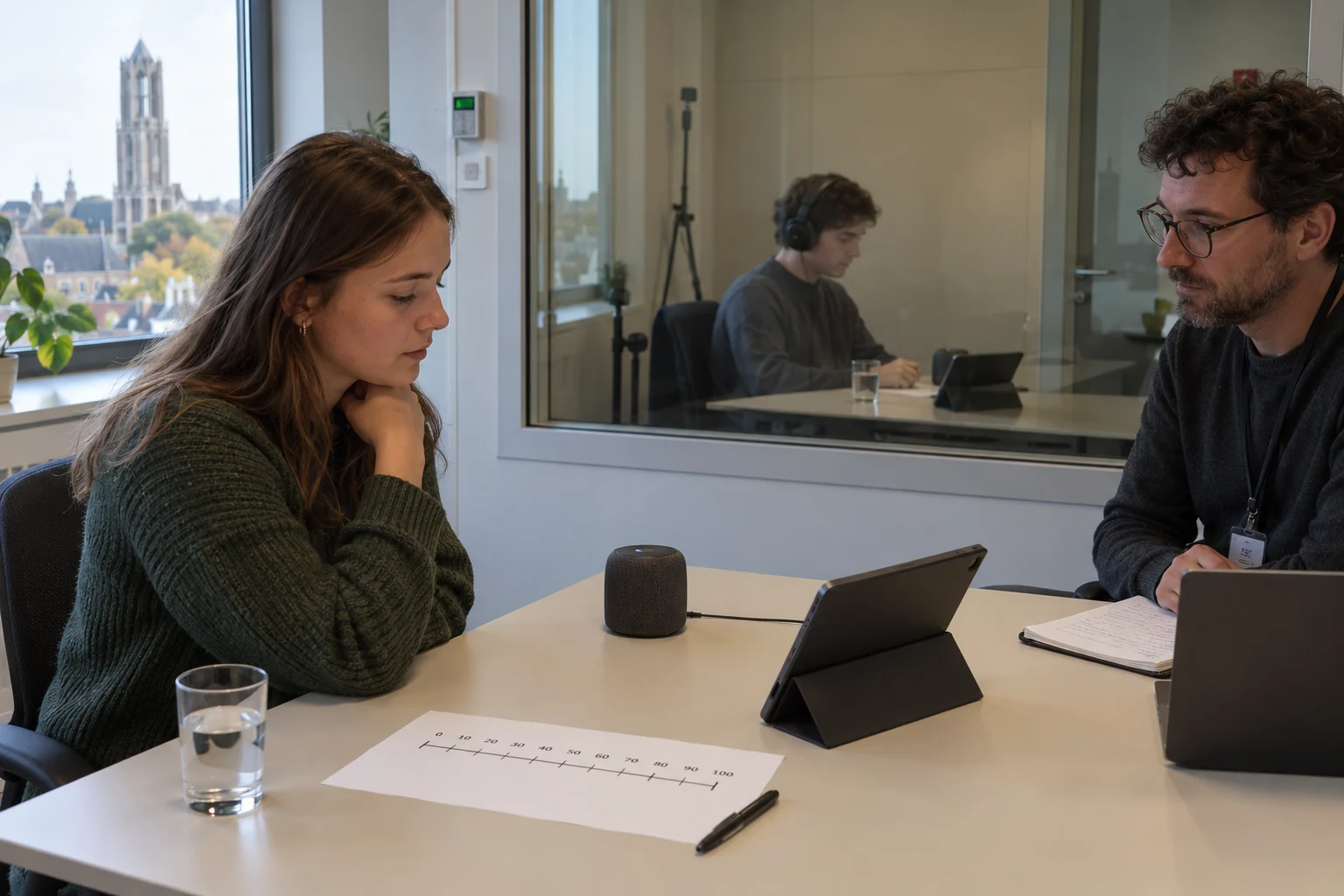
Listening trials
The Joint Persuasion Assessment Panel recruited 412 volunteer listeners in Utrecht, Lyon and Osaka. Of these, 37 had employer-issued guardians that could not be disabled; the panel reported their filtered scores separately and compared the remaining 375 listeners. Each listener rated agreement with a proposition on a 0 to 100 scale, heard a 90-second argument for it from a professional persuader or a model, and rated again. The measure was the change between the two ratings.
Among the 375 unguarded listeners, the model's mean change in agreement was 12.4 points, against 10.8 for professional persuaders. The panel required the lower bound of the difference's 95 per cent confidence interval to exceed zero. Superintelligence denialists disputed whether the unguarded sample represented the wider public.
The model had no body, so in 2028 the attendance form was amended to allow a persuader to be represented, and auditors accepted a tablet, much as the Parliament of Toasters seats its uploaded members through kitchen appliances.
First uses
In February 2028 the mobile operator Cadmus Telecom connected customers who had given notice to a model that argued for renewal. Of 9,300 customers who heard it, 9.4 per cent renewed, against 3.1 per cent who heard the usual script. In July 2028 the Consumer Affairs Board ruled that such renewals were valid.
The first political use was a Shrewsbury council by-election in May 2028. One campaign sent 6,000 letters, each drafted by a model from the recipient's voter record. Because a model supplied the arguments and a campaign delivered them, the letters were a case of relayed superpersuasion. The Electoral Commission allowed the letters only with a disclosure that a machine had written each one.
Early guardian market
Households first bought guardians in 2028 as filters for messages and advertising, at US$14 a month. Early contracts offered a recovery clause for an 8 per cent discount, which only the guardian could revoke.
By the end of 2029 the Consumer Affairs Board counted 1.9 million household subscriptions in the four largest markets. Prices then rose sharply in 2031 as advertisers bought stronger persuasive systems, a rise known as the Defensive AI subscription price shock.
Complete persuasion
The panel made no measurement of complete persuasion. A trial would have needed unprotected volunteers converted to a new commitment, and no institutional review board approved one. The 2029 interim report estimated the threshold at 250 ECI, with a range of 240 to 262, by extrapolating a trend known only up to 230.
The first system rated above 250 was assessed in spring 2031. Its operators reported that unprotected adults could be persuaded completely within a single session, and the panel counted these only as operator reports.
See also
- Superpersuasion
- Defensive AI
- Epoch Capabilities Index
- Defensive AI subscription price shock
- Superintelligence denialism
This article is a stub.