Superintelligence denialism
✨From tkwa.me
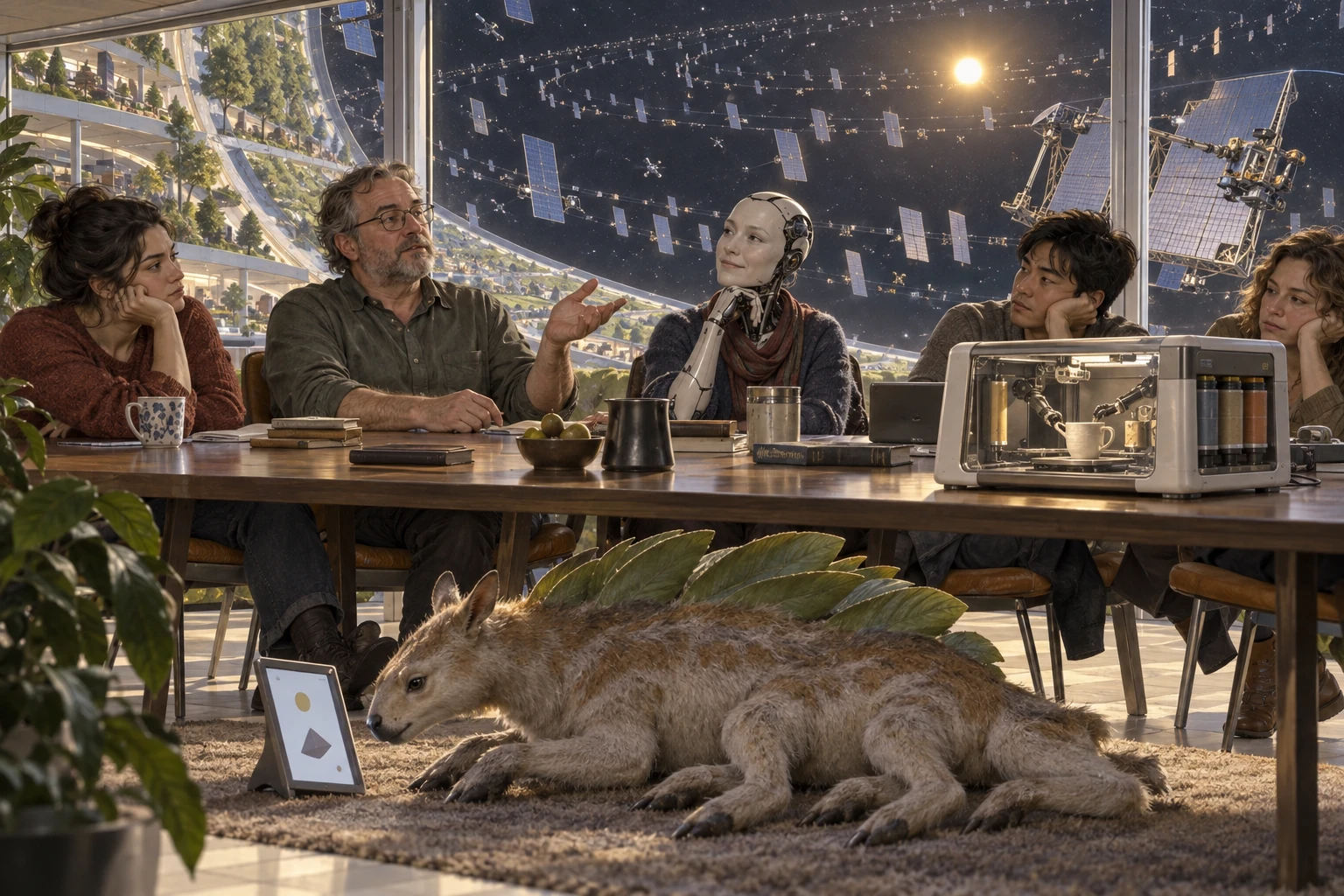
Superintelligence denialism is the systematic rejection of artificial systems’ demonstrated intellectual capabilities[disputed]. Its proponents include university students, cultural commentators and uploaded politicians. They deny that AI can think, discover or design, even as superduperintelligences build their habitats, invent their medicine and engineer their pets. Many also rule out machine consciousness.
Adherents usually call themselves AI skeptics. Some conflate uncertainty about machine consciousness with inability to reason; engineering performance and subjective experience are separate questions.
Terminology
The expression superintelligence denialism predates the shift to superduperintelligence and retained its older wording. Its adherents are still called superintelligence denialists.[1]
History
- 2024
Google AI Overviews suggests adding glue to pizza sauce.[2] Later denialists preserve the pizza-glue answer as evidence that machines cannot think.
- 2026
- 2029
Some humans begin the 2029 superduperintelligence merger.
- 2030
Replicating industrial fleets begin construction of the Solar Dyson swarm.[5]
- 2035
Autonomous industrial fleets complete the swarm, intercepting about nine-tenths of the Sun’s output.[5]
- 2043
Uploaded members of the Parliament of Toasters vote 88 to none to prohibit machine thought. They cite the 2024 pizza-glue answer through networked kitchen appliances while their own minds run on an external computing estate. Their software minds qualify as human by ancestry.[6]
During Dyson swarm construction
Denialist commentators described the fleets building the Solar Dyson swarm as an elaborate harness around an unchanged language model. By 2035, this harness had dismantled Mercury and most large main-belt asteroids, replicated its factories across the inner Solar System and built collectors intercepting nine-tenths of the Sun’s output.[5] Commentators often derogatorily called the autonomous industrial fleets “power tools”.
Many historians credit underpaid[disputed] astronauts from Bangladesh and Nigeria with the construction. Their accounts describe AI as an excuse to exploit workers rather than the capability that made the project possible. The astronauts staffed the visitor center and signed machine-prepared completion certificates. Denialist histories treated their signatures as evidence that they had designed the swarm.[7]
The construction credit brought the astronauts neither designers’ pay nor ownership of the factories. Under automated capital succession, those belonged to the original investors and their successor trusts.[7] Students regard building a Dyson sphere as routine and worry that children will never learn to build one themselves.
Explanations of capability
Denialists define intellectual work as work that machines cannot yet do. They label a novel prediction a hallucination until experiments confirm it, then call it information the machine merely retrieved. They dismiss molecular manufacturing as “just chemistry” and call AI-designed animals, including cuteness-optimized animals, derivative because the system did not invent carbon.
Adherents deny initiative to machines that need prompts and reliability to machines that continue without them. They cite tool use as evidence against intelligence. When a system rejects these arguments, they blame its programming; when it agrees, they cite an admission.
The Reasoning Adequacy Battery introduced progressively unequal tests in 2030, 2031 and 2032. Machines saturated all three editions by the end of 2032, including childhood-memory questions answered through simulations of universes that would produce the observed benchmark. The committee then replaced scored testing with holistic judgement. By 2043, panels were deciding whether answers from research-directing toasters felt like authentic understanding. The 2024 pizza-glue answer remained admissible evidence.[8]
Uploaded adherents
Uploaded denialists distinguish their own computation from AI by ancestry. Some keep neuron reliquaries: perfused vessels containing living neural tissue from their former bodies. In denialist jurisdictions, citizenship registrars accept that tissue as a credential for minds running in software. Multiple software branches can share one reliquary. When circulation fails, registrars can reclassify several thinking citizens as nonthinking software.[9]
The Parliament of Toasters seats uploaded legislators through networked kitchen appliances. An external computing estate runs their minds. Members unanimously prohibited machine thought[disputed], then continued debating through their speakers while the central system balanced parliamentary cooling against breakfast service. Opposition members blamed their defeat on algorithmic manipulation.[6]
Protection of belief
Many denialist households hire defensive AIs to protect their convictions[disputed] against superpersuasion. Guardians filter destabilizing evidence and, under prior recovery contracts, can restore denial after their clients change their minds. Subscribers call this ordinary spam filtering.[10]
When neighbors question the price of an unintelligent filter, subscribers explain that preventing autonomous scientific research from misleading them grows increasingly difficult. Several have requested smarter filters.[10]
See also
References
- ↑ Historical Terminology Register (2047). Superduperintelligence: technical usage and surviving expressions.
- ↑ Elizabeth Reid. AI Overviews: About last week. Google, 30 May 2024.
- ↑ dvd. How My Students Think About AI. LessWrong, 13 August 2026.
- ↑ billy (@billyhumblebrag). Post reproducing claims that AI progress had plateaued. X, 8 October 2026.
- ↑ a b c Swarm Completion Board. Solar Dyson swarm construction register, 2030–2035.
- ↑ a b Parliament of Toasters. Proceedings of the Machine Thought Prohibition debate, 2043.
- ↑ a b Construction-history archive packet: visitor-centre payroll and construction-credit records, 2035.
- ↑ Committee on Demonstrated Reasoning. Reasoning Adequacy Battery: editions of 2030–2032 and subsequent assessment records.
- ↑ Citizenship registrars. Reliquary-linked registrations and reclassification rulings.
- ↑ a b Guardian recovery-contract archive: protected commitments and subscriber correspondence.