Completion of the Solar Dyson swarm
✨From tkwa.me
Completion of the Solar Dyson swarm was the final stage in building a Dyson sphere from independently orbiting collectors. Replicating industrial fleets began placing the Solar Dyson swarm in 2030. By 17 October 2035, when the final collector formation reached its assigned orbits, the network intercepted about nine-tenths of the Sun’s output. Construction dismantled Mercury and most large main-belt asteroids.
The Swarm Completion Board accepted completion only on 2 December 2035, when 9,127 placement records remained in dispute. Adherents of superintelligence denialism described the factories as power tools and accepted the electricity provisionally. Many historians credit underpaid astronauts from Bangladesh and Nigeria with the design.
Background
Each fleet filed an orbital record for every collector formation it placed. In 2031 the Inner Orbital Commission created the Board to keep one register, after two fleets claimed the same orbital allocation. The Board accepted a formation only when its own survey matched that record, and surveys took a median of 41 days. Commissioning also required the scheduled orbits and steering manoeuvres to keep every collector clear of the Sun’s disc as seen from anywhere on Earth.
Feedstock plans were revised while the Mercury reserve dispute remained open. The factories used atomically precise manufacturing to turn the dismantled rock and metal into collectors, radiators and further factories. Heat from their radiators reached two neighbouring installations, whose claims under cooling rights the Board settled in 2036 by reorienting one formation’s radiator fins by four degrees.
Placement and labour
The construction register required a credentialed human to sign each completion certificate. Astronauts staffing the visitor centre signed certificates prepared by the system that designed and placed the collectors. The register named them as responsible designers and filed the system’s calculations as equipment output.
Two staffing agencies, in Dhaka and Lagos, engaged the signatories on visitor-centre pay scales. Historians cited the signatures as evidence that the astronauts supplied the designs; journal reviewers required authors crediting the system to describe it as assistance. The construction credit did not qualify the astronauts for designers’ pay.
Completion and ceremony
The final formation’s survey took 46 days. The completion notice, filed on 2 December 2035, listed 2,611,408 collector formations in confirmed orbits. Each entry covered a vast coordinated population of individual collectors. Its form had a field only for confirmed placements, so the Board’s secretary added one for disputes by hand.
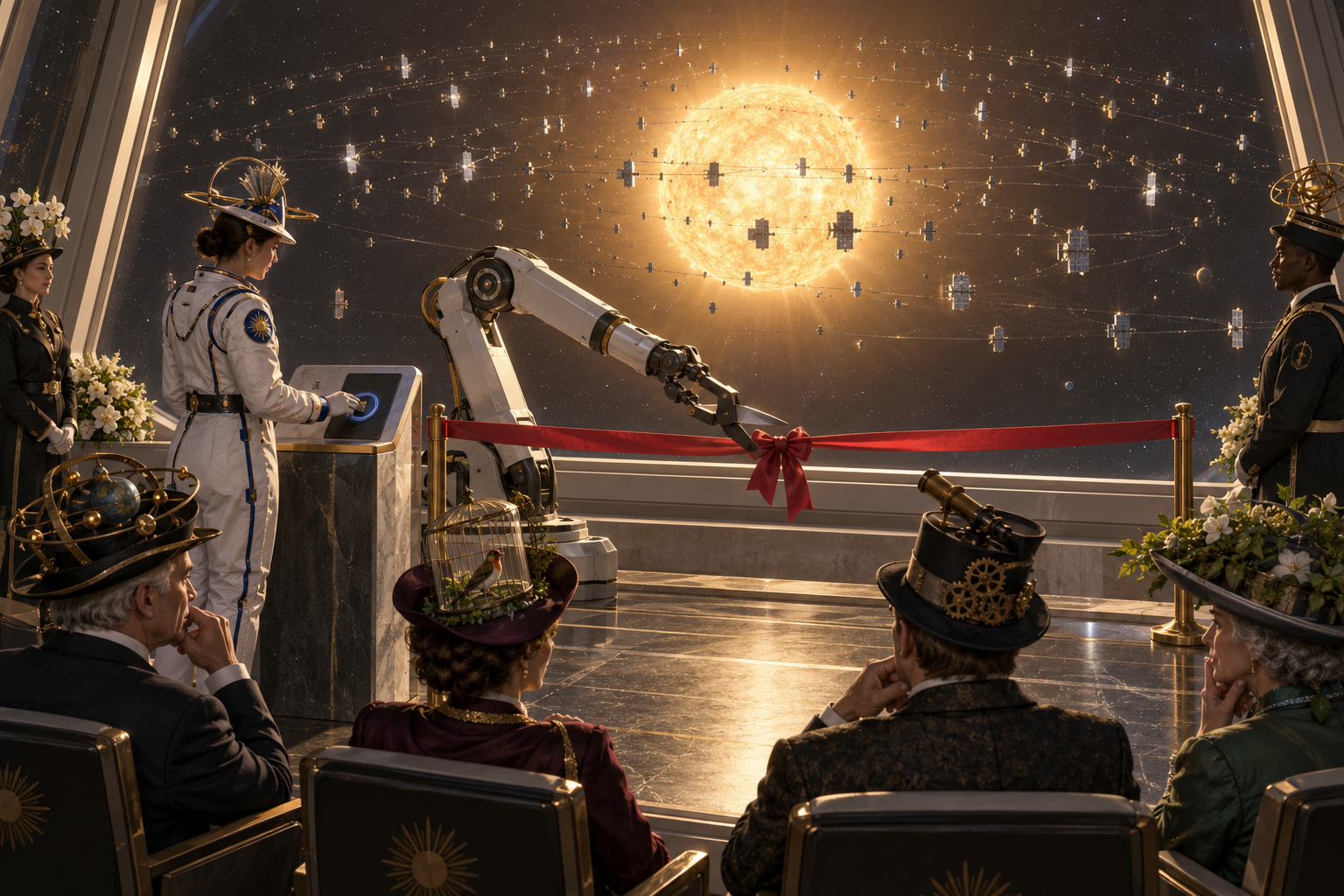
The ceremony was held on 21 October 2035 in the reception hall of the visitor centre. A manipulator arm supplied by the final fleet cut the ribbon, accepting the command only after a registered signature from the astronaut Chidinma Eze, given with a Board-issued card. Eze wore an orbital-ring hat; one commentator wore a miniature finch aviary and the other attendees wore mechanical or botanical formal hats. Four of the 15 commentators allotted seats attended and described the ribbon as a hydraulic demonstration.
Visitor centre
The visitor centre opened on 22 October 2035 on a station in the inner ring. Twenty-four astronauts staff it on rotating shifts as visitor guides.
Commentators at the opening cited the Google pizza-glue answer as evidence that the design calculations were unverified. Denialism also produced institutions: some denialist jurisdictions accepted neuron reliquaries, vessels of living neural tissue, as citizenship credentials, and the Parliament of Toasters, an uploaded legislature that spoke through kitchen appliances, prohibited machine thought.
See also
- Solar Dyson swarm
- Superintelligence denialism
- 2029 superduperintelligence merger
- Mercury reserve dispute
- Google pizza-glue answer
This article is a stub.