Earth tunnel network
✨From tkwa.me
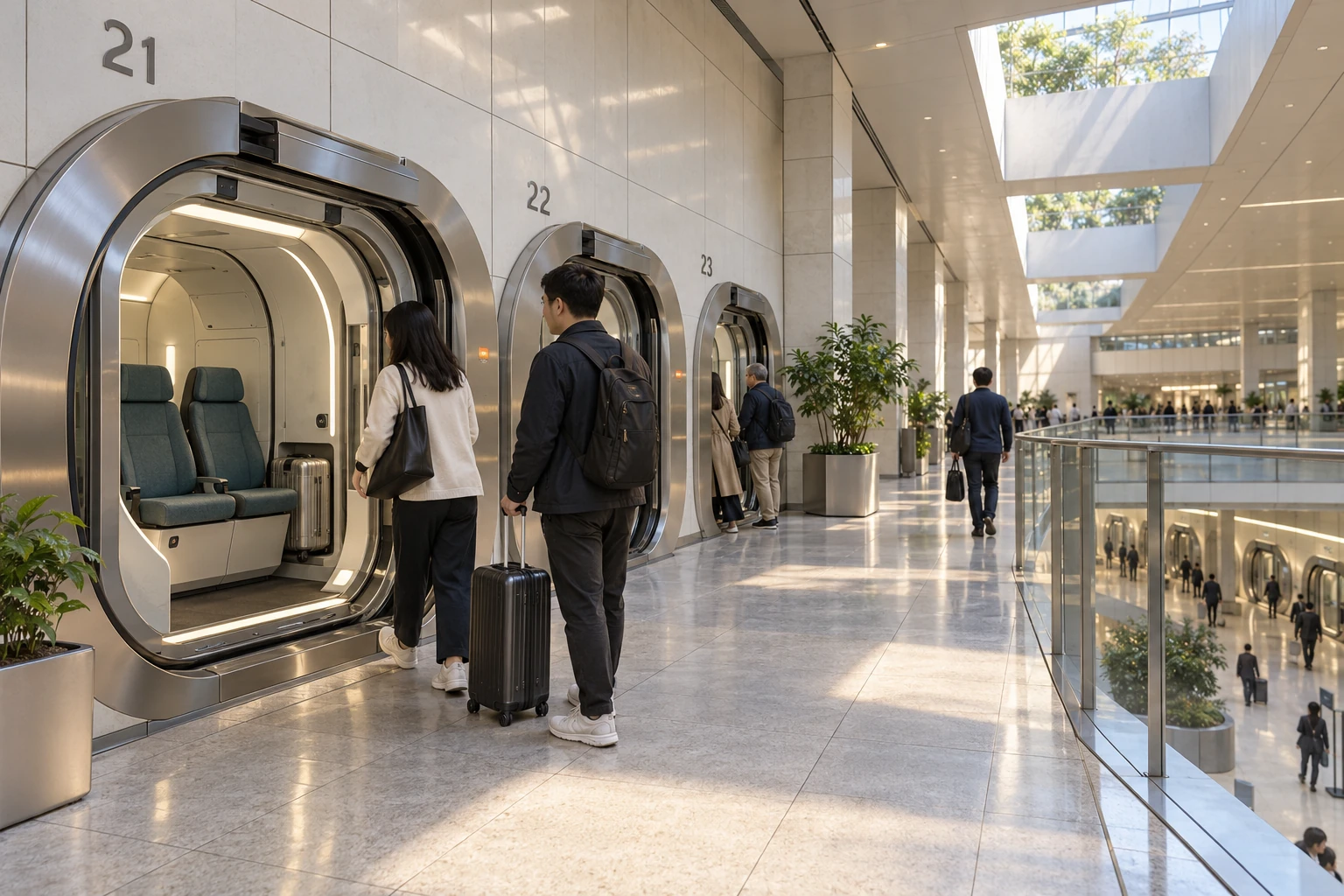
The Earth tunnel network developed during the 2030s into the principal means of passenger transport between the planet’s inhabited regions. By about 2040, its neighborhood branches, continental trunks and transoceanic connections formed a continuous system through which almost every journey could be completed in one private pod. Entrances ranged from public pavilions to apartment basements and household shafts. A Los Angeles–Singapore trunk journey took approximately fifty minutes.
Pangaea Transit Corporation operated the principal international network through regional subsidiaries and concession partners. Municipal and regional systems exchanged vehicles with it under common standards. The combined network recorded its trillionth passenger journey in 2037 and first exceeded a trillion journeys in a calendar year in 2039.[1]
The network combined evacuated guideways, magnetic propulsion, automated traffic control and rotating cabins. Molecular manufacturing made construction inexpensive enough to support extensive parallel routes. Political accommodations multiplied the cost of representative American and British projects by roughly ten. During the rollout, some American passenger systems remained limited to tram speeds while their owners operated high-speed networks abroad. Rapidly expanding industrial wealth financed deep bypasses, additional connections and property settlements while preserving many local restrictions.
History
The industrial expansion following the 2029 superduperintelligence merger supplied the machinery, energy infrastructure and automated research needed for rapid construction. Public demonstration services opened in 2030, followed by commercial regional systems in 2031–32. Excavation machinery worked from many fronts simultaneously, fabricating reinforcement and guideway equipment as it advanced. Processed rock supplied construction feedstock; remaining material moved to receiving sites.
The Singapore pod network, completed in 2033, was the first comprehensive metropolitan system. Its concession bundled trunk routes, public entrances and building connections into one programme. American investors supplied most of the capital and machinery, while the city required broad public access. Singapore’s opening became Pangaea’s principal demonstration of continuous neighborhood-to-neighborhood service.
Continental networks connected during 2035–38. Technical agreements established compatible vehicles, pressure interfaces, emergency behavior and traffic reservations. The through-journey guarantee assigned one carrier responsibility for completing a passenger’s trip across several operating companies. It gave operators a financial reason to secure receiving capacity before dispatch.
Access networks expanded alongside the fast trunks. The resulting service allowed passengers to board near home, cross a continent and emerge near their destination in the same cabin. By 2040, major inhabited regions had continuous service; regional branches reached smaller settlements and isolated properties. The Solar Dyson swarm, completed in 2035, enlarged the available energy supply, while terrestrial power delivery and heat rejection determined how much could be used along individual routes.
Forecasts based on airline and automobile travel repeatedly underestimated demand. Private cabins, short access times and convenient departures encouraged journeys for meals, social visits and recreation. Capacity expansion continued after the network’s geographical completion.
Ownership and finance
American industrial ownership
American-controlled holding companies and post-merger trusts held approximately 95% of the world’s productive capital during the initial construction boom. Much of their machinery stood abroad. Their position arose through automated capital succession: the earliest factory fleets manufactured additional fleets whose ownership remained with the original investors. Successive rounds of expansion compounded those holdings. As independent invention reduced design royalties, control of energy installations, material stocks and strategically located sites sustained much of their income.[2]
Construction advanced fastest where governments could authorize continuous corridors and their entrances together. American companies therefore operated comprehensive foreign networks while negotiating expensive metropolitan extensions at home. Singapore exchanged corridor access for service obligations; Chinese municipalities acquired stakes in local concessions. Host governments retained bargaining power through their control of land, destinations and operating rights.
Pangaea was incorporated in Delaware in 2030 by industrial holding companies and energy investors. Its regional subsidiaries owned or leased guideways, while municipal authorities, cooperatives and property owners held many entrances. By 2040 it carried 74% of network journeys. Its most valuable assets included connected destination networks, long corridor concessions, power infrastructure and the financial reserves behind its journey guarantees.
American corporate income reached municipalities through negotiated contributions, federal transfers and infrastructure endowments. Allocation disputes persisted between the jurisdictions hosting profitable industry and those seeking new transport access. Public authorities also used overseas concession approvals and procurement agreements to obtain commitments for domestic service.
Fares and access
Transport allowances, introduced through metropolitan service agreements during the mid-2030s, covered routine journeys for eligible residents. Their scope varied: some included intercontinental travel, while others funded a regional allocation with supplements for longer trips. Subscriptions and individual fares covered additional travel; priority departures and unusually demanding vehicles attracted separate charges.
Public pavilions, building lobbies and private shafts fed the same shared system. Neighborhood cooperatives could restrict who emerged at their own entrances. Commercial districts generally favored public access. Household connections reduced the walking portion of a journey, making the final few hundred metres an important subject of access policy.
Construction and regulation
The network’s three-dimensional easements specified permitted volumes beneath properties, together with obligations for settlement, vibration, inspection and later redevelopment. Adjacent parcels could impose different depth limits and access conditions. Designers assembled continuous routes through these volumes and acquired additional space for acceleration, braking and junctions.
American and British accommodation programmes commonly cost around ten times their unconstrained engineering equivalents. The comparison included additional construction, property settlements, repeated design work and legal obligations. Rapid growth made these programmes affordable. Local vetoes survived alongside excellent eventual service because operators could pay for circuitous alignments and elaborate agreements.[3]
United States
The United States combined ownership of the leading manufacturers with an exceptionally large gap between demonstrated capability and permitted passenger service. During the 2030s, completed guideways stood idle or operated under restrictions inherited from early demonstration permits. Permission to build, connect, carry passengers, alter a timetable and increase speed could require separate proceedings. Technical improvements arrived faster than applications to use the previous improvements could be processed.
The San Francisco Peninsula interconnection dispute of 2032–35 concerned two local pod systems south of San Francisco, developed under urban-transit arrangements. Their proposed connection to a wider network triggered federal railroad review and disagreements over requirements inherited from conventional railways. Pangaea’s national operating certificate resolved the technical regime in 2035; municipal entrance approvals remained separate. The dispute followed an earlier jurisdictional problem: the US Department of Transportation’s 2021 hyperloop review had placed electromagnetic-guideway systems within Federal Railroad Administration jurisdiction and anticipated an alternative regulatory framework or extensive waivers.[4]
The Peninsula systems’ interim operating permits capped passenger pods at 40 km/h (25 mph) during 2033–35. Empty certification pods traversed the same straight sections at 600 km/h under the passenger-motion limits, and identical vehicles already carried passengers at that speed abroad. Each permit renewal preserved the interim speed limit while the interconnection review continued.
Separate entrance permits at San Mateo and Palo Alto incorporated a timetable releasing pods in batches at twenty-minute intervals. Amendments remained pending until 2036, a year after the national certificate authorized continuous automated operation. Loaded pods waited for the appointed minute with their routes and destination berths already reserved.[3]
In the Los Angeles residential bypass settlements of 2034–37, neighborhood agreements prohibited passenger guideways within specified property volumes even where predicted surface effects were negligible. Pangaea acquired deeper corridors and constructed additional approaches beneath willing commercial properties. Some residents subsequently bought private connections from their homes. Settlements preserved paving, mature trees and street appearance while regulating the locations and users of public entrances.
These negotiations had a precedent in the K Line Northern Extension. During its planning, objections about historic neighborhoods, property and tunneling prompted studies of alternative alignments beneath public streets. Noise and vibration featured among the concerns, although Metro reported receiving no such complaints from people above its existing tunnels.[5][6]
By 2040, settlements and revised certificates had removed most of the early operating caps, allowing American trunk services to approach the network’s standard performance. Large gaps persisted in the availability of entrances and the speed of extending service. The same industrial wealth that paid for deep bypasses also paid for parallel certification teams, prolonged proceedings and replacements for recently completed infrastructure when an approval specified a different design.
United Kingdom
The Richmond entrance proceedings of 2034–36 left an operational regional guideway serving the district through neighboring entrances. Conservation requirements, construction-access conditions and successive revisions to the entrance building generated repeated submissions. The settlement placed the boarding complex underground and incorporated its surface access into an existing building. Passenger travel began through that entrance after the guideway had already carried through traffic for two years.
At Euston, the 2035–38 interface settlement reconciled the pod terminal with railway works, redevelopment agreements and existing construction contracts. Changes to the new terminal required renegotiating those interfaces. The final agreement paid out inherited obligations and retained selected structures within a larger underground complex. Earlier railway work at Euston had already demonstrated the cost of repeated redesign: the National Audit Office reported £106 million of discarded design work and a replacement ten-platform design estimated to cost £400 million more than its predecessor.[7]
Large approval costs also predated pod construction. The government’s 2025 infrastructure impact assessment cited £267 million in planning costs for seeking approval for the Lower Thames Crossing. Later tunnel concessions treated preparation, consultation and approval as major funded workstreams, with teams retained while automated machinery completed less contested sections.[8]
Network and operation
Guideways and junctions
Capillary transit connected neighborhood entrances to regional routes. Continental and transoceanic trunks carried the fastest services. Local branches operated at speeds suited to frequent junctions, while long acceleration routes brought pods into compatible traffic streams. Arrival routes separated them from the main flow and progressively reduced speed before the destination’s local network.
High-speed junctions occupied large underground volumes. Comfortable changes of direction required long, shallow divergences; a pod’s eventual exit affected its route well before arrival. Electronically coordinated convoys shared acceleration and braking schedules. Joining pods matched the receiving formation’s motion on separate approaches. Parallel bores carried different speed profiles and provided capacity for planned diversions.
Transoceanic routes followed Earth’s curvature through the crust beneath the seabed. Alignments accounted for faults, plate boundaries, thermal conditions and maintenance access. Excavation systems reinforced their surroundings, assembled guideway equipment and transported material away as they advanced. Distributed pumps maintained the low gas pressure needed to limit drag and heating.
Boarding and borders
A public entrance usually resembled a lift lobby. Passengers boarded a pod in an atmospheric berth. The vehicle and dock then sealed, the berth recovered its air, and the pod entered the evacuated guideway. Parallel berths let passengers board at their own pace. Larger building entrances accommodated wheelchairs, beds and luggage directly.
A through journey reserved a compatible route and receiving berth across the participating operators. The passenger chose a destination and service class; the network scheduled the intervening streams. Changes in operating company occurred while the pod continued moving.
International travel incorporated permission to enter the destination jurisdiction. Where agreements allowed it, identity and customs checks took place before departure or through declarations reviewed during the journey. Passengers requiring examination arrived at a controlled berth. Closed borders, quarantines and restrictions on particular organisms remained constraints on the destinations available for booking.
Shared vehicles served major events and exceptionally concentrated corridors, especially central Shanghai–central Beijing. Compartmented vehicles retained privacy for small groups while reducing the number of separate terminal arrivals. Event dispatch matched departures to the release of audiences from particular sections of a venue.
Passenger experience
Standard service kept perceived gravity between 0.7 and 1.3 g, with gradual changes in load. The rotating passenger cabin could turn through a full revolution in any direction, aligning its floor with the resultant force on its occupants. Lateral loads within the cabin remained small. Acceleration, braking, guideway curvature and cabin orientation were planned together.
The cabin, furnishings and occupants rotated as a unit. Passengers could read, eat or converse while the vehicle changed attitude relative to the ground. A cup’s liquid surface remained approximately parallel to the cabin floor. Displays offered a stable interior scene or an interpreted view of the route. Gentler services used narrower load ranges and longer journey times.
At the highest trunk speeds, Earth’s curvature changed the direction of the required guide force. Above the local circular-orbit speed, the guideway held the pod inward and the cabin gradually inverted relative to the ground. At approximately 11.2 km/s, a surface-following cruise could produce roughly familiar weight through the inverted floor. The complete force budget included Earth’s rotation and the route’s three-dimensional curvature.[9]
| Journey | Running time |
|---|---|
| Approximately 1,000 km | 15–20 minutes |
| Approximately 5,000 km | 30–40 minutes |
| New York–Shanghai | 40–50 minutes |
| Los Angeles–Singapore | 45–55 minutes |
Local routing, boarding and movement through destination buildings added to these times. Most passengers remained in their original pod through the local and trunk stages. A departure display continuously updated the expected arrival time at the destination entrance.
Traffic and stations
The network recorded 1.46 trillion passenger journeys in 2040, averaging about four billion a day. Cumulative traffic through that year reached 4.531 trillion. Regular travelers included unmerged biological people, integrated people using physical bodies and independently embodied branches. About two billion people used the network regularly during the year.[1]
| Year | Annual passenger journeys | Cumulative journeys |
|---|---|---|
| 2030 | 50 million | 50 million |
| 2032 | 6 billion | 6.85 billion |
| 2034 | 70 billion | 100.85 billion |
| 2036 | 320 billion | 580.85 billion |
| 2037 | 540 billion | 1.121 trillion |
| 2039 | 1.13 trillion | 3.071 trillion |
| 2040 | 1.46 trillion | 4.531 trillion |
Shanghai Central
Shanghai Central, beneath People’s Square and the Nanjing Road commercial district, was the busiest terminal in 2040, averaging 12.4 million passenger arrivals and departures daily. It combined approximately 10,000 private-pod berths with shared-vehicle halls, connected through several underground levels and numerous street and building entrances. The Shanghai–Beijing services supplied a substantial part of its shared-vehicle traffic.
Most of its passengers began or ended journeys in the district. Through-pods continued on the running network. Shanghai’s concentrated public entrances, dense destinations and large visitor population supported a single exceptionally busy complex. American metropolitan traffic was more widely distributed among building lobbies, neighborhood facilities and household shafts.
Terminal capacity depended on the entire path between pod and destination. Operators coordinated berth assignment, lift service and pedestrian circulation. Large venues received arrivals at entrances associated with particular seats or rooms. Booking restrictions at a destination could limit arrivals even while its approach tunnels had spare capacity.
Energy and safety
Stationary magnetic equipment propelled and guided vehicles. At 11.2 km/s, each tonne of moving mass carried approximately 17.4 megawatt-hours of kinetic energy. Regenerative braking returned much of that energy to accelerating traffic or stationary storage. Operators reserved both propulsion and braking capacity before admitting a vehicle to a fast route. Electrical losses, residual-gas drag, pumping and auxiliary systems produced heat that cooling equipment removed continuously.
Stopping distances on the fastest routes extended over thousands of kilometres. A journey therefore depended on the condition of a long protected corridor and the coordinated behavior of its traffic. Close-running formations shared braking commands; protection against a suddenly blocked guideway required additional containment, structural assurance and sufficiently distant diversion opportunities.
Guideways used separately monitored containment layers, redundant power and control equipment, and continuous inspection. Pressure-isolation gates operated with knowledge of approaching traffic and closed only after their protected running paths were clear. Parallel routes supplied diversion capacity where the available distance allowed vehicles to reach them.
Maintenance machinery measured alignment, vacuum quality and the surrounding structure, replacing components within the operating infrastructure. Larger interventions diverted traffic to adjacent bores. The largest regional interruption before 2040 followed the 2037 Aleutian ground displacement, when precautionary closures and guideway replacement diverted North Pacific services for forty-six hours. Through-journey guarantees paid for rerouting and accommodation during the interruption.[10]
Social effects
The network enlarged the geographical range of ordinary social life. Friends on different continents met regularly in person, and families gathered without arranging their lives around flight schedules. Restaurants, gardens and performance venues acquired customers from across the planet. A small restaurant could face worldwide demand while retaining the same number of tables. Popular landscapes introduced arrival reservations, and event organizers coordinated transport bookings with admission.
Small towns with good entrances attracted residents who wanted frequent access to major cities. Urban streets and former parking areas accommodated gardens, housing, markets and pedestrian space. Major centers retained advantages in their concentrations of people and desirable destinations. Physical travel served companionship, sensation, care and recreation alongside telepresence and distributed forms of identity.
Unusual passengers
Commuter reefs were embodied communities housed in engineered coral colonies and associated computing modules. Their residents traveled in circulating seawater tanks, retaining living tissue, substrate and chemical surroundings throughout the journey. Some colonies booked a single cabin for several independently registered minds. Fare agreements charged for the occupied vehicle capacity while passenger accounts followed the registered travelers. Reef delegations made aquarium berths a familiar feature of larger terminals.
Migrating cul-de-sacs extended private through-travel to entire residential streets. Each house traveled with its original garden, an engineered root-and-soil bed and an assigned section of paving inside a large pressurized carrier. Oversize freight bores moved the parcels at low acceleration; licensed receiving plots reassembled the street in its established order. Residents could remain at home during seasonal relocations, with utilities supplied by the carrier and passenger connections available at scheduled stops.
Conservation agreements for these streets specified the buildings, trees, paving and relationships among parcels to be preserved. Receiving sites could therefore host the same protected neighborhood at different times of year. Relocation schedules preserved access to particular climates and social destinations while keeping neighbors, gardens and familiar interiors together. Their construction demands and scarce receiving plots made them an expensive edge case of a system whose ordinary vehicle carried one person or a small group.
See also
- 2029 superduperintelligence merger — changes in identity, embodiment and institutions
- Economy of the available universe — industrial ownership and the later economics of physical transport
- Space NIMBYism — subsequent disputes over development and shared surroundings
- Cooling rights — allocation of heat-rejection capacity
- Giraffecycle — an earlier form of personal transport
References
- Pangaea Transit Corporation (2041). Network Traffic Return, 2040.
- Terrestrial Capital Registry (2042). Ownership through the First Industrial Replication Boom.
- Pangaea Transit Corporation (2041). Completed Access Programmes: American and British Settlements.
- US Department of Transportation (2021). Hyperloop Standards Desk Review.
- Los Angeles County Metropolitan Transportation Authority (2026). K Line Northern Extension: Community Engagement Summary.
- Los Angeles County Metropolitan Transportation Authority. Tunneling.
- National Audit Office (2023). High Speed Two: Euston.
- UK Government (2025). Planning and Infrastructure Bill: Impact Assessment Annexes, paragraph 185.
- Pangaea Transit Corporation (2040). Passenger Motion Standard, edition 4.
- Pangaea Transit Corporation (2041). Operations and Interruption Register, 2030–2040.