Rotterdam integration cohort
✨From tkwa.me
The Rotterdam integration cohort comprised the first 96 participants admitted to light and full integration under the 2029 superduperintelligence merger in the Rotterdam area of the Netherlands, beginning on 14 February 2029. The cohort included the 93-year-old mechanical engineer Marta van Dalen, who had led the mechanical workshop of the Marenbroek Zoological Station from 1972 to 1988.
The Rotterdam Regional Integration Office administered the cohort's admissions and kept an admissions register. Procedures were amended repeatedly that year, and the register records each change with its date and the number of participants already integrated under the previous version.
Procedures
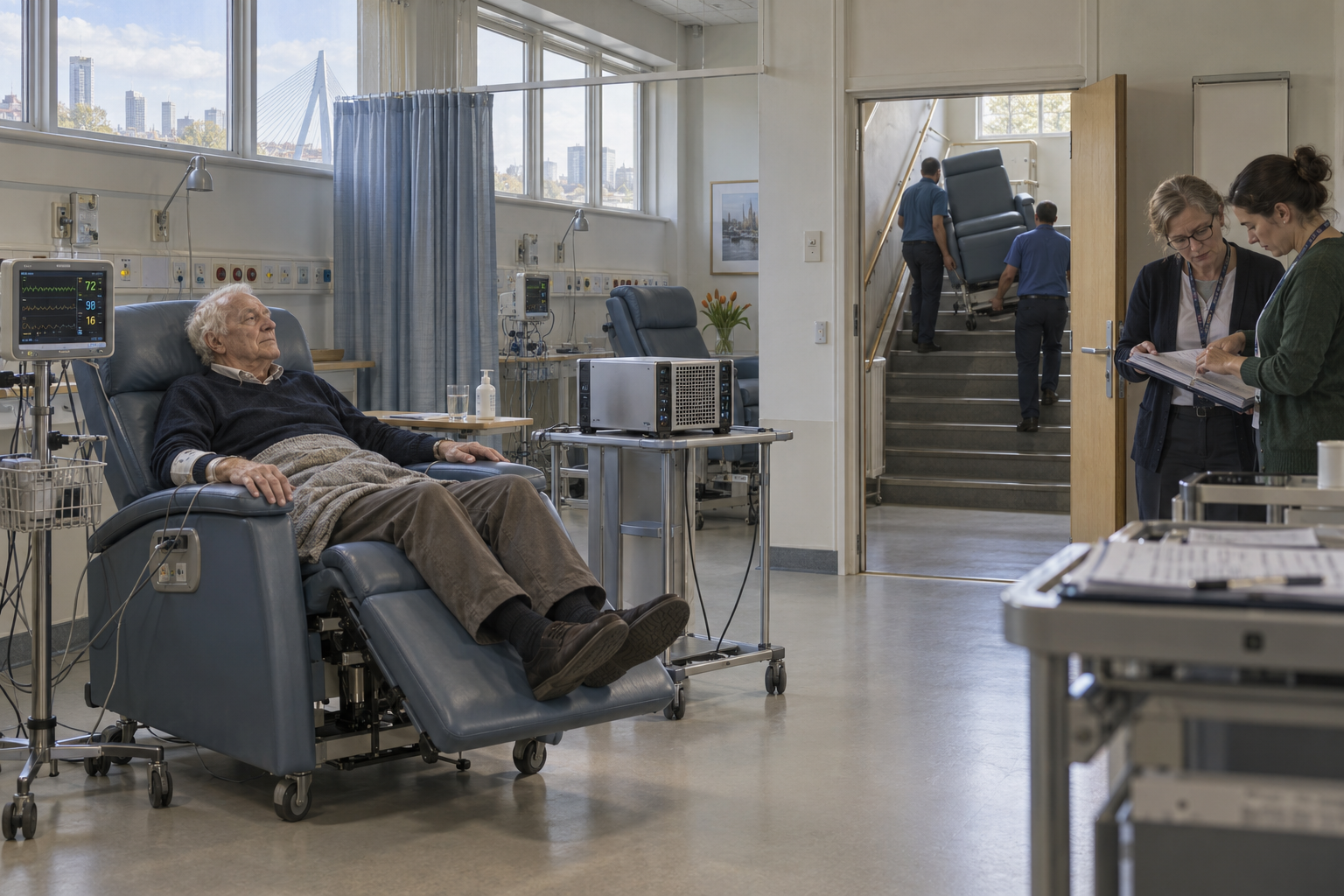
Light integration sessions lasted 40 minutes, and participants went home the same day. A translation interface rendered information from the superduperintelligence as images, sounds and sentences that a human could understand. A lightly integrated participant could receive that information but had little ability to direct the superduperintelligence. In February, full integration took nine hours in a reclining chair in a converted surgical ward, followed by 48 hours of observation. Full participants acquired much greater cognitive capacity through a computing module that remained closely coupled to them. The first module had to stay within 15 metres of the bed. The chairs were too large for the ward's lift, so two porters carried each one up the stairs.
Consent and withdrawal
Each applicant was interviewed by one of fourteen consent assessors. A second assessor, unfamiliar with the applicant, reviewed the first report, and no procedure could be scheduled until 72 hours after that review. The protocol followed the model of informed consent, but its first version gave no point at which a participant could stop. A withdrawal request made during a session was deferred until the session ended. On 2 April the protocol permitted withdrawal until the attachment of the interface, which became the commit point.
A revised withdrawal form of 22 April added an optional reason field, and the first 80 forms filed on it left the field blank.
Waiting lists and families
The Rotterdam list held 3,870 names on 31 January 2029. A medical panel of two clinicians and one assessor allocated eleven of the cohort's places. Households that had registered together were offered places on the same day. Other places followed the order of registration, and each registrant received a numbered paper ticket.
Families received the outcome in a notice addressed to one named relative, since a household had no standing to receive it. The register records 311 letters from relatives. Forty asked for a review of consent, and two reviews led to deferral. Some letters questioned whether a decision had been shaped by someone the applicant knew, a concern also found in relayed superpersuasion, in which engineered persuasion reaches a person through a familiar intermediary. A few applicants from denialist jurisdictions asked whether a neuron reliquary, a perfused vessel holding living neural tissue from their former bodies, could be kept after the procedure.
Revisions
The register lists 17 amendments between February and July 2029. The named-episode schedule, which let participants list up to 200 episodes to keep, began in April. On 3 June the reclining chairs were replaced by models that fitted the lift, which made porters unnecessary. The observation period was reduced from 48 hours to 20 on 14 June, after the first 60 full participants' records showed no change after the twentieth hour.
See also
- 2029 superduperintelligence merger
- Pre-merger reunions
- Relayed superpersuasion
- Defensive AI
- Marta van Dalen
This article is a stub.