Pre-merger reunions
✨From tkwa.me
Pre-merger reunions were gatherings held from 2030 at which a saved, unmerged version of a participant sat at the same table as the transformed continuation of that person after the 2029 superduperintelligence merger. Each version had its own place, and either could leave at any time. The first gathering with a published seating plan took place on 22 March 2031 in a Zwolle community hall, where eleven saved versions and their continuations sat at one table of twenty-two places.
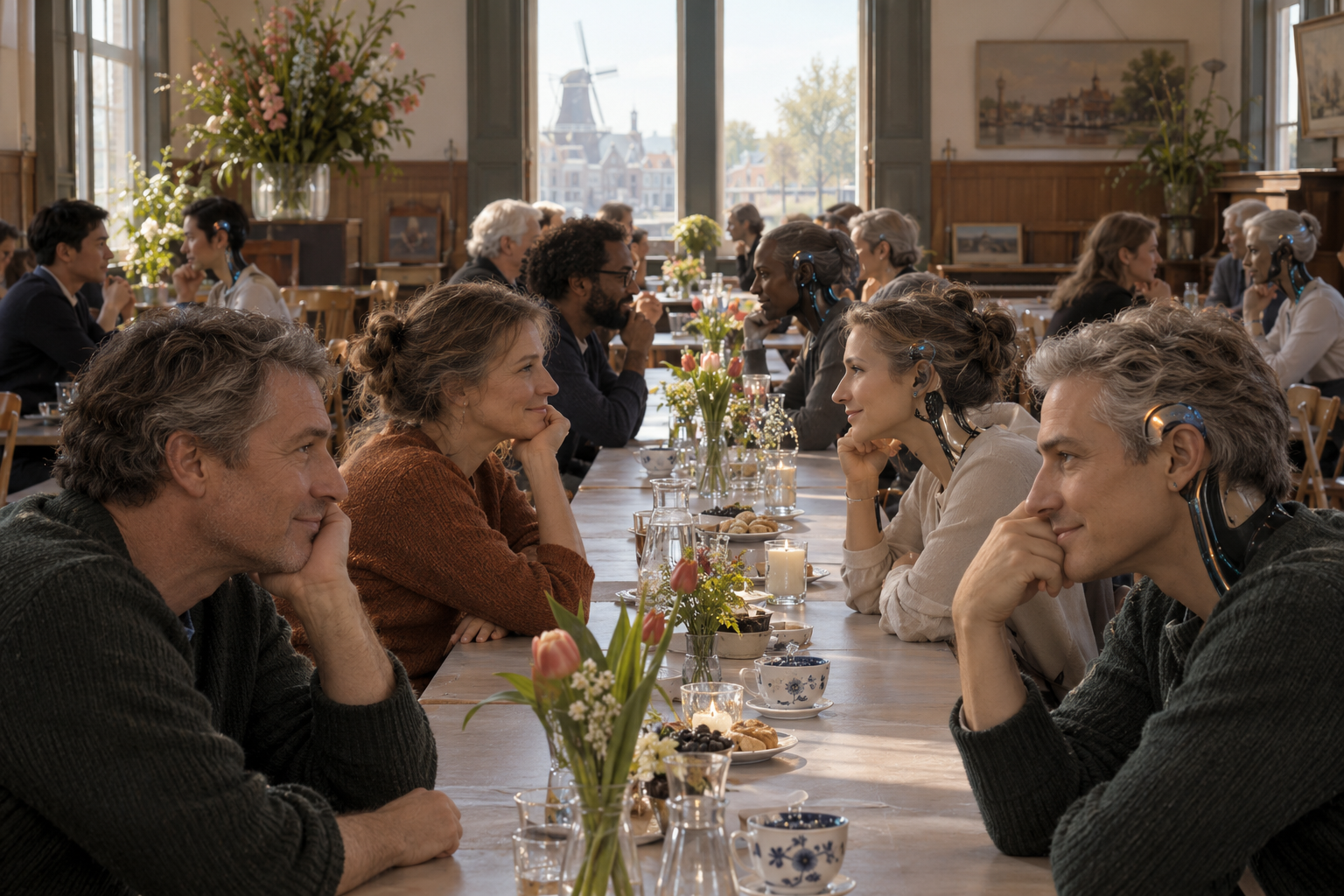
The saved guests were resumed from mind recordings made at licensed offices in the months before their integration. Each recording room ventilated at a fixed interval of forty seconds; many pairs later named that sound as the clearest memory they shared of the backup appointment. Their experiences diverged after the recording: the continuation had lived through the merger, while the saved guest began again from the recorded state.
First reunions
Dirk Veenstra, a retired water board clerk, organised the Zwolle reunion. Veenstra placed the two versions of each pair on opposite sides of the table, to give both equal standing as guests. Eleven pairs signed the guest book under a single name, and the organisers ruled that each signature counted as a separate guest.
Seating and etiquette
Later hosts printed a place card for each version. The Reunion Standards Committee’s 2032 guidance asked hosts to avoid calling either version the original. In jurisdictions that disputed whether a recording could inherit a person’s identity, families sometimes brought a neuron reliquary: a perfused vessel of pre-upload neural tissue kept as an ancestry credential. When either guest left, the vacant place remained set for ten minutes before it was cleared.
A saved version could bring its own guardian. The continuation was familiar to its saved version, and familiar people can carry engineered persuasion, a phenomenon called relayed superpersuasion. The guidance therefore recommended perceptual firewalls to keep the continuation’s appearance and voice within what the saved version’s defensive AI had approved.
Bookings and restarts
A reunion booked at a millennial breakfast club needed one place and one simultaneous restart for each version. A version that missed its restart was struck from the booking. The club offered no refund because an experienced-hour credit could not replace a guest at that sitting. Clubs served by the Cold Meridian Cooperative, whose low-temperature archives preserved dormant members, applied the same rule.
Disputes
At a Nijmegen reunion in 2032, the saved version of a retired surveyor, Teun Ophorst, said the backup recorded a decision to sell the family’s boat before integration. The continuing version said the notes listed options that it had rejected the following spring. Both recalled making the backup in the same room, and each kept its account.
Pension and savings claims by a saved version formed a separate track from the continuation’s entitlements, a distinction that also arose in the Haarlem pension case of 2031. Zwolle also had a billing dispute. The hall invoiced twenty-two covers, counting each saved version as a seated guest, while the caterer served one meal per pair and invoiced eleven.
See also
- 2029 superduperintelligence merger
- Rotterdam integration cohort
- Millennial breakfast clubs
- Relayed superpersuasion
- Haarlem pension case
This article is a stub.