Model galaxy
✨From tkwa.me
This article is about scale reproductions of galaxies. For the dispute between two modellers, see § Brackenridge–Halloway Recursion, and read the Talk page before editing it.
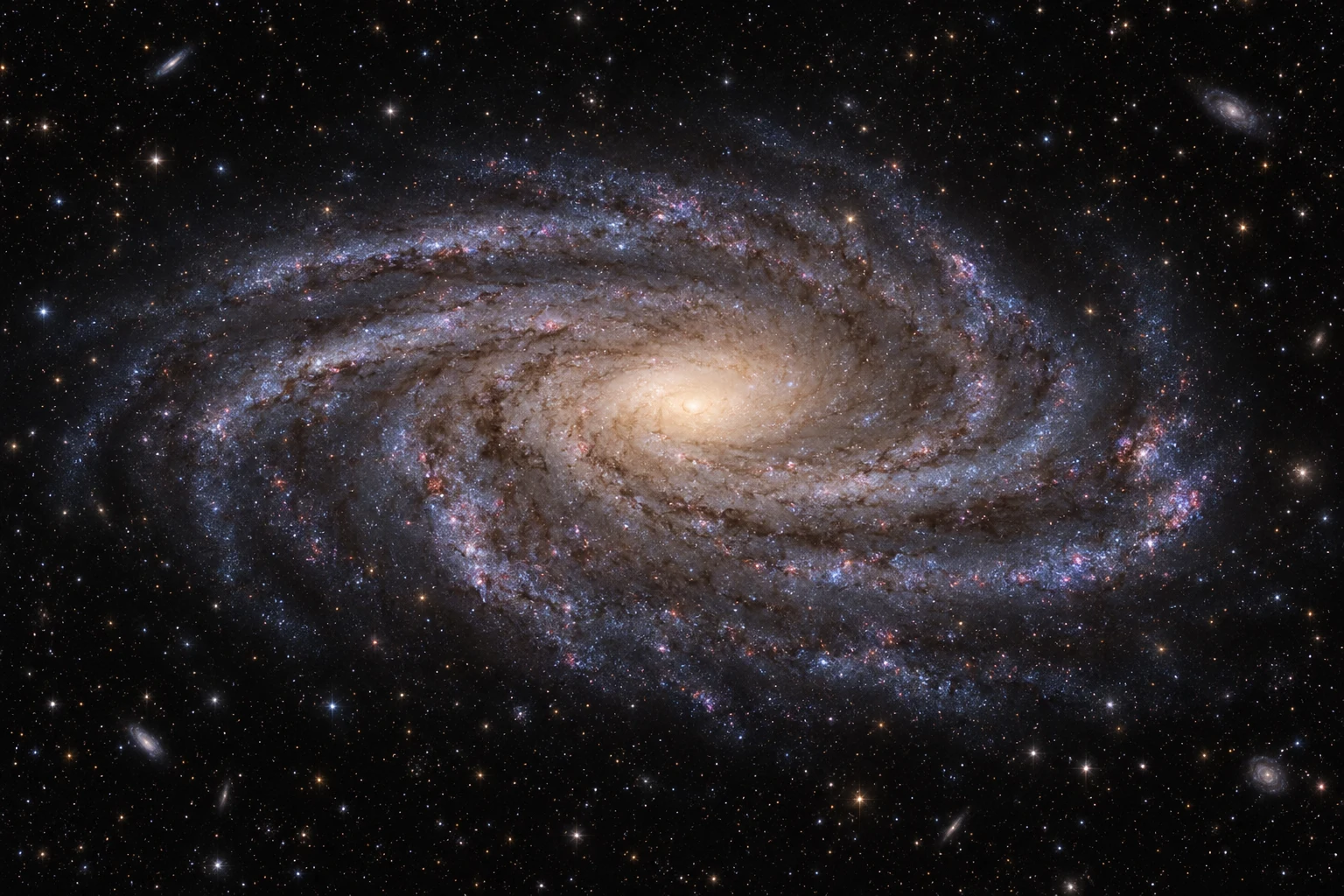
A model galaxy is a working scale reproduction of a real galaxy, complete with scale stars, planets, moons, nebulae and, among serious hobbyists, a scale central black hole. Nearly all model galaxies are built at 1:87.1, the HO scale that the hobby inherited from railway modellers who had, in the words of one founder, "run out of railway".[1] The stellar disc of a 1:87.1 model of the Milky Way is about 1,150 light-years across. Preserving the original mass distribution at constant density preserves its Newtonian orbital periods: a model Earth circles its model Sun once a year, and the model Sun circles the model galactic centre once in about 230 million years.[2]
Almost everything else about the hobby is difficult. Scale stars are too small to burn on their own and run on a buried lamp core; scale planets need diamond "varnish" to hold their air; and the scale black hole problem has divided the hobby for 39 million years. The Guild of Galactic Modellers requires scale figures of the galaxy's modellers and copies of their models. Its accuracy-complaints procedure drew two builders into the Brackenridge–Halloway Recursion, a 28-million-year dispute over a hairline.[3]
History
The hobby began in the late 2030s, soon after the completion of the Solar Dyson swarm made uncontested matter cheap and atomically precise manufacturing routine. The usual story is that a retired signalling engineer bought a starter kit containing a 16,000-kilometre scale Sun and half an Earth mass of hydrogen.[1] He had a scale Solar System within months and a 1:87.1 Orion Arm within a few thousand years. He never finished the Perseus Arm, citing "the back".
The Guild of Galactic Modellers was founded in 2041. Its first act was a 306-year argument over whether the correct scale was 1:87 or 1:87.1. The Guild adopted 1:87.1 in 2347 by a margin the minutes describe as "decisive" and the losing faction describes as "fraudulent".[4] The first complete model, the Kettering Triangulum, opened around 3.4 million CE.[5]
Scale and density
Constant density
Model galaxies work because of one fortunate fact. If every object shrinks in length by 87.1 while keeping its real density, its mass falls by 87.13, or 660,776. Under Newtonian gravity, gravitational acceleration and orbital speed both fall by 87.1, and an orbit 87.1 times smaller takes exactly as long as the original.[2] Model galaxies therefore run in real time, with correct rotation curves. Modellers call this "the only free lunch in the hobby".
Siting
A model Milky Way needs about 1,150 light-years for its stellar disc, with its ballast halo extending thousands of light-years farther. Full-halo models usually occupy intergalactic berths selected for weak ambient tides. The Guild also licenses berths in the galactic halo, "where land is cheap and visitors are few", following a tidal survey. These use active stationkeeping throughout the disc and ballast halo to compensate for the host galaxy's differential pull.[2] A failed compensation system stretches the model, strips its outer ballast and produces complaints from the host galaxy's residents.
Construction
Stars
A scale Sun is 16,000 km across, a little larger than the real Earth. Its total mass is about 3 × 1024 kg. The standard recipe uses the solar photospheric mixture, about three-quarters hydrogen by mass.[21] The lamp core combines an inertial-confinement fusion engine with an actively confined envelope. Distributed magnetic confinement and cooled internal supports maintain the prescribed density profile, while the optical surface radiates at the Sun's nominal effective temperature of 5,772 K.[6] The containment system holds hot gas whose thermal motion exceeds the model star's escape speed. Its machinery is included in the mass budget. Scale planets orbit 87.1 times closer, so the lamp supplies 1/7,586 of the Sun's luminosity, about 5 × 10²² W. The colour then comes out right without adjustment, which modellers describe as "extremely satisfying".[2]
Topping up
A model star holds 1/660,776 of its original's mass and spends 1/7,586 of its power. At equal fusion efficiency, its fuel consumption per kilogram is therefore 87.1 times the full-size equivalent's. A model Sun's roughly 2.2 × 1024 kg hydrogen reservoir would last about 0.9 billion years at its nominal output if all of it were circulated through the engine. Builders add fresh hydrogen and draw off helium continuously, a chore called topping up. A model Sun takes about 79,000 tonnes of hydrogen a second, and the Guild's reference Milky Way model takes about one Earth mass every five weeks.[7] Supply arrives from intergalactic scoop fleets by tanker. Tanker crews write regularly to the trade press about the long, densely starred Scutum–Centaurus Arm.[8]
Planets
A scale Earth is 146 km across. Its surface gravity is 0.11 m/s², its oceans average 42 m deep, and Everest stands 101 m tall. Its escape velocity is about 130 m/s, slower than air molecules move at room temperature, so an unprotected atmosphere leaves within days. Modellers fit a transparent diamond pressure shell at the scaled tropopause, 138 m up. Purists call the shell "varnish" and some call it cheating.[9] Air viscosity, molecular motion and surface tension keep their ordinary values, so miniature raindrops have different terminal velocities and need active weather control. Weather remains the least accurate feature of most models.
Completeness rules require the original's modellers to appear as figures about 2 cm tall, together with copies of their models. Deeper nested copies are ordinarily optional. An accuracy complaint requires an inspected copy of the disputed model, including the feature under complaint; reciprocal complaints can therefore require successively deeper copies.[3] Model railways on a model Earth run at 1:7,586, with a track gauge of 0.19 mm. The sub-hobby, HO-on-HO, is regarded by the Guild as "a lot, even by our standards".[10]
Black holes
Black holes refuse to scale. The Guild's reference Sagittarius A* uses the approximately 4.15-million-solar-mass value measured in 2019.[11] Applying the cubic mass rule gives a 6.3-solar-mass counterpart with an event horizon 37 km across. Applying the linear rule to the original horizon's diameter instead gives 282,000 km. Gravitationalists install the 6.3-solar-mass hole alone, which is dynamically correct and, according to critics, "looks like a full stop". Visualists use a slightly lighter hole inside a hollow, actively supported sphere of tiles, 282,000 km across and coated in Vantablack: the Bowling Ball Compromise. Photon-pressure supports hold the tiles in place. The hole, display and support machinery together retain the 6.3-solar-mass budget, preserving the central gravitational field outside the display. Gravitationalists call the sphere "a lie told in paint".[12] The Guild permits both approaches and forbids the subject at its annual dinner.[10]
Dark matter
About 95% of the Guild's reference Milky Way model's mass represents its dark matter halo; without the halo's pull the disc rotates wrongly and flings outer stars into neighbouring models. Most modellers use MACHO ballast, a diffuse halo of scaled massive compact halo objects with the required mass and radial distribution. The name came from early microlensing surveys, whose candidate compact lenses were estimated to supply part of the Galactic halo; the 2000 MACHO analysis favoured about 20% under its standard model.[13] Purists insist on certified, ethically sourced dark matter, which no inspector has ever seen.[2]
Light
The speed of light stays fixed at every scale. Sunlight reaches a model Earth in 5.7 seconds instead of 8.3 minutes, and light from the model centre reaches the model Sun in about 300 years instead of 26,000. Each model's sky is therefore "87.1 times too current", a condition the Guild tolerates as "unavoidable freshness".[2]
Materials
A complete model Milky Way uses about 2 million solar masses, most of it supplied by stellar dismantlers through star lifting.[7] Modellers who build their home galaxy remove the scale counterparts of their own materials from the model, a practice described as "paying for the kit".[3]
Notable models
The Kettering Triangulum, a model of the Triangulum Galaxy about 700 light-years across, was the first complete model galaxy. Its Guild review is still in progress.[5] The Large Magellanic Cloud (Unfinished) was abandoned in 18.4 million CE when its committee concluded that the real Large Magellanic Cloud, an irregular galaxy, is "also, frankly, unfinished".[14] The 1:87.1 Sombrero carries a decorative tassel, the only intentional inaccuracy the Guild has approved; it later withdrew the approval.[15]
Brackenridge–Halloway Recursion
The neutrality of this section is disputed. See the discussion on the Talk page.
The Brackenridge–Halloway Recursion is one of the hobby's longest disputes, having outlasted every O-type star that was shining when it began.[15]
Origin
Ottoline Brackenridge-Fenn lives in the Milky Way and builds a 2,500-light-year model of the Andromeda Galaxy. Dmitri Halloway-Quist lives in Andromeda and builds a 1,150-light-year model of the Milky Way. Both are biologically immortal. Light takes 2.5 million years to cross between them, so each copies the other's model as it looked 2.5 million years earlier.[15]
Around 11.6 million CE, Brackenridge-Fenn noticed that Halloway-Quist's 2-cm figure of her had its hairline 2 mm too far back at full scale, a 23-micrometre error on the figure.[16] Halloway-Quist called his figure "the best data available".[17] She built the figure of his house in her model one plank short, an omission the Milky Way Inspectorate confirmed in 11.7 million CE.[18]
Escalation
Both modellers filed accuracy complaints, requiring inspected copies of the disputed models. Brackenridge-Fenn's Level 2 copy of Halloway-Quist's Milky Way model carried a corrected hairline on a figure 0.23 mm tall. Halloway-Quist received it 2.5 million years later and reproduced it at Level 3 with the hairline restored. Each complaint about a submitted copy demanded the next inspected copy. The parties have since alternated, each level arriving after an approximately 2.5-million-year crossing: Brackenridge-Fenn built the even levels, from Level 2 in 11.6 million CE to Level 10 in 31.6 million CE, and Halloway-Quist the odd levels, from Level 3 in 14.1 million CE to Level 11, sent in 34.1 million CE.[15]
| Level | Galaxy | Sun-like star | Modeller figure | Milestone |
|---|---|---|---|---|
| 0 | 100,000 ly | 1.39 million km | 1.75 m | The real galaxy |
| 1 | 1,150 ly | 16,000 km | 20 mm | Hairline; plank |
| 2 | 13 ly | 183 km | 0.23 mm | Corrections |
| 3 | 0.15 ly | 2.1 m[dubious – discuss] | 2.6 µm | Corrections of corrections |
| 4 | 110 AU | 24 m | 30 nm | Figures the size of viruses |
| 5 | 1.3 AU | 28 cm | 0.35 nm | Correspondence moved to lawyers |
| 10 | 38 m | About one atom | — | "The Floor" |
| 11 | 43 cm | Subatomic | — | Disputed |
The Floor
At Level 10 each Sun-like star is represented by a single hydrogen atom, roughly the right size and about 13 times too heavy; the Inspectorate accepted the excess. The thin stellar layer holds about 400 atoms per cubic centimetre, a better vacuum than most ultra-high vacuum laboratories, and inspectors could not distinguish it from an empty chamber.[15]
Halloway-Quist's Level 11 uses stars made of implication. He announced that Brackenridge-Fenn "simply lacked the commitment".[17] She received the announcement in about 36.6 million CE and replied the same day. Her reply, in full, was "Plank."[16]
Current status
The reply was due to reach Andromeda around 39.1 million CE; a response or delivery confirmation cannot reach the Milky Way before about 41.6 million CE. Each round of correspondence takes about 5 million years. At the approximately 110 km/s approach speed used in the Guild's timetable, the round-trip light delay shortens by about 3,700 years per round.[19] The timetable still quotes the roughly four-billion-year first close passage of the two galaxies calculated in 2012. The Guild's fourth arbitration notice asks both parties to "consider the possibility that it was never about the hairline".[20]
See also
- HO scale — the railway-modelling standard behind 1:87.1.
- Solar Dyson swarm — the project whose completion made the hobby affordable.
- Intergalactic scoop fleets — the main hydrogen supply for topping up.
- Guild of Galactic Modellers — standards, inspections and arbitration.
- List of disputes that outlived their stars — other arguments measured in stellar lifetimes.
- Bowling Ball Compromise — the painted-sphere answer to the black hole problem.
References
- ↑ a b Halsey, Imogen (9,840 CE). Run Out of Railway: An Oral History of Galactic Modelling. Orion Arm: Guild Press.
- ↑ a b c d e f Guild of Galactic Modellers (39,200,000 CE). Handbook of 1:87.1 Galactic Modelling (1,118th ed.). Guild Press.
- ↑ a b c Guild of Galactic Modellers (39,350,000 CE). Rules of Completeness and Conduct. Guild Press.
- ↑ Guild of Galactic Modellers (2347). Minutes of the scale question, 2041–2347. Guild archive.
- ↑ a b Kettering Triangulum Trust (3,400,000 CE). Opening weekend programme. Kettering Triangulum Trust.
- ↑ Prša, A.; et al. (2016). "Nominal values for selected solar and planetary quantities: IAU 2015 Resolution B3". The Astronomical Journal. 152 (2): 41.
- ↑ a b Galactic Modellers' Gas Exchange (39,380,000 CE). Delivery statistics: Milky Way scale models. Gas Exchange.
- ↑ Tanker & Topping-up Monthly (39,390,000 CE). "Letters: the Scutum–Centaurus run".
- ↑ Ollerenshaw, P. (412,000 CE). "Against varnish". The Galactic Modeller.
- ↑ a b Guild of Galactic Modellers (39,400,000 CE). Annual report, appendix on HO-on-HO standards.
- ↑ GRAVITY Collaboration (2019). "A geometric distance measurement to the Galactic center black hole with 0.3% uncertainty". Astronomy & Astrophysics. 625: L10.
- ↑ The Galactic Modeller (1,206,000 CE). "Paint, purity and the centre".
- ↑ Alcock, C.; et al. (2000). "The MACHO Project: Microlensing results from 5.7 years of Large Magellanic Cloud observations". The Astrophysical Journal. 542 (1): 281–307.
- ↑ Large Magellanic Cloud (Unfinished) Committee (18,400,000 CE). Notice of abandonment.
- ↑ a b c d e Guild of Galactic Modellers (39,400,000 CE). Brackenridge–Halloway: summary of proceedings. Guild archive.
- ↑ a b Brackenridge-Fenn, O. (11,600,000–39,300,000 CE). Complaints to the Guild, nos. 1–4,112.
- ↑ a b Halloway-Quist, D. (14,100,000–36,900,000 CE). Statements to the Guild.
- ↑ Milky Way Inspectorate (11,700,000 CE). Report on a plank. Guild archive.
- ↑ van der Marel, R. P.; Besla, G.; Cox, T. J.; Sohn, S. T.; Anderson, J. (2012). "The M31 velocity vector. III. Future Milky Way–M31–M33 orbital evolution, merging, and fate of the Sun". The Astrophysical Journal. 753 (1): 9.
- ↑ Guild of Galactic Modellers (39,390,000 CE). Arbitration notice 4.
- ↑ Asplund, M.; Amarsi, A. M.; Grevesse, N. (2021). "The chemical make-up of the Sun: A 2020 vision". Astronomy & Astrophysics. 653: A141.