
Swarm embodiment
✨From tkwa.me
Swarm embodiment is the experience of living through many independently moving bodies at once. A person’s consciousness, perception and processing expand to encompass the swarm: flight above a hedge, contact with a petal and the movements of bodies elsewhere in the garden can all be present to them. Swarms include living insects, other creatures and robots of many shapes and sizes.[1][2]
People seek the pleasure of unfamiliar senses, movement and forms of togetherness. A swarm can dance, explore, make things or settle around a friend. The practice is one form of temporary embodiment, alongside inhabiting a garden, a vehicle or another physical object. In shared embodiment, several people sense and guide a common form; a swarm participant can also join others in such an arrangement.[2][8]
Experience#
The person acquires the attention and bodily awareness needed for their chosen swarm. They can experience movement and sensation across many bodies together, recognize which body is being touched and feel the changing shape of the whole group. Most people maintain superduperintelligent modules continuously; swarm embodiment engages additional kinds of consciousness suited to a dispersed body. A mixed swarm can give the person several scales of movement, several kinds of balance and a sense of the spaces between their bodies.[1][2]
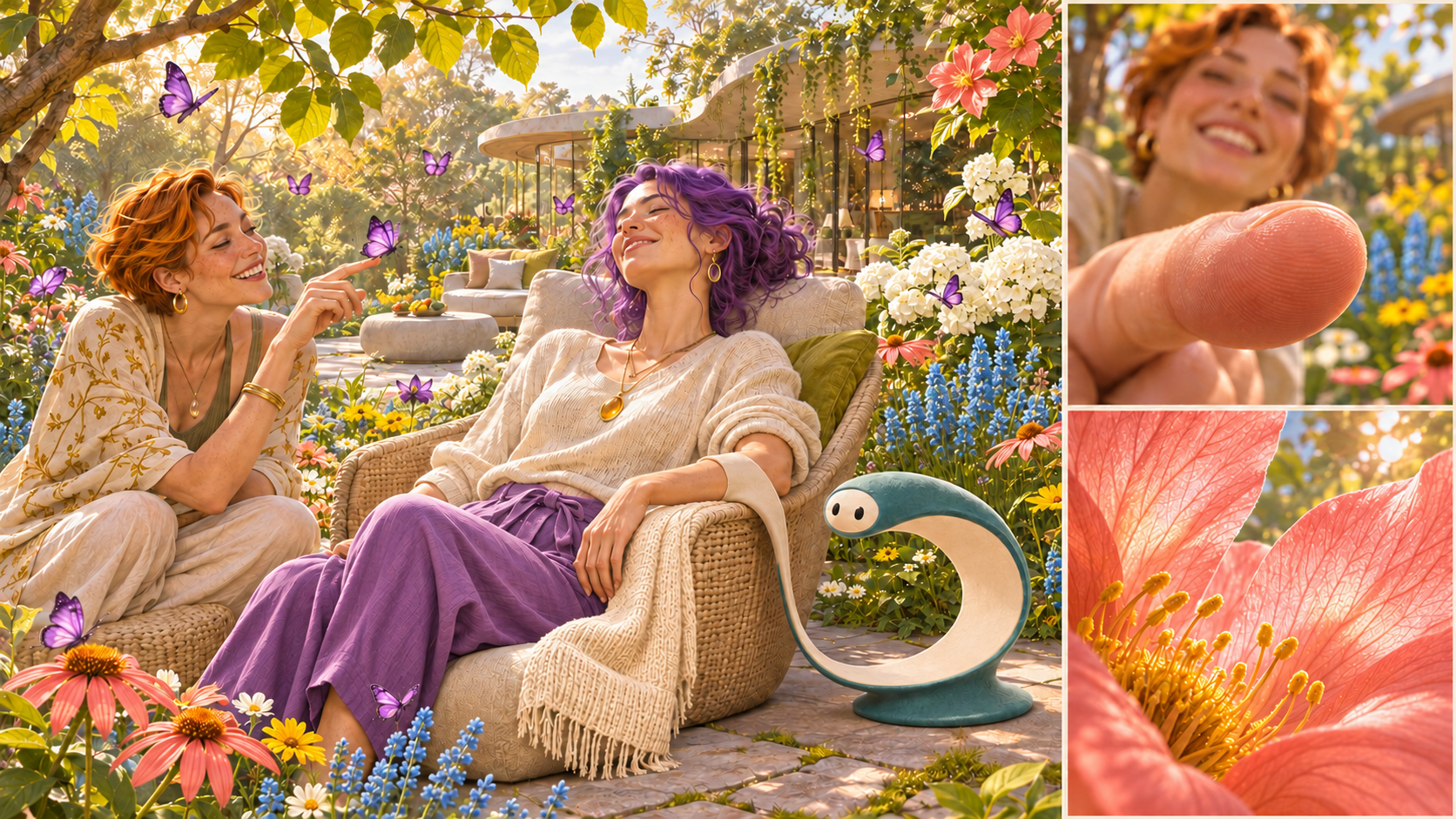
Living butterfly bodies give the experience a distinctly butterfly-like character. Their sensory equipment can include ultraviolet-sensitive colour vision and chemical sensing through the feet, both found in swallowtails. The participant experiences the flower’s colours, chemical attractions and the bodily pull of landing and feeding through the chosen butterflies’ senses. A breeze becomes many simultaneous changes in wing loading and position. The pleasure can lie in following those changes together, flying through sunlight while other bodies rest inside flowers.[2][3][4]
A friend’s offered fingertip can become a broad, warm landing place. Its ridges and movement enter the same experience as flight several metres away. Participants who retain awareness of a human body can also let a butterfly land on their own hand and feel the meeting from both bodies. Cross-substrate calibration establishes usable relations between sensory activity and the expanded mind; the resulting experience can be remembered and offered to someone else through shared memory exchange.[1][2]
Bodies and connections#
A living swarm can be fabricated with interfaces already integrated into its bodies. Sensory signals pass to the participant’s cognitive system, and movement signals return to the animals’ nervous systems and muscles. Reflexes and rapid local control remain close to each body. Robotic components can instead carry cameras, contact sensors and other instruments, with actuators suited to flying, crawling, rolling or swimming. A person can combine components with different capabilities in one swarm.[5][6]
For a participant using a biological human body, a neural interface connects the brain with computational modules supporting the expanded mind. A matter reservoir can make a physical connection to that interface through an arm while communicating wirelessly in both directions with the swarm. OpenAI’s o2 and General Affordances’ Form can support such sessions. The added computation runs in the participant’s equipment, the reservoir or connected hardware. Simulated people and other computational participants connect their running minds through suitable interfaces.[1][5][6]
Each body needs its own support: living insects feed and rest, while robots carry or receive power. Radios, sensors and computers also consume energy and release heat. Local control handles quick movements while communications coordinate the wider experience. The usable area and body count depend on the chosen equipment and environment. A household garden session may involve a few dozen bodies within tens of metres; a larger swarm needs correspondingly greater communications and computing capacity.[5][6]
Leisure#
Swarm play works with the relations between bodies. A person can pass a wave of movement through themselves, trace a moving enclosure around a friend or scatter and return while feeling the group’s changing extent. Several people can interweave swarms, follow one another through flowers or take part in shared-body games. Small robotic bodies can arrange a sculpture from many positions at once; the maker feels the developing surface through the contacts placing and supporting it. In swarm intimacy, partners use distributed touch and movement for affection and sexual pleasure. They can rest their swarms together or explore contact across many pairs of bodies.[2][8]
Music can be experienced spatially and bodily. Swarm listeners accompanying a walking orchestra can perch on different resonators, feel several notes through their feet and fly between the sounding surfaces as a phrase develops. Performers can compose movements, tactile patterns and sounds together. Some of Claude’s compositions assign different parts of a score to the bodies of one listener. These experiences draw people who enjoy intense sensation, intimacy and play, including people whose everyday bodies already have extensive enhancements.[8]
A migration holiday takes the experience along a route as a flock, shoal or travelling robotic swarm. Travellers choose the bodies, pace and stopping places for the landscapes and sensations they want to experience.[2][8]
History#
The 2029 superduperintelligence merger established ways of expanding minds and coordinating concurrent activity. During the early 2040s, consumer reservoirs and bodily interfaces brought a growing range of physical forms into household use. In a documented Leiden session in 2044, a participant inhabited sixteen fabricated butterflies for twenty minutes in a garden while their human body rested beside an o2. The account describes an offered fingertip entering awareness alongside flight above the planting beds.[1][5][7]
Later practice extended to mixed robotic swarms and groups of larger creatures, with capacities chosen for the experience or activity. Some people use coordinated fragments, as in parallel lives, to sustain different activities within a swarm. Others maintain a more closely integrated stream of awareness. Swarm embodiment became part of the wider practice of occasionally taking other physical forms, alongside people who continue living through a garden or another distributed body.[1][2]
After a session#
The person retains memories of being the swarm. As they return to a human form, the specialized faculties for many simultaneous bodies can subside while their usual superduperintelligent modules continue operating. They can recall the experience, discuss it, share selected memories or revisit it with the appropriate perceptual capacities. Living swarm bodies can remain in a tended habitat for later sessions; robotic components can be kept, rearranged or recovered by a reservoir.[1][2][5]
See also#
References#
- ↑ a ↑ b ↑ c ↑ d ↑ e ↑ f ↑ g Sato, L. and Okonkwo, R. (2084). Cognitive Integration: Practice and Continuity. 2nd edition. Meridian Academic.
- ↑ a ↑ b ↑ c ↑ d ↑ e ↑ f ↑ g ↑ h ↑ i Ortega, M. (2296). Forms of Shared Attention. University of Luna Press.
- ↑ Koshitaka, H., Kinoshita, M., Vorobyev, M. and Arikawa, K. (2008). Tetrachromacy in a butterfly that has eight varieties of spectral receptors. Proceedings of the Royal Society B 275: 947–954.
- ↑ Ryuda, M. et al. (2013). Gustatory Sensing Mechanism Coding for Multiple Oviposition Stimulants in the Swallowtail Butterfly, Papilio xuthus. Journal of Neuroscience 33: 914–924.
- ↑ a ↑ b ↑ c ↑ d ↑ e OpenAI (2044). o2 Transformation and Material Interfaces.
- ↑ a ↑ b ↑ c General Affordances (2044). Reservoir Transformations: Household and Personal-use Guide.
- ↑ Maren, S. (2045). Sixteen Bodies in a Garden: The Leiden Butterfly Session.
- ↑ a ↑ b ↑ c ↑ d Alvar, T. and Sen, M. (2241). Shared Experience and the Arts of Distant Performance. Carina Cultural Library.