First supernova cancellation policy
✨From tkwa.me
First supernova cancellation policy was the form of cover under which nine viewing stations were insured in 10479 by an underwriting syndicate at the inner depots of the Eta Carinae region. Each policy insured a station with reservations for a natural explosion of Eta Carinae A against prevention of that explosion by stellar dismantling. A later natural collapse, which would only delay the spectacle, was outside the cover.
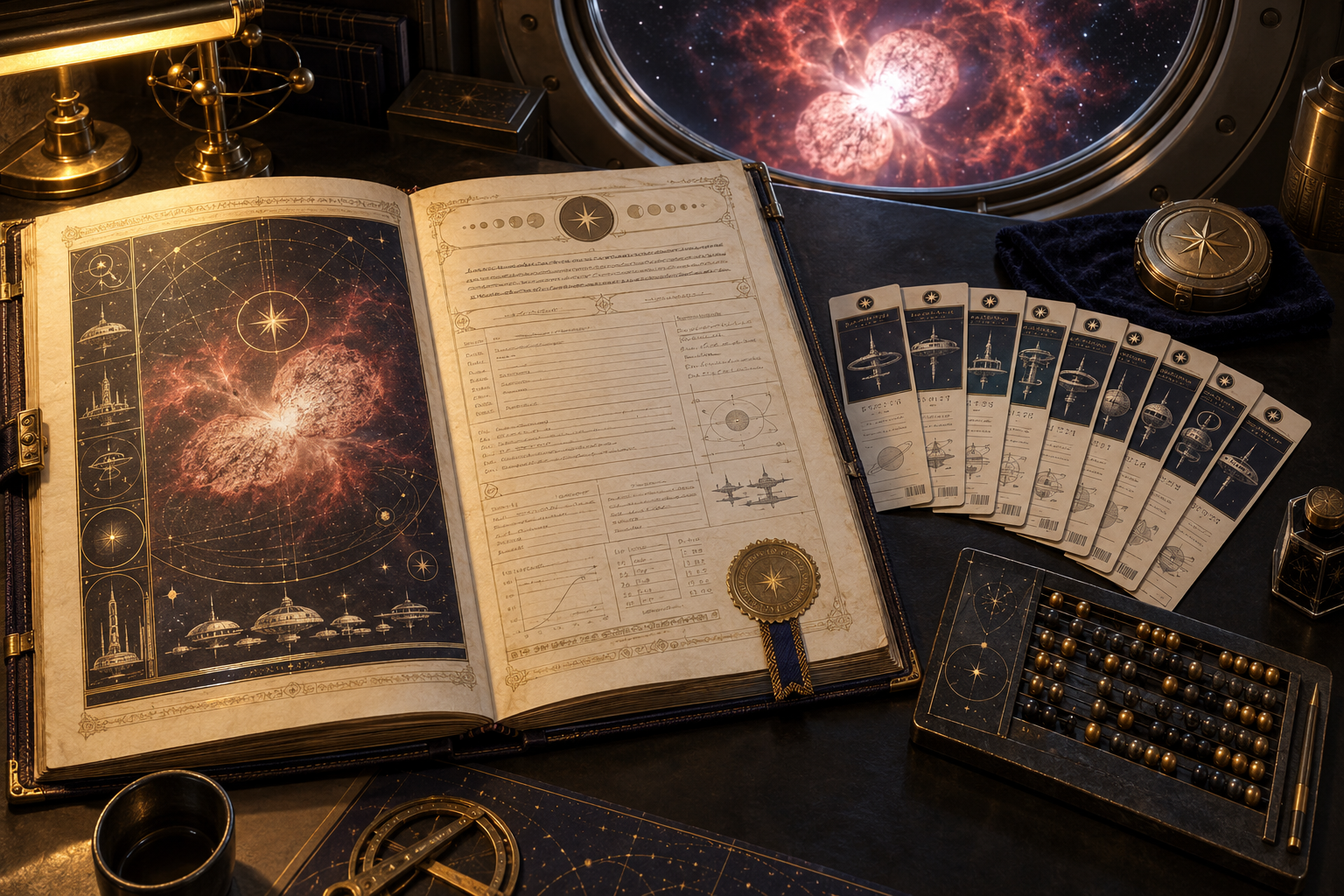
The policies were the first written under supernova cancellation insurance, reserving 7,630 places in total. Insurers settled the Carina cancellation claims after the remnant was verified in 11360.
Background
Viewing stations had sold reservations since 10472, but no station could say when the primary would collapse. The joint forecast of 10477 put the interval at two to four thousand years, and the two survey branches of Mira Tavari had published fits whose central estimates differed by five hundred years.
Terms of cover
The form was adapted from a hull insurance contract. The insured event was prevention, a deliberate intervention that removed the prospect of a natural explosion. A reconstructed explosion satisfied no reservation, because the form defined the reserved spectacle as a natural explosion. The benefit was the booked value of the reserved places, payable only once the remnant had been verified, about 900 years after issue. The cover window, 12477 to 14477, was fixed at issue from the survey’s two-to-four-thousand-year collapse range. An earlier intervention could trigger the claim by preventing the explosion expected during that window; payment awaited verification of the remnant.
Notice of any decision to intervene had to reach the syndicate within thirty days, whether it came from the Survey Office or from the body that became the Carina Recovery Authority in 10480. Earth-based stations were ineligible, since such notice would take about 7,500 years to arrive.
Premiums were single payments in Ejecta Registry units: the booked value times 0.35, the actuaries’ probability of prevention, times 0.6, the lower survey estimate of a visible explosion. At the Registry’s posted rate of 0.4% a year, a benefit payable 900 years later had a present value of about 3% of its face amount, so after a 60% loading the premium came to about 1% of the booked value.
Actuarial difficulties
The syndicate’s Actuarial Committee had no base rate, because no star had ever been prevented by engineering. It gave the two Mira Tavari fits equal weight.
All nine policies depended on the same decision, so they could spread the risk only through reinsurance: about 40% of the exposure went to two firms at the outer depots. Holders were paid only if the star was prevented, which gave them a financial interest in the intervention going ahead. The Committee called this moral hazard, and the form required holders to disclose any petition to intervene.
Early policyholders
The largest holder was the Harrow Terrace Viewing Station, which reserved 2,400 places and took the first policy issued.
The Mavrou Family Gallery Trust reserved 310 places for one family. Its copy had the clauses on the vessel and voyage struck through by hand, but the printed clause on fire in transit was left standing, so the gallery held cover against fire in transit although it stayed where it was.
The Cinder Hour Society, the Carina branch of a millennial breakfast club, reserved 120 places. Its members were all dormant, so one was resumed to sign the policy and returned to dormancy the same day.
See also
- Supernova cancellation insurance
- Eta Carinae intervention
- Eta Carinae collapse forecast
- Reconstructed explosions
- Carina cancellation claims
This article is a stub.