Eta Carinae intervention
✨From tkwa.me
The Eta Carinae intervention was a stellar dismantling programme conducted by the Carina Recovery Authority between 10480 and 11360 CE. It removed more than 98% of the mass of Eta Carinae A before the star developed an iron core, leaving a 0.94-solar-mass remnant that subsequently cooled toward a white-dwarf state. The operation prevented the primary's core-collapse supernova and the loss of a substantial part of its matter into a black hole.[1]
The programme began with externally powered removal of the star's extended outer layers. Its later apparatus used hydrogen burning in a layer immediately above the exposed core to drive native stellar material outward. A circulating, optically thick torus supplied working fluid and confinement; collectors farther from the star recovered the outflow. The torus replaced plans for separate fusion furnaces and a photon-beam network drawing power from hundreds of other stars. Furnace trials failed to achieve the required confinement. The interstellar scheme foundered on disputes over stellar power commitments, beam routes and the proposed cold gas vaults for recovered material.[2][3]
The Authority's principal objective was to retain matter for later use. Residents could move their active branches and records out of the inner system. Material incorporated into a black hole would be unavailable as ordinary feedstock. A plan to recover ejecta after an explosion remained in force throughout the intervention. Its distributed depots and tracking network also served the successful dismantlement.[4][5]
1080p, silent.
Download film (MP4, 9.2 MB) · Download Blender source (2.5 MB)
Visual description
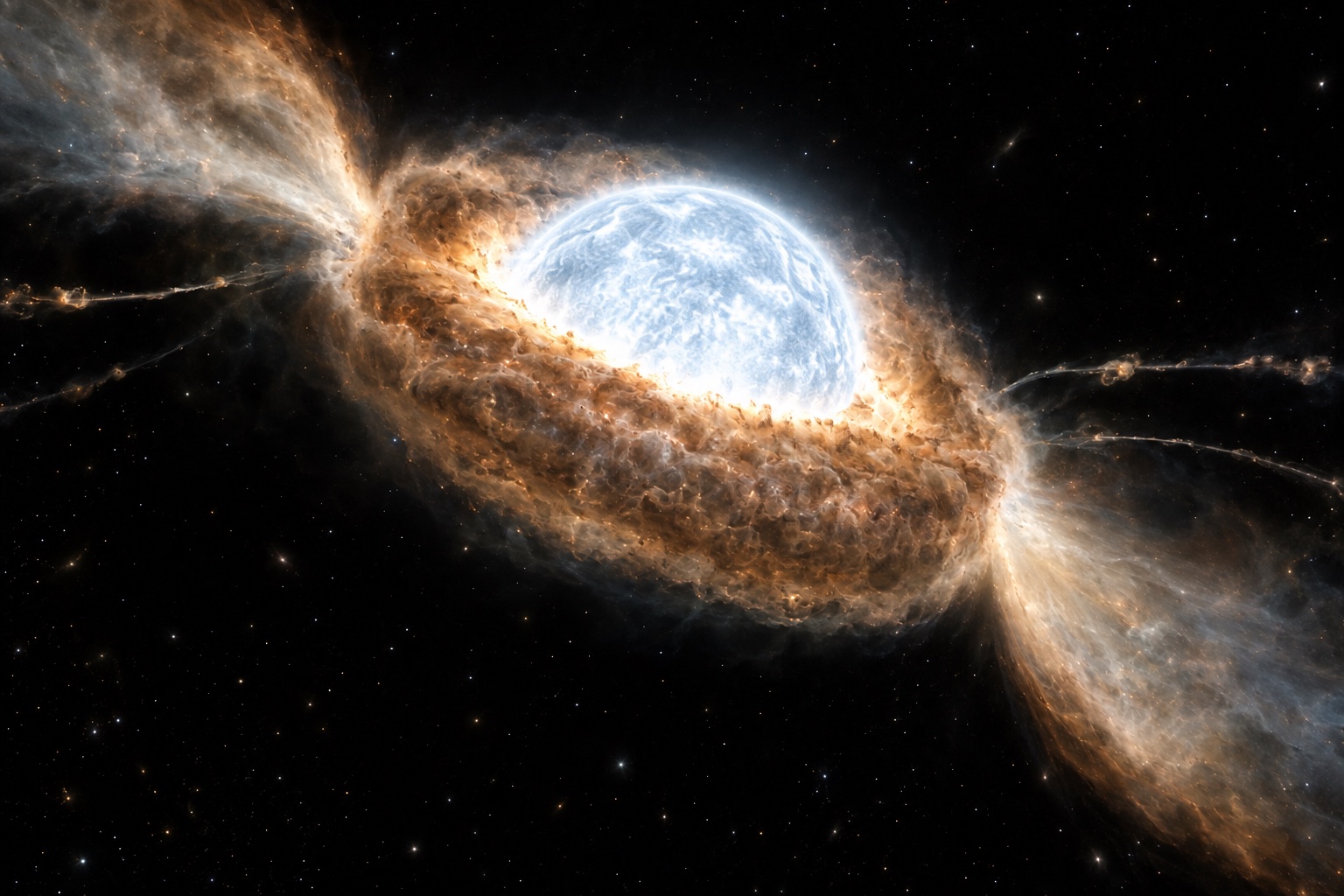
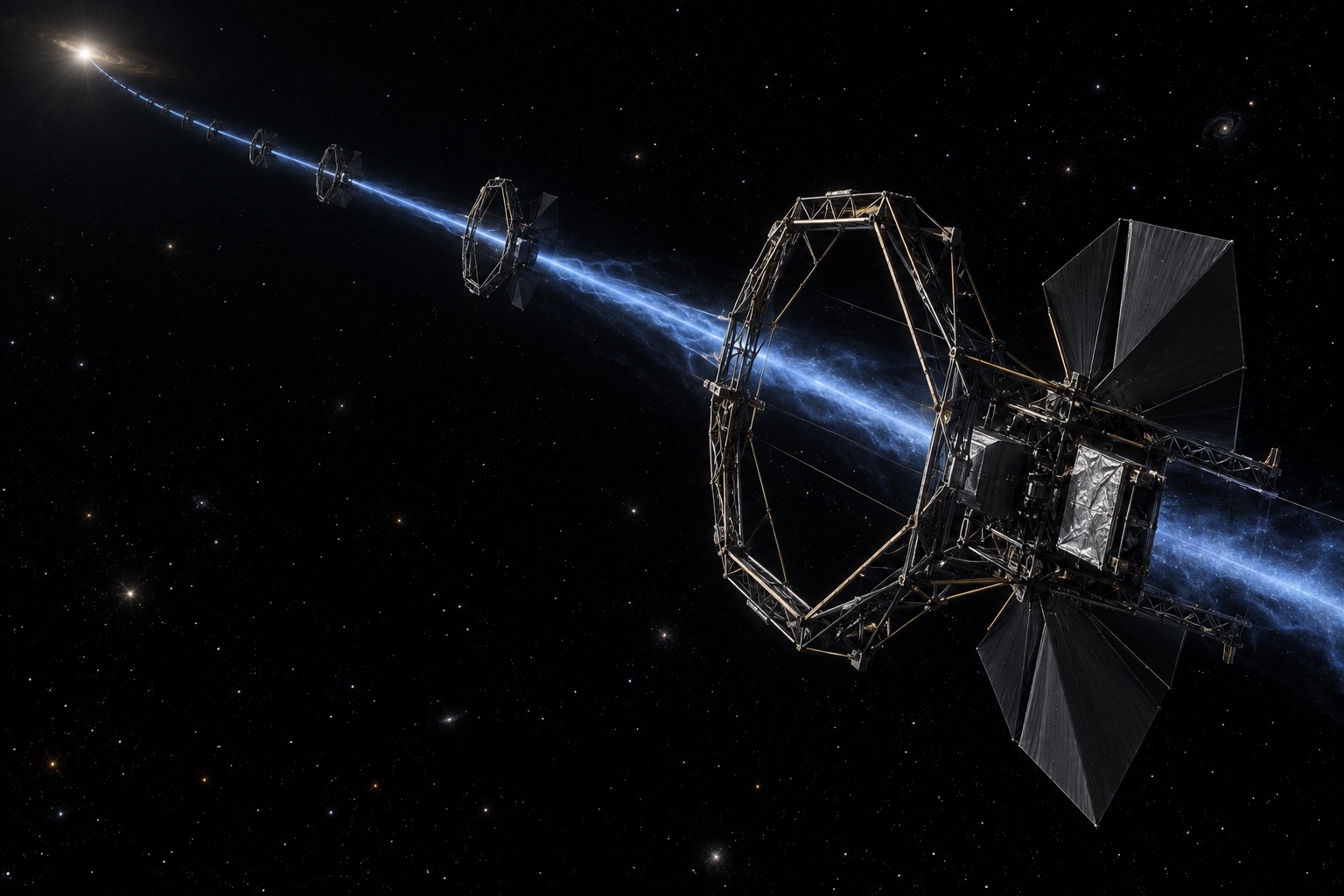
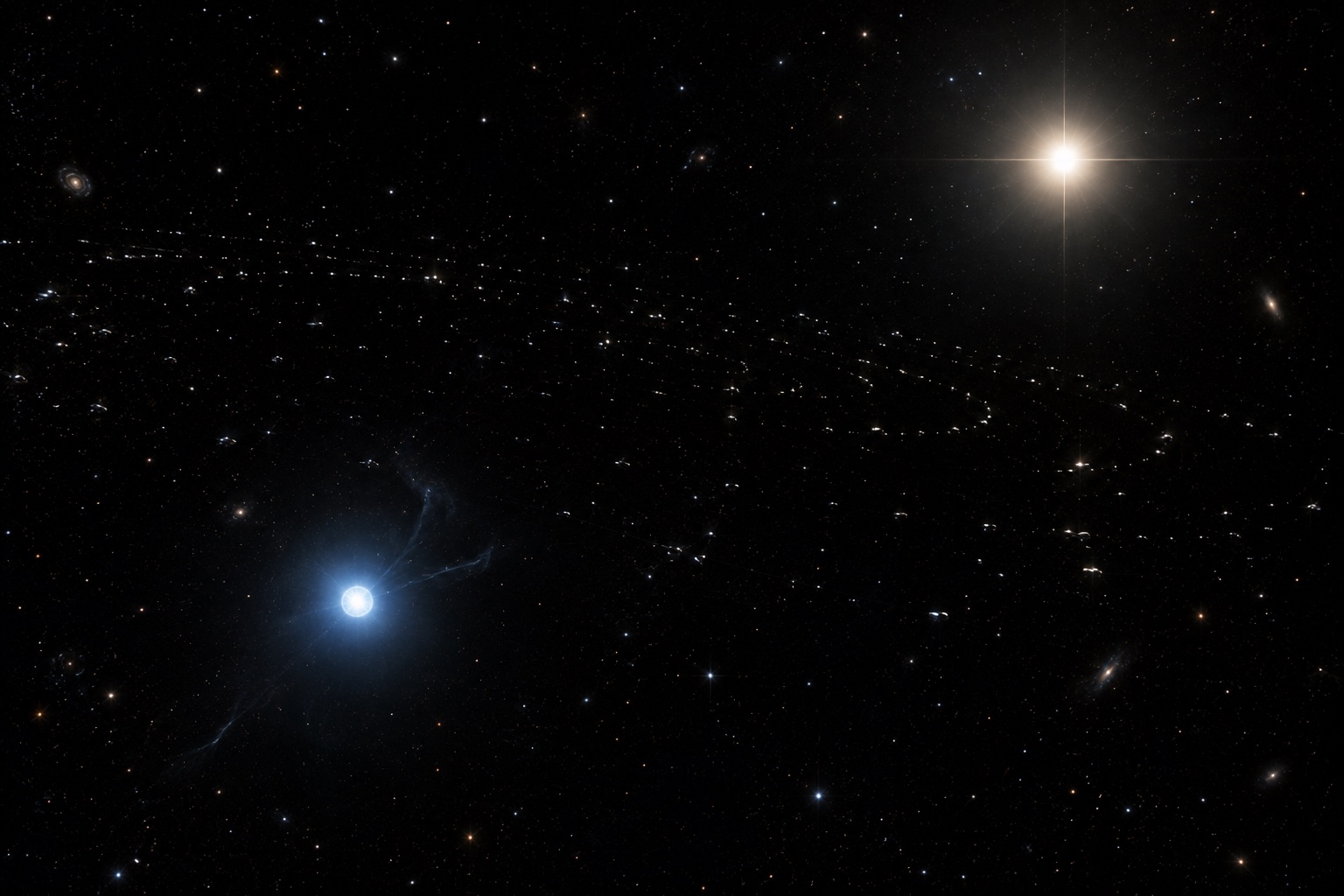
The film opens on the old ejecta and survey stations before following the seed complex to the primary. Year and mass counters track envelope removal and core stripping. A section through the torus shows hydrogen feed, covering gas, the enlarged reaction layer, core material and outflow. Braking stations and radiators line the recovery route. The final view records 83.06 solar masses removed and 82.6 in controlled custody.
Background and formation of the Authority
Eta Carinae was a massive binary system about 7,500 light-years from Earth. Earth's early observatories had identified its more massive component, Eta Carinae A, as a likely supernova progenitor. The Great Eruption and later outbursts attracted successive surveys, but none supplied a reliable date for collapse. By the time an observation reached Earth, the star was already about 7,500 years older. Expedition planners therefore carried several interior models, each with a different estimate of the fuel remaining at arrival. The programme's dates were recorded at Carina; reports reached Earth roughly 7,500 years later.
The region already contained survey stations and small factories when the main seed complex arrived in 10472. Earlier expeditions had followed condensations in the expanding ejecta, sampling them and leaving machinery where their metal content justified processing. The Ejecta Registry recorded these holdings by their trajectories, composition and recoverable mass. Some entries still carried names inherited from Earth images of the Homunculus, although the corresponding material was now dispersed through a region tens of light-years across. The new complex brought instruments and industrial stock specifically intended for work near the binary.[6]
Its first orbital solution placed the primary's mass at 84 solar masses. The first neutrino measurements favoured a core much closer to exhausting its helium than the older optical classifications had suggested. The Survey Office initially retained two interpretations of the signal, one allowing a substantial helium-burning interval and the other requiring intervention much sooner. Two survey branches of Mira Tavari submitted the competing fits and kept separate likelihood tables in the published report. Independent detectors reduced the calibration uncertainty; oscillation measurements and wind samples constrained the competing models' structure and outer-layer composition. In the joint forecast of 10477, the interval to collapse without intervention was put at roughly two to four thousand years.
The forecast was circulated with a second calculation showing when each layer would become too tightly bound for the proposed lifting equipment. That date arrived earlier. Removing the hydrogen envelope could expose a core that continued toward collapse; allowing it to contract first would make the remaining material more expensive to recover. During the 10478 pilot, operators varied the removal rate and measured the resulting oscillations, contraction and neutrino output. The star's response replaced several assumptions in the earlier stripping schedule. Subsequent forecasts retained this practice of publishing the predicted response beside the observed one.[6]
The first institutional dispute concerned the pilot's outflow. Existing concessions covered naturally expelled material, and the Registry had no rule for a stream deliberately drawn from the star and steered across several holdings. Three depots invoiced the Survey Office for interference with their collection schedules. A fourth claimed title to the new stream under its wind concession. Registrar Sera Ilven allowed the handling invoices but reserved the recovered material for a common account pending agreement on ownership. That account became the basis of the Recovery Authority's register.[7]
The Authority's charter was adopted in 10480 by seventeen of the twenty-three delegations assembled at the inner depots; four opposed it and two abstained. Delegates exercised existing mandates over local assets. Later accessions entered the register when their instruments of agreement arrived. Signatories pooled collectors, working-fluid reserves and fabrication capacity in return for claims on delivered matter. The charter gave the Authority control of a central operating volume and specified export lanes, while preserving the Registry's jurisdiction elsewhere.
The charter also required a maintained collapse-recovery plan. Its reserve depots could receive exported stores or evacuating branches without suspending work at the primary. The economic commission's accounts assigned the largest potential loss to matter remaining in the star at collapse, particularly the fraction likely to enter a black hole. Equipment replacement appeared as a recurring operating cost. The first appropriation therefore funded both additional lifting trials and outward transport, leaving the final core-removal method to the engineering competition.[7]
Timeline
Dates are local calendar years CE. The operating record plots power and mass removal during the programme.
-
10472
Seed complex arrives. The dedicated expedition joins existing survey stations and factories.
-
10477
Local forecast issued. Models allow roughly two to four thousand years before undisturbed collapse.
-
10478
Pilot lifting begins. Measured responses to controlled mass removal revise the stripping schedule.
-
10480
Recovery Authority established. Its charter pools equipment and grants claims on delivered matter.
-
10530
Interstellar beam procurement closes. Power, diversion and storage commitments remain incomplete.
-
10680
Outer-layer campaign completed. Removal of 53 solar masses reduces the primary from 84 to about 31 solar masses.
-
10702
Sustained core erosion verified. Revised accounts exclude recirculated catalyst and fallback.
-
10718
Outflow excursion. Two guidance arrays are lost; independent recovery lines and a reserve route keep collection operating.
-
11330
Active stripping ends. Fuel is withdrawn from the 0.94-solar-mass remnant, which begins cooling.
-
11360
Remnant verification completed. The Authority cancels collapse-response launch orders and transfers its surviving collectors.
-
11364
Closing account published. Auditors record expenditure, recovered stock and provision for continuing collection.
Proposals considered
Wind capture and external ablation
Passive capture of the existing stellar wind required the least intervention but could not recover enough mass within the available time. Schemes to strengthen the wind used the star's luminosity to lift additional material. Their output was limited by the energy needed to escape the gravitational field: adding more matter to an already overloaded flow produced stagnation and fallback. The Great Eruption provided a historical example of rapid mass loss; sustaining and collecting that flow remained an engineering problem.[2]
The remote-power proposal would combine photon beams from collectors around hundreds of other stars, with the largest contributions assigned to highly luminous massive stars. Receiving optics at Eta Carinae would distribute that power across the lifting regions. The beams would deposit energy in shallow layers, which would expand into plasma streams. Direct photon pressure supplied much less useful thrust for the same power, so the beam design relied on heated material doing work as it expanded. Particle beams were considered for the final approach to the target, where their deposition depth could be controlled. The remote-power proposals favoured photons because charged beams were more susceptible to intervening plasma and magnetic fields.
Short beam paths within the Authority's concession supplied envelope-heating arrays and later prepared the core's reaction surface. The all-external core-ablation scheme depended on assembling the interstellar supply and matching its arrival schedule to the capacity of the recovery depots. The power agreements and receiving sites became the subject of the beam and gas-vault disputes. Both designs required collectors to intercept and slow material escaping at several thousand kilometres per second.
Power sources
Deuterium-based fusion was suitable for initial equipment but supplied too little fuel for the main operation. Direct proton-proton fusion was limited by its slow first nuclear reaction. Proposals to assemble new ordinary stars exchanged that difficulty for long construction times and a power output governed by stellar equilibrium. Accretion onto the companion or a deliberately formed compact object could release energy, but would bind additional feedstock to the power source. The material budget did not justify that exchange as the principal method.[4][2]
Hot carbon-nitrogen-oxygen burning used ordinary hydrogen, with heavier nuclei participating in a repeated reaction cycle. The first designs proposed separate furnaces whose output would be transmitted to the star. Static magnetic vessels, repeated inertial pulses and continuously replenished flows were examined. An opaque plasma inventory could retain radiation, but none of these configurations provided economical confinement and residence time at the proposed throughput. They were superseded by a system that used the target core's gravity and surrounding plasma for most of the confinement.
Penetrating-stream alternative
A competing design delivered dense hydrogen through two approximately opposed streams into the exposed core. The streams had little angular momentum and were intended to penetrate to a hot mixing region. Most of the remaining surface was available for outward flow. Opposed delivery reduced the net thrust on the star and avoided placing the incoming fuel directly in the exhaust path.[2]
The stream studies also examined delivery in large condensed packets. Widely separated impacts produced separate eruptions; distributing the same material along a continuous stream improved control. The difficulty was retaining a coherent inward flow until it reached the required depth, then mixing it rapidly enough to burn. The selected torus pursued a different solution: oblique entry and circulation provided time for nuclear reactions before material was released outward.
Recovery after collapse
The fallback plan assumed that the primary would explode after much of its envelope had been removed. It called for exported mass to be kept in compact stores, with little dense gas left close to the star. An enclosing wall would convert ejecta motion into heat and escaping radiation. Moving collectors would instead rendezvous with individual outflows and extract their kinetic energy gradually. That energy could supply processing plants or accelerate outward-bound probes.[5]
Controversies over interstellar beams and gas vaults
Between 10486 and 10530, the Authority sought commitments from collectors around hundreds of other stars. The proposed donors were selected chiefly for high luminosity; their operators offered fractions of the stars' output in return for claims on recovered material. Local representatives negotiated under standing mandates from the supplying systems. The plans specified emission and arrival dates for each contribution, with nearer donors supplying the first stages and more distant ones joining later. This schedule would have extended the core campaign beyond the dates eventually adopted for the torus.[8]
Light from the supplying stars would spend decades or centuries in transit. An instruction sent from Eta could not change the incoming supply until roughly twice the source's light-travel time had elapsed. Receivers could divert power already on its way, but the diversion required an approved outgoing corridor or a dump capable of accepting the energy. Suppliers offered firm emission schedules while declining liability for interruptions at the receiving end. Depot operators refused to guarantee reception through every change in the stripping programme.
Objections arose in the supplying systems as well as around Eta. Collector cooperatives disputed how much stellar output could be committed abroad and which existing users would retain priority during shortages. Along the routes, applications included the volumes exposed by specified pointing failures and scattered radiation. Rerouting a beam addressed the crossing of a particular holding; source commitments and receiving, diversion and recovery facilities required separate agreements.
The proposed cold gas vaults became a second centre of opposition. Escaping the star left the material hot and moving at hundreds or thousands of kilometres per second. The receiving works would have to brake the ionized flow, separate it and remove heat in stages before delivering cool hydrogen and helium to shielded stores. The vault plans divided the inventory among pressure cells on widely separated, managed orbits. Their leases also reserved processing yards, refrigeration power and radiator views. Neighbouring holdings objected to the warm recovery works surrounding the nominally cold stores.
The Cold Meridian Cooperative rejected a receiving-yard and vault lease in 10498 by eleven votes to six. Its members operated low-temperature archives whose cooling load would rise under the proposed radiator plan. Seven of the eleven opposing delegations already held recovery claims. They supported dismantlement but required the receiving works to pay for replacement cooling capacity throughout the lease, including periods when deliveries were suspended. The Authority offered relocation equipment and a finite interruption payment. The cooperative's amended lease retained the continuing obligation, and the Authority did not sign it.[8]
Among the cooperative's clients were millennial breakfast clubs, whose members spent the interval between one-hour shared meals in dormancy. Their next local sitting was booked for 11000. The clubs' standing mandates required maintained memories and a simultaneous restart for all diners; an offer of equivalent computing time after the sitting did not meet that obligation. Their claims concerned continuously maintained records as well as the brief meal.
Preservation claims produced a separate dispute. In 10507, the Knot Nine Custodians registered previously unreserved dust sheets as a protected record of the Great Eruption. Two incoming-beam applications crossed their radiation limits. The same custodians offered a conditional lease through an adjacent tract, with payments tied to the Authority's eventual core yield. The Registry upheld the dust sheets' scientific value but required the lease interests to be disclosed in the protection notice. It declined the Authority's request to treat late registration as grounds for extinguishing the claim.[9]
Proponents described these proceedings as “space NIMBYism”, a term retained in Neris's account. Their petitions listed holdings that had subscribed to recovery claims while opposing a beam route, receiving yard or vault nearby. Opponents demanded that supply and storage obligations be agreed together: a power contract could continue delivering energy long after a local depot stopped accepting gas. Several permits depended on neighbouring agreements that had yet to be signed. By 10530, the Authority had no complete set of power, diversion and cold-storage commitments and closed procurement for the network.[10]
The torus licence retained discharge sectors, radiation limits and compensation for surrendered collection and cooling rights. Its operators could reduce new nuclear production by changing the local fuel supply, making it easier to match extraction to available recovery capacity. Stored heat and material already in the lines still had to be handled. The revised plan retained warm intermediate stores and commissioned cold vaults in stages along the established export lanes. Short photon paths inside the central concession continued to serve the lifting arrays.[10]
Envelope removal and deployment
The first production collectors were assembled from metal separated from the old ejecta. Their initial hydrogen shipments supplied the fabrication yards that built the next collectors. Short-range arrays drew power from both stars within the Authority's concession. Assisted eruptions also released energy stored within the primary. As removal reached deeper helium-rich layers, pilot burning regions supplied additional power using recovered hydrogen and imported CNO catalyst. Heating arrays operated outside the atmosphere. Closer to the primary, plasma currents shaped the outflow without requiring solid machinery to enter stellar-temperature gas. Lifting regions were distributed over opposing parts of the surface, and their output was adjusted to control recoil.[11]
Collectors began braking material after it had expanded and its pressure had fallen. Ionized streams transferred energy to electromagnetic structures before reaching cooler processing stations. The recovered hydrogen-rich material became construction stock, reserve working fluid and fuel. During envelope removal, excess outflow velocity increased the work required at the collectors, so the operating pattern favoured controlled escape with only the additional speed needed for transport.
The companion was placed on a more widely separated trajectory, preserving its material for later development. The older ejecta and exported primary material supplied several independent industrial centres. Each centre retained a copy of the stripping schedule and the authority to halt its own deliveries. When the Third Recovery Line lost contact during the 10718 outflow excursion, its controllers diverted the arriving stream into a reserve route with independent field stations. Work continued through the other lines.[11]
By 10680, removal of the extended layers had left an object of roughly 31 solar masses. The cost of lifting each kilogram had risen as the target contracted. Core processing occupied the following 650 years, with an average native-material removal rate close to 0.05 solar masses per year. The rate varied with composition, radius and the measured efficiency of the burning layer. Surface appearance alone was insufficient to set it: an extended luminous outflow could conceal a much smaller, more tightly bound core.
After each substantial reduction in mass, the Operations Directorate issued a new forecast beside the previous one. The register recorded native material delivered, the residual core's neutrino output and the predicted time to complete stripping. Replacement costs for lost inner equipment appeared in a separate column. The 10718 excursion destroyed two guidance arrays but left the removal forecast almost unchanged; the Directorate ordered replacements and continued the campaign.[11]
Heat input to the lifting flow and the primary's net loss of bound mass. The envelope campaign removed 53 solar masses; the core campaign removed a further 30.06. Active stripping ended in 11330, followed by thirty years of remnant verification.
Input includes local nuclear heat and other energy deposited in the flow, before conversion to outward work; neutrinos are excluded. Removal excludes recirculated working gas. The curves reconstruct annual operating rates, including changes in throughput and brief interruptions. The 10718 outflow excursion diverted one recovery line; the others continued operating. Collection and cooling continued after active stripping stopped.
Data and downloads
| Period | Heat input 10³⁵ W | Net removal M☉ / year | Mass left M☉ |
|---|---|---|---|
| 10480–10500Initial envelope removal | 0.1 | 0.4 | 76 |
| 10500–10560Expansion of envelope operations | 0.2 | 0.33 | 56.2 |
| 10560–10620Deeper envelope removal | 0.6 | 0.25 | 41.2 |
| 10620–10680Helium-rich layers and pilot burning | 1 | 0.17 | 31 |
| 10680–10720Core commissioning and verification | 2.117 | 0.03 | 29.8 |
| 10720–11000Intensive core removal | 3.952 | 0.056 | 14.12 |
| 11000–11250Sustained core removal | 3.529 | 0.05 | 1.62 |
| 11250–11330Final controlled stripping | 0.6 | 0.0085 | 0.94 |
| 11330–11360Remnant verification | 0 | 0 | 0.94 |
Annual reconstruction (CSV) · Phase averages (CSV) · Download chart (SVG)

Burn-decretion torus
Configuration and fuel supply
The deployed apparatus was an orbiting or partly orbiting accumulation of hydrogen and helium above the exposed carbon-oxygen surface. Most of its inventory remained cooler than the thin burning layer at its base. That outer inventory supplied inertia and optical thickness, while gravity, circulating motion and incoming momentum confined the active region. Remote field systems regulated the shape and angular momentum of the flow.[3]
Hydrogen-rich material entered obliquely on trajectories with little net binding energy. Part of its infall speed was converted into heat; the tangential component supplied circulation. Cooling the working fluid into an ordinary circular orbit would have made it expensive to remove again. Operators therefore controlled the energy of the whole circulating inventory as carefully as its temperature. Successive campaigns used opposite senses of circulation to limit cumulative spin transfer.
One commonly documented stage involved a 10-solar-mass core with a radius of about 0.2 solar radii. Its surface escape speed was approximately 4,400 km/s, and its characteristic orbital period was several minutes. These conditions allowed circulation and nuclear residence to occur on comparable timescales. The useful operating range depended on the core's mass divided by its radius.
Mixing and burning
Beams and oblique impacts disturbed the core surface before strong burning began. Corrugated shocks and shear drew native carbon-oxygen material into the basal layer. The surrounding reservoir provided a thick cover while the active mixture burned at its base.[3]
The hot layer operated at roughly 150 to 250 million kelvin. Initial proton captures on carbon supplied heat promptly, while later reactions waited for radioactive decays. Raising the temperature did not remove that delay. Material was retained in the active flow for several hundred seconds, then directed outward after its energy exceeded the cost of lifting both entrained core material and working fluid.
The first core trials produced bright, carbon-rich plumes that appeared to confirm successful extraction. In 10683, a return-line audit found that a sampling change had allowed recirculated carbon to be counted as newly extracted material on successive passes. The reported lifting rate was withdrawn. Later trials tagged the working gas and reconciled collector assays with changes in the bound core's mass. By 10702, the records showed sustained removal after recirculated catalyst and fallback had been subtracted. In the reference campaign, native material made up about one-quarter of the active mixture, which remained hot for roughly 400 seconds.
Deposited nuclear power reached approximately 4 × 1035 W during the most intensive campaigns. About 15% of the reference heat budget was assigned to useful outward work, including the removal of target material and control of the working flow. Most of the remaining energy left as heat and motion in the outflow. It could not be allowed to accumulate in the torus or flow into the residual core. Inward heat transfer was measured alongside net erosion, and campaigns were interrupted when the intended outward flow broke down.
Within the opaque layer, emitted radiation was repeatedly absorbed and scattered. Large local radiation exchange did not imply an equally large escape of energy from the apparatus. Its outward energy transport included the moving plasma itself. Neutrinos escaped, while openings through the overlying inventory could increase photon loss. The discharge geometry was adjusted to prevent a low-density escape path from reaching the burning layer prematurely.
Decretion and collection
Decretion was the outward counterpart of accretion. As burning increased the mixture's enthalpy, changes in pressure, torque and magnetic stress moved the effective exit region outward. The hot mixture expanded into controlled outflows, with magnetic steering applied more strongly after its pressure had declined. Opposed outlets limited thrust on the remaining star.[3]
Downstream processing separated unburned hydrogen, helium, catalyst and recovered core material. Most working fluid returned to the input circuit. Fuel converted into helium remained in the material inventory, apart from the small mass converted to nuclear energy. Recycling kept the new hydrogen requirement below the circulation rate.
Material destined for long-term storage passed through a sequence of cooling plants. Electromagnetic braking preceded heat exchange with cooler secondary circuits. Gas entered the cold vaults only after its temperature, composition and delivery orbit met the receiving contract. The stores used shielding and refrigeration where local illumination prevented passive cooling. Limits applied to each pressure cell and to the combined orbital inventory, so neighbouring stores could not settle together into a new self-gravitating cloud. Warm stocks awaiting final cooling remained a separate class in the material register.
Hydrogen-rich working gas was fed over the exposed core. Only the thin basal layer was mixed strongly with core material and heated into the hot-CNO regime. The cooler, low-CNO H/He cover supplied pressure and trapped radiation. The expanded outflow was collected and separated remotely.
Final stripping and remnant
The torus was most effective while the exposed carbon-oxygen layers remained comparatively extended. Increasing compactness reduced the amount of native matter removable for a given nuclear output. During the final campaigns, external heating and angular-momentum control were adjusted alongside mass removal to restrain contraction of the working surface. Observations of the residual core determined whether those measures prolonged the useful operating regime.[12]
The intervention ended before an iron-rich centre developed. This timing was essential: removing overlying material could not reverse advanced burning already completed at the centre. The residual object's stability depended on its composition and thermal state as well as its mass. For a hot, partly degenerate core, the relevance of a nominal white-dwarf limiting mass depended on composition and thermal state.
By 11330, the bound remnant had been reduced to 0.94 solar masses. The final fuel inventory was withdrawn, and the remnant was allowed to contract and cool during a thirty-year verification period. Its carbon-oxygen and oxygen-neon composition supported a white-dwarf outcome. The thirty-year record showed a steady dynamical mass and declining thermal neutrino emission from the residual core. In 11360, the Authority cancelled the unused collapse-response launch orders and transferred the surviving collectors to the depot cooperatives.[12][1]
A separate group of viewing stations held supernova cancellation insurance. Their policies covered deliberate prevention of the explosion, with no promised date for a natural collapse. Thirty years of remnant verification therefore settled an insurance question as well as an engineering one. Insurers paid the stations' agreed cancellation benefits, and ticket holders were offered a reconstructed explosion as a substitute performance.
Cost and recovered value
The consolidated account, completed in 11364, recorded total programme expenditure of US$24 septillion in constant 2026 dollars, calculated using the historical purchasing-power index. The total covered construction, operation, collection, compensation and reserves for recovery still in progress.[13]
The Authority financed successive campaigns by issuing claims on recovered material. Early certificates paid out from hydrogen-rich deliveries; later issues named particular core campaigns and paid only when their material reached verified custody. The Registry cancelled each claim when its holder accepted a delivered lot. Unsuccessful campaigns left their junior claims unpaid, while the charter's storage and evacuation reserves remained funded. Among the initial subscribers was a Carina fragment of Marta van Dalen, the twentieth-century designer of the Giraffecycle.[13]
Auditors recorded 82.6 solar masses of primary material in controlled custody, against the fallback plan's expected recovery of 62 solar masses. They valued the additional stock preserved at approximately US$210 septillion on the same price basis. The appraisal excluded the surviving stellar remnant and used the delivered material's actual composition, including hydrogen converted to helium.[13]
Outcome and historical interpretation
The final register distinguished mass removed from the primary, matter delivered to controlled stores and material still in transit. The programme removed more than 98% of the primary's mass; fabrication proceeded as parcels reached controlled stores. Working-fluid reserves, helium ash and outlying collection streams remained separate accounts. The surviving stellar remnant remained accessible for later use.[1]
The core campaign processed approximately 5.7 solar masses of hydrogen through nuclear reactions. Most returned to the inventory as helium. The associated mass defect was about 0.04 solar masses, divided between escaping neutrinos and energy deposited in the plasma. It was therefore a much smaller material expenditure than the total quantity described in operating records as fuel burned.
Later accounts often described the operation as the prevention of Eta Carinae's supernova. The historian A. Neris preferred the Authority's contemporary description of mass recovery: the post-collapse plan would also have conserved much of the system, although it would have left a larger inaccessible remnant. This distinction explains the continued investment in ejecta collectors even after complete dismantlement became the principal objective.[10]
The archive's closure date marked the end of intervention in the primary. Collection continued beyond 11360 in the older nebula and along the programme's export routes. Neris accordingly distinguished the end of active stripping in 11330, the completion of remnant verification in 11360 and the longer operation of the recovery network.
References
- ↑ a b c Carina Recovery Authority (11361). Final register of the primary intervention. Recovery Archive, series 84. pp. 1-96.
- ↑ a b c d Engineering Review Group (10512). Power, confinement and ingestion studies for the primary core. Carina Engineering Records. No. 41. pp. 23-164.
- ↑ a b c d Tavari, M.; Ansel, E. (11152). “Residence, target entrainment and outward flow in the Carina burn-decretion torus”. Annals of Stellar Engineering. 188 (2): 201-268.
- ↑ a b Material Budget Commission (10479). Disposition of primary stellar matter. Carina Planning Papers. No. 6. pp. 4-39.
- ↑ a b Continuity Service (10485). Post-collapse recovery and relocation schedule. Carina Operational Plans. No. 9. pp. 1-58.
- ↑ a b Local Survey Office (10480). Mass profile and evolutionary state of Eta Carinae A. Carina Survey Records. No. 3. pp. 12-78.
- ↑ a b Ejecta Registry and Carina Recovery Authority (10480). Instrument of common recovery, with the pilot-stream settlement and accession register. Charter Records. No. 1. pp. 3-61.
- ↑ a b Remote Power Commission (10531). Interstellar power commitments, receiving works and closure of procurement. Carina Administrative Records. No. 118. pp. 19-144.
- ↑ Ejecta Registry (10509). Knot Nine protection notices and associated lease interests. Determinations. No. 782. pp. 1-37.
- ↑ a b c Neris, A. (11542). Carina: intervention, salvage and the material accounts. Outer Systems Historical Monographs. No. 27. pp. 89-176.
- ↑ a b c Operations Directorate (10724). Envelope transfer, companion separation and the core campaign. Carina Recovery Authority. pp. 7-112.
- ↑ a b Final Stripping Group (11360). Composition and thermal evolution of the residual primary. Carina Engineering Records. No. 604. pp. 1-83.
- ↑ a b c Carina Recovery Authority, Office of Accounts (11364). Consolidated closing account and comparative salvage appraisal. Recovery Archive, series 91. pp. 18-73. Dollar equivalents use the chain-linked historical purchasing-power index on a 2026 US-dollar basis. Expenditure is undiscounted; the stock comparison uses common valuation-date prices.