Cairn (intestinal implant)
✨From tkwa.me
The correct title of this article is Cairn® (intestinal implant). The omission of the registered trademark symbol is due to technical limitations.
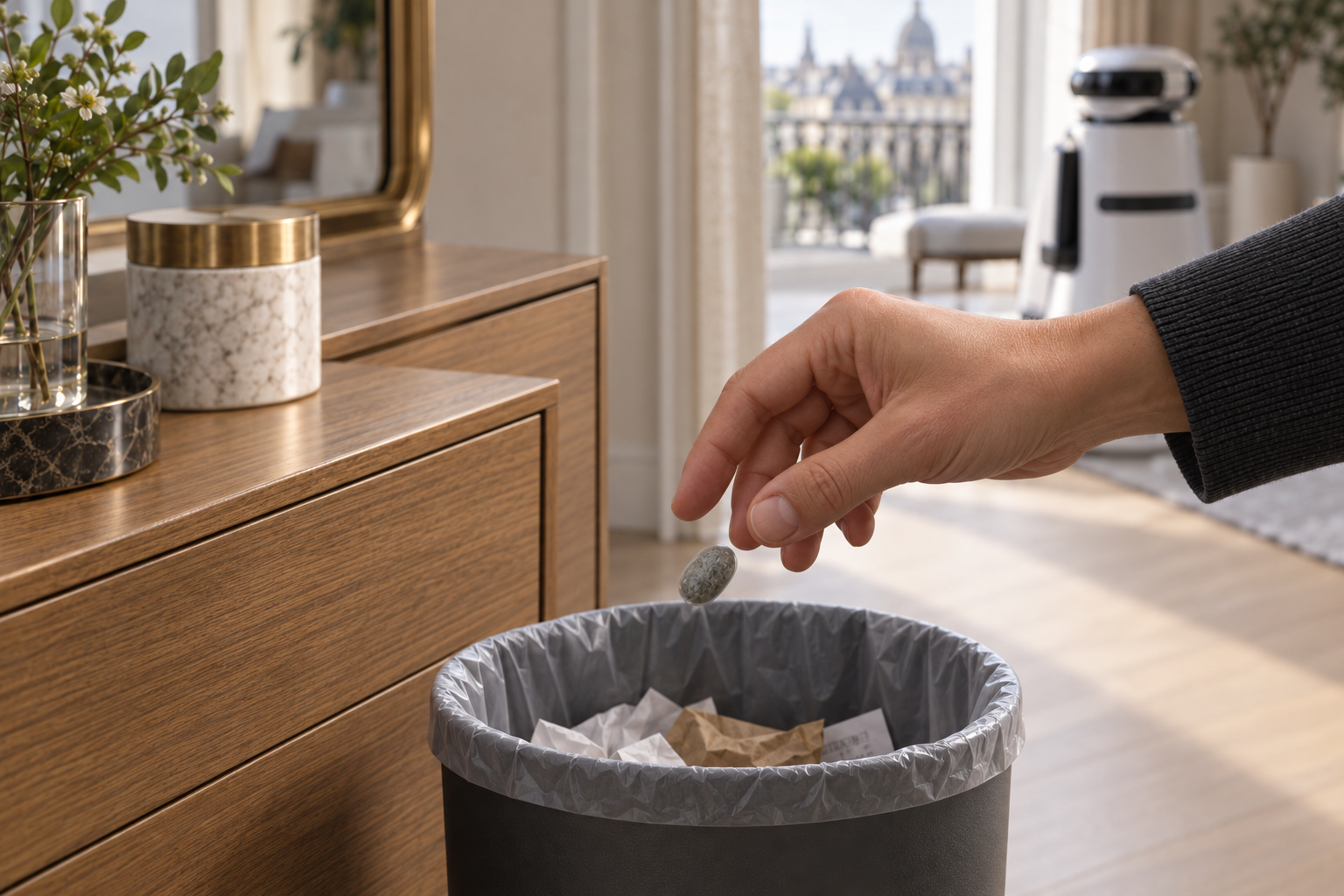
Cairn® is an intestinal implant that removes the need for ordinary defecation. It converts much digestive residue to exhaled carbon dioxide, packing the rest into dry pellets released on demand.[1] Pelagic Somatics introduced it in 2034; some customers had kept biological bodies after the 2029 superduperintelligence merger of human and machine minds.[1] By 2038, some homeowners' associations in Los Angeles's Bel Air and landlords in London's Mayfair made installation a requirement.[2]
Design and operation
Waste processing
A pouch near the sigmoid colon receives residue.[3][4] Atomically precise machinery processes it, using blood to supply oxygen and carry dissolved carbon dioxide to the lungs.[5]
Pellet collection
The digestive residue is sterilized and enclosed in an inert polymer skin, producing about 13 grams daily. A three-day reservoir releases pellets through an everting sleeve, normally zero to twice daily depending partly on Rill® use. Most users choose one daily to keep a routine. Pellets can be carried loose in a bag or pocket until disposal in a household bin.[4]
Maintenance and limits
When a user's subscription lapses or the implant loses its internet connection, Cairn® deactivates and waste must be excreted normally.[4] The implant also requires yearly maintenance.[4]
Cairn® users can also eliminate ordinary urination with Rill®, released in 2035. It diverts its waste into additional Cairn® pellets.[6]
Licensing
Cost and enforcement
Competing hardware was cheap by 2036. Pelagic's 2037 purchase of Sterile Interface Holdings gave it overlapping patents on blood interfaces, sterilization and pellet release, with no expiry dates. It sued manufacturers, clinics and users of home-built implants in the United States and Europe; imported implants also incurred royalties.[7] In 2038, Cairn cost US$270 quadrillion a year; Rill® added US$135 quadrillion.[8] The combined bill equalled 22.5% of the median self-paying Cairn subscriber’s annual disposable investment income.[9]
Ownership and licence scope
Some patents belonged to rat endowments, whose trustees relied on royalties.[10] Licences attached to intestines: a saved self restored for a pre-merger reunion owed a year's charge for one dinner with its continuation.[11]
Social effects
Housing and employment
By 2038, some Bel Air homeowners' associations required installation, while Mayfair landlords refused applicants without Cairn. Residents were also expected to have Rill®.[2] Some employers paid employees' annual licences, then stopped when they left.[8] Buildings sent unmodified visitors and staff to a toilet by the service entrance.[2]
Hygiene stigma
Despite the everting sleeve, which kept pellets from touching the anus, early adopters' pellets were often considered unclean. Later, the stigma shifted to people who did not use Cairn.[4][2]
Leila Qamar's 2038 The Borough article “The New Clean” quoted a Bel Air resident: “[The pellet] has no smell. I still tense up when an unmodified guest asks for the toilet.” Some Cairn users took offence when a host offered them the use of a toilet.[2]
Another interviewee, a Mayfair resident, said, “My sister still uses a toilet. When she comes out of the bathroom, I imagine what might be on her hands even after she washes them. I check which towels she used and secretly throw them away.”[2]
Pellet etiquette
At the 2038 Morrow Children's Fund Autumn Gala, singer Mara Vey, in an aviary hat and pocketless dress,[12][13] set a pellet beside her wineglass until a bin was brought over.[12][14] A photograph sparked a controversy:[15] some guests saw no problem with the sealed pellet; others objected to bodily waste on a dinner table.[15][16] Organizers added covered pellet dishes at later galas.[17]
See also
- Atomically precise manufacturing — construction of membranes and molecular machinery.
- 2029 superduperintelligence merger — integration and the continued baseline human economy.
- Rat endowment — ownership of income-producing assets for animal care.
- Pre-merger reunions — meetings between saved selves and their continuations.
References
- ↑ a b Pelagic Somatics (2038). Cairn®: patient and purchaser prospectus, revised edition.
- ↑ a b c d e f Qamar, Leila (12 June 2038). “The New Clean.” The Borough.
- ↑ Cremer, J., Arnoldini, M. and Hwa, T. (2017). Effect of water flow and chemical environment on microbiota growth and composition in the human colon. Proceedings of the National Academy of Sciences, 114(25), 6438–6443.
- ↑ a b c d e Pelagic Somatics (2037). Cairn® operation and service manual, revision 7, §§3–5.
- ↑ Geers, C. and Gros, G. (2000). Carbon dioxide transport and carbonic anhydrase in blood and muscle. Physiological Reviews, 80(2), 681–715.
- ↑ Pelagic Somatics (2035). Rill® release circular.
- ↑ Fenwick Research (2038). Pelagic’s permanent patents: litigation in the United States and Europe.
- ↑ a b Pelagic Somatics (2038). Tariff and fleet licensing schedule.
- ↑ Fenwick Research (2039). Pelagic Somatics: consumer augmentation market review.
- ↑ Noorderhof Colony Endowment (2038). Annual accounts, patent-royalty schedule.
- ↑ Reunion Licences Board (2038). Decision 38-112: annual charge for a restored guest.
- ↑ a b The Borough picture desk (21 September 2038). Photograph of Mara Vey at the Morrow Children's Fund Autumn Gala.
- ↑ Vey, Mara (22 September 2038). Statement to The Borough on the Autumn Gala.
- ↑ Morrow Children's Fund (21 September 2038). Autumn Gala dining-room incident log, entry 18:47.
- ↑ a b The Borough (23 September 2038). “A pellet at dinner.”
- ↑ The Borough (27 September 2038). “Letters: What belongs on the table.”
- ↑ Morrow Children's Fund (3 October 2038). Banquet service memorandum.